For some contractors, using the wagon is seen as an opportunity to cut operating costs, especially on lighter second-cut silage, and to reduce labour requirements. For farmers, it’s seen as a way of getting longer-chop silage for allegedly improved digestion as well as cutting costs.
With that in mind, we invited six of the most popular manufacturers of silage wagons to an Irish Farmers Journal with the Farmers Guardian group test in Gurteen Agricultural College, Ballingarry, Roscrea, Co Tipperary.
Four manufacturers accepted the invitation, including Claas, Strautmann, Krone and Lely. Pottinger declined to enter a machine for the test, as their new model was not available yet. Pottinger have promised us that we can perform a similar test at a later date. Malone was unable to attend due to an earlier commitment to a demonstration in the UK.
Each of the four machines supplied for the test was roughly similar in size and capacity. The group test of four very different machines allowed us to look at and compare what each manufacturer’s machine had to offer Irish users.
In an attempt to measure each machine’s capacity, both in-field and at the clamp, we looked at several measurables and recorded them for each machine.
What was tested in each forage wagon?
In-field, we looked at the maximum load potential of each wagon. This was done by measuring the amount of material picked up in the field, and weighing the wagons in and out on the way to the clamp.At the clamp, we timed how long it took to unload each of the wagons.The chop length from each of the machines was also examined.Using an in-line PTO dynamometer, we attempted to measure, or at least get an impression of, the PTO power it took to drive each machine. The loading on the drive system was quite irregular, as you could imagine. This was down to how it was laid by the mower, raked up and ultimately picked up by the wagon.The number of power spikes in the drive system could be used as an indicator of how well the pickup and rotor performed in handling the crop.Other aspects we looked at were machine design, features and functions.So on 25 May, with 50 acres of Gurteen College grass on the ground, and the farm manager watching the weather, we set about our test.
Lely Tigo PR50
The purchase of German firm Mengele by Dutch company Lely saw a revival of Mengele products under the Lely brand here in Ireland. Today, Lely has rebuilt the business and introduced its silage wagon ranges to Irish farmers and contractors.
In 2012, Lely launched its Lely Tigo XR combi loader wagon, which featured a unique movable bulkhead. This increased the capacity of the wagon and assisted in the unloading process. The Tigo XR range featured three large models at that time suited to contractor use.
In 2014, Lely introduced its new Lely Tigo PR range. The Tigo PR replaced the Lely Tigo R Profi range with three models in the 31-41 DIN m3 capacity range (PR 50, 60 and 70).
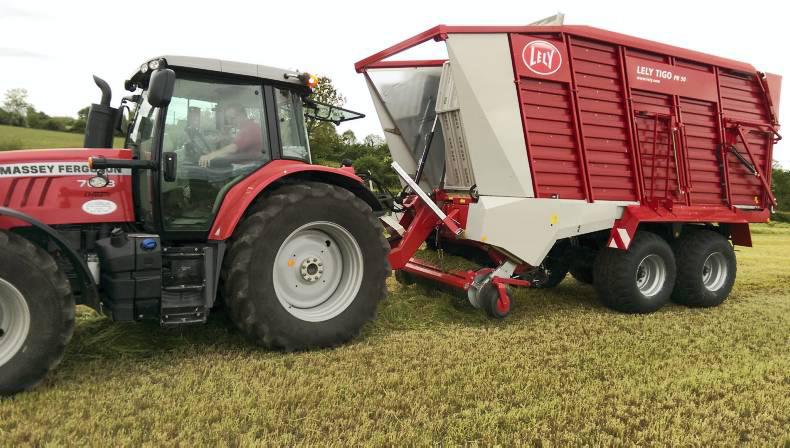
For the Irish Farmers Journal group test in Gurteen, Lely Ireland provided the Tigo PR50. This has a DIN capacity of 31m3. Its model number of 50 indicates its capacity (in m3) at medium compaction.
Features and functions
Lely’s movable bulkhead is certainly the most distinguishable feature of the Lely Tigo PR50. Lely points out that this design allows the space above the drawbar to be utilised. The bulkhead moves through an 80º arc, which Lely says creates an additional 6m3 capacity.
Lely adds that this extra capacity enables its machine to be one metre shorter than previous models. This is an important asset where manoeuvrability is a concern on narrow rural roads and farmyards.
Its bulkhead is not just about creating space – it allows the crop compaction pressure and subsequent density of the crop load to be adjusted. It also assists in shifting the load rearward when unloading at the silage clamp.
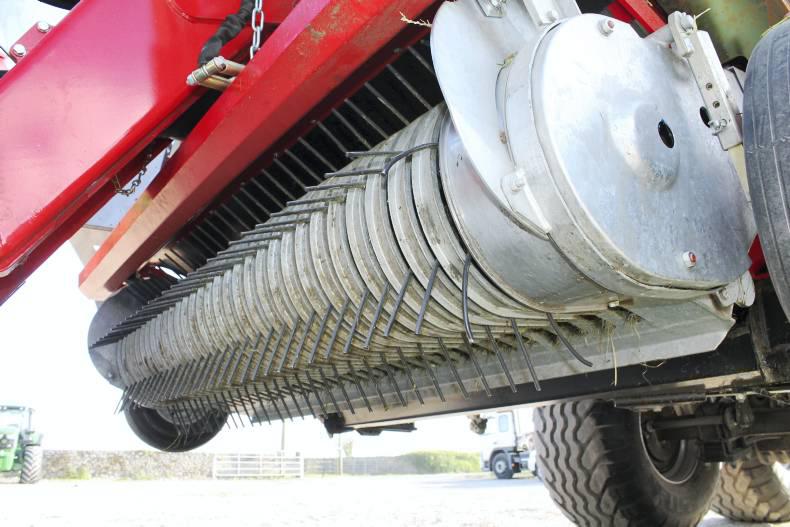
Other features include a camless pickup reel with freewheeling reverse feature. This allows the tines to roll forward if inadvertently reversing over a grass row or other obstacle where the tines or reel drive mechanism could get damaged. The outside tines are curved to release crop that the pickup guide wheels may be standing on. This is often a problem associated with headland runs in tight corners.
An 800mm-diameter rotor feeds the crop through a 40-knife bank. Blades are single edge, non-reversible. The face of each rotor finger is 25mm wide, which Lely says provides the best possible chop through the 37mm gap between knives.
The knife bank can be split to use just 20 knives at a time, which increases the theoretical chop length to 74mm. Splitting the knife bank is done manually with a large lever.
Knives are brought into work under full tractor hydraulic pressure. Each knife is individually protected by its own spring.
Rotor fingers, should they become damaged, can be replaced (welded) in sections. The Tigo features a series of rotor scrapers, each held in place by two bolts. There is one scraper pair per rotor finger.
Behind the rotor, the floor is inclined up to main floor level to reduce pressure on the rotor.
The floor on the test machine was timber, but a stainless steel floor is available as an option. Two pairs of chains and floor slats provide the necessary floor activity. A two-speed motor driving the floor chains speeds up the unloading process.
A cover plate is available as an optional extra to cover the exposed rotor in the floor if the machine is being used as a silage trailer. Also optional is a rear feed conveyor to feed freshly harvested grass out to livestock in a zero-grazing scenario.
The test machine was fitted with drawbar suspension – a must for our roads. Twin commercial spec axles with mechanical springs provided additional suspension. A passively steered rear axle aided tight manoeuvres in and out of fields or yards. Options in this department include active rear-axle steering and air brakes. Four Vredestein 600/55-22.5 tyres were fitted to the test machine.
Bodywork is worth a mention on the Lely Tigo PR50. A combination of galvanised and painted surfaces is applied to the machine.
Operation and control
There are a couple of control and monitoring options which include the standard control panel, E-link Pro terminal, and the tractor’s own isobus terminal if so equipped. Combining the standard control panel and the tractor’s isobus terminal works very well.
The isobus terminal can display additional data that is not possible to display on the standard control terminal. When fitted with the optional ultrasonic sensors, it is possible to see how much grass is in the wagon.
The filling process is automated at the push of a button. The Lely system also sets the correct drawbar height, lowers the pickup, and controls the position of the headboard and floor.
Floor movement is triggered by the pressure build-up in the two rams that move the bulkhead. This can be varied depending on how dense you want the load and to adapt to varying crops.
Once a certain pressure level is reached, the floor will then automatically move and keep moving until the ram pressure drops. This means the floor only moves as much as it needs to, sometimes only a chain link at a time.
During filling, once most of the wagon is full, the headboard then starts to move forward to create more space for the crop. When full, the headboard comes right to its most forward position.
Pressure on the door can also be monitored, as can number of loads and time to fill. If tying it into a tractor’s Isobus system is not an option, then LEDs along with a diagram on the controller give a visual representation of what is going on.
The unloading procedure is just as easy as the filling procedure. One touch of a button and the rear door opens, followed by floor activation (two speeds).
Set-up and serviceability
Depending on your tractor’s capabilities, the Lely’s hydraulics can be switched between load-sensing and non load-sensing. We would definitely recommend load-sensing if possible due to the sheer demand of hydraulic flow. Plus you will notice your fuel bills drop as the tractor does not have to constantly pump oil.
Service access is good all-round, with wide-opening side panels and a bonnet which lets you get at the rotor. The rotor can also be reversed manually in case of a major blockage via a crank handle located in the left side of the machine.
The entire knife bank can be lowered and swung outside the machine to service or sharpen blades.
For some contractors, using the wagon is seen as an opportunity to cut operating costs, especially on lighter second-cut silage, and to reduce labour requirements. For farmers, it’s seen as a way of getting longer-chop silage for allegedly improved digestion as well as cutting costs.
With that in mind, we invited six of the most popular manufacturers of silage wagons to an Irish Farmers Journal with the Farmers Guardian group test in Gurteen Agricultural College, Ballingarry, Roscrea, Co Tipperary.
Four manufacturers accepted the invitation, including Claas, Strautmann, Krone and Lely. Pottinger declined to enter a machine for the test, as their new model was not available yet. Pottinger have promised us that we can perform a similar test at a later date. Malone was unable to attend due to an earlier commitment to a demonstration in the UK.
Each of the four machines supplied for the test was roughly similar in size and capacity. The group test of four very different machines allowed us to look at and compare what each manufacturer’s machine had to offer Irish users.
In an attempt to measure each machine’s capacity, both in-field and at the clamp, we looked at several measurables and recorded them for each machine.
What was tested in each forage wagon?
In-field, we looked at the maximum load potential of each wagon. This was done by measuring the amount of material picked up in the field, and weighing the wagons in and out on the way to the clamp.At the clamp, we timed how long it took to unload each of the wagons.The chop length from each of the machines was also examined.Using an in-line PTO dynamometer, we attempted to measure, or at least get an impression of, the PTO power it took to drive each machine. The loading on the drive system was quite irregular, as you could imagine. This was down to how it was laid by the mower, raked up and ultimately picked up by the wagon.The number of power spikes in the drive system could be used as an indicator of how well the pickup and rotor performed in handling the crop.Other aspects we looked at were machine design, features and functions.So on 25 May, with 50 acres of Gurteen College grass on the ground, and the farm manager watching the weather, we set about our test.
Lely Tigo PR50
The purchase of German firm Mengele by Dutch company Lely saw a revival of Mengele products under the Lely brand here in Ireland. Today, Lely has rebuilt the business and introduced its silage wagon ranges to Irish farmers and contractors.
In 2012, Lely launched its Lely Tigo XR combi loader wagon, which featured a unique movable bulkhead. This increased the capacity of the wagon and assisted in the unloading process. The Tigo XR range featured three large models at that time suited to contractor use.
In 2014, Lely introduced its new Lely Tigo PR range. The Tigo PR replaced the Lely Tigo R Profi range with three models in the 31-41 DIN m3 capacity range (PR 50, 60 and 70).
For the Irish Farmers Journal group test in Gurteen, Lely Ireland provided the Tigo PR50. This has a DIN capacity of 31m3. Its model number of 50 indicates its capacity (in m3) at medium compaction.
Features and functions
Lely’s movable bulkhead is certainly the most distinguishable feature of the Lely Tigo PR50. Lely points out that this design allows the space above the drawbar to be utilised. The bulkhead moves through an 80º arc, which Lely says creates an additional 6m3 capacity.
Lely adds that this extra capacity enables its machine to be one metre shorter than previous models. This is an important asset where manoeuvrability is a concern on narrow rural roads and farmyards.
Its bulkhead is not just about creating space – it allows the crop compaction pressure and subsequent density of the crop load to be adjusted. It also assists in shifting the load rearward when unloading at the silage clamp.
Other features include a camless pickup reel with freewheeling reverse feature. This allows the tines to roll forward if inadvertently reversing over a grass row or other obstacle where the tines or reel drive mechanism could get damaged. The outside tines are curved to release crop that the pickup guide wheels may be standing on. This is often a problem associated with headland runs in tight corners.
An 800mm-diameter rotor feeds the crop through a 40-knife bank. Blades are single edge, non-reversible. The face of each rotor finger is 25mm wide, which Lely says provides the best possible chop through the 37mm gap between knives.
The knife bank can be split to use just 20 knives at a time, which increases the theoretical chop length to 74mm. Splitting the knife bank is done manually with a large lever.
Knives are brought into work under full tractor hydraulic pressure. Each knife is individually protected by its own spring.
Rotor fingers, should they become damaged, can be replaced (welded) in sections. The Tigo features a series of rotor scrapers, each held in place by two bolts. There is one scraper pair per rotor finger.
Behind the rotor, the floor is inclined up to main floor level to reduce pressure on the rotor.
The floor on the test machine was timber, but a stainless steel floor is available as an option. Two pairs of chains and floor slats provide the necessary floor activity. A two-speed motor driving the floor chains speeds up the unloading process.
A cover plate is available as an optional extra to cover the exposed rotor in the floor if the machine is being used as a silage trailer. Also optional is a rear feed conveyor to feed freshly harvested grass out to livestock in a zero-grazing scenario.
The test machine was fitted with drawbar suspension – a must for our roads. Twin commercial spec axles with mechanical springs provided additional suspension. A passively steered rear axle aided tight manoeuvres in and out of fields or yards. Options in this department include active rear-axle steering and air brakes. Four Vredestein 600/55-22.5 tyres were fitted to the test machine.
Bodywork is worth a mention on the Lely Tigo PR50. A combination of galvanised and painted surfaces is applied to the machine.
Operation and control
There are a couple of control and monitoring options which include the standard control panel, E-link Pro terminal, and the tractor’s own isobus terminal if so equipped. Combining the standard control panel and the tractor’s isobus terminal works very well.
The isobus terminal can display additional data that is not possible to display on the standard control terminal. When fitted with the optional ultrasonic sensors, it is possible to see how much grass is in the wagon.
The filling process is automated at the push of a button. The Lely system also sets the correct drawbar height, lowers the pickup, and controls the position of the headboard and floor.
Floor movement is triggered by the pressure build-up in the two rams that move the bulkhead. This can be varied depending on how dense you want the load and to adapt to varying crops.
Once a certain pressure level is reached, the floor will then automatically move and keep moving until the ram pressure drops. This means the floor only moves as much as it needs to, sometimes only a chain link at a time.
During filling, once most of the wagon is full, the headboard then starts to move forward to create more space for the crop. When full, the headboard comes right to its most forward position.
Pressure on the door can also be monitored, as can number of loads and time to fill. If tying it into a tractor’s Isobus system is not an option, then LEDs along with a diagram on the controller give a visual representation of what is going on.
The unloading procedure is just as easy as the filling procedure. One touch of a button and the rear door opens, followed by floor activation (two speeds).
Set-up and serviceability
Depending on your tractor’s capabilities, the Lely’s hydraulics can be switched between load-sensing and non load-sensing. We would definitely recommend load-sensing if possible due to the sheer demand of hydraulic flow. Plus you will notice your fuel bills drop as the tractor does not have to constantly pump oil.
Service access is good all-round, with wide-opening side panels and a bonnet which lets you get at the rotor. The rotor can also be reversed manually in case of a major blockage via a crank handle located in the left side of the machine.
The entire knife bank can be lowered and swung outside the machine to service or sharpen blades.






SHARING OPTIONS