John Deere had much to show and talk about at a launch day in the UK recently with the introduction of a huge array of new and updated products, which included tractors, silage harvesters, sprayers, combine harvesters and balers.
The tractor range featured updates and new introductions in most of the models. Among the smallest included the new speciality tractors for the orchard, soft fruit and vineyard markets.
The range features cab-less and narrow versions if required – the 5GF, 5GN, 5GV and 5GL. The GN and GL variants are new and broaden Deere’s options for the speciality tractor industry.
It is clearly an industry that John Deere has in its sights. The firm estimates that approximately 900 units per year are sold into this sector.
At the top end are the 9R and 9RT tractors, with final T4 engines. With five articulated models and three tracked models, power output ranges from 420hp up to 620hp.
Not mentioned at the launch was the 9RX model, which has been previewed in the USA. This is the articulated 9R, but with tracks on all four corners similar to the CaseIH Quadtrac.
The official line on the 9RX is that John Deere in the UK and Ireland has no visibility on these products. We can safely assume that it is unlikely we will see the 9RX anytime soon.
The company is introducing the new five-walker W330 and six-walker W440 entry-level combine harvesters for the 2015 season, with reliability and simplicity at a low operating cost.
These John Deere-branded combines are the result of a marketing agreement with Finnish manufacturer Sampo Rosenlew and feature 210hp and 238hp Sisu engines, with maximum power ratings of 216hp and 253hp.
Aimed at arable farms, speciality crop growers and contractors, the new R4040i self-propelled sprayer replaces the current 5430i model for 2015.
The firm has made a large number of improvements over the previous machine. Among these are better cab access and features. Also, a new chassis, more powerful drive train and T4 engine mean a better-balanced machine and an increase of 19% in hill-climbing ability.
Also revamped is the large square baler series, which in Europe is built by Kühn.
The new L1533 and L1534 models replace the 1433 and 1434 balers. These make 90cm x 80cm and 90cm x 120cm bales, respectively. Both now feature double knotters, significant changes to guarding and much more besides.
Perhaps most significant for our market and time of year is the firm’s new 6R series tractors and 8000 series self-propelled silage harvesters.
All meet T4 final regulations with the addition of SCR or AdBlue to the engines, along with the existing exhaust gas recirculation technology.
New 6R tractor range
Meeting the latest round of emission regulations is the new mid-size 6R series. Replacing the current six-cylinder Stage IIIB/iT4 compliant 6170R, 6190R and 6210R are the 6175R, 6195R and 6215T.
These are what the company describes as large-frame models and now incorporate Stage IV/Final Tier 4 engines.
All are powered by 6.8-litre John Deere Power Tech PVS/PSS engines, rated from 175hp to 215hp (97/68 EC). All deliver an extra 5hp compared to the previous models.
The PSS engine on the 6195R and 6215R models features high-tech in-series twin turbochargers. These force more air into the combustion chamber to deliver their increased power outputs.
Fuel injection pressure has also been raised from 2,000 bar to 2,500 bar as part of John Deere’s solution to meeting the latest round of emission regulations.
Up to now, John Deere has managed to avoid selective catalytic reduction (SCR) with diesel exhaust fluid (DEF – AdBlue). That has changed now to meet tighter emission controls.
SCR works in combination with the firm’s existing DPF unit, twin turbos, higher injection pressures and EGR to keep a handle on all things exiting the exhaust.
The upside of the added emission control is a 5% improvement in fuel economy, according to John Deere’s Dan Roe, who added that DEF consumption is just 3%.
He added that the DPF unit is now a lifetime item rather than a service item. This is expected to be around 10,000 hours. Service intervals have also been extended to 750 hours, 250 more than the previous generation of tractors. Big service including the backend is at 1,500 hours.
All 6R models feature engine intelligent power management (IPM). This make an extra 40hp available for transport and PTO work. This is 10hp more than was available on the previous range.
Fuel efficiency of these new models can also be enhanced by choosing either the established auto power continuously variable transmission or the new, advanced double-clutch Direct drive e23 transmission.
Software updates to direct drive include adjustable clutch sensitivity, a speed-matching mode and starting gear selection.
It is now possible to select a three-gear difference between forward and reverse for shuttling operations (two previously).
At the rear, there is a new valve stack on 6R Series tractors, similar to the 7R series and Waterloo-built tractors. It is easier to access, according to the company, with easier uncoupling under pressure using quick-release levers.
Up to five double couplers are available plus power-beyond couplings. Alternatively, a maximum of six are available without the power-beyond couplings. The standard oil flow is 140 litres/minute for services, while a 155 litre/minute pump is optionally available.
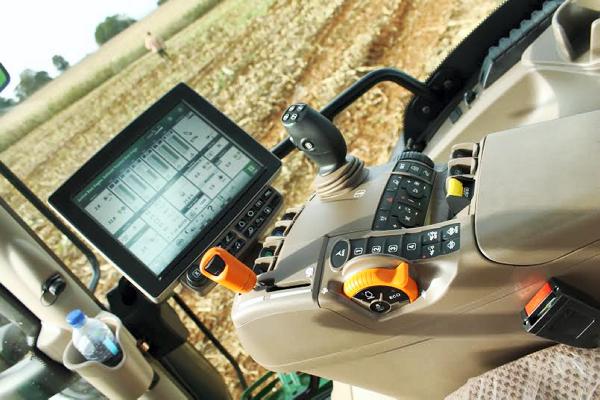
On models equipped with the direct drive or auto power transmissions, the new 6R command arm features an electronic joystick.
This can be programmed to operate front linkage, front loader or rear services. The generation four command centre display, like its larger siblings, incorporates smartphone technology with screen swipe function.
There are also extra mirror and lighting options, including an LED light option. According to the company, these use 45% less amps than standard halogen lights. They also have a 55-times longer lifespan, according to the firm.
Other options include premium front hitch, with a dedicated hydraulic service, pressure-free oil return, a remote control to lift and lower the hitch and electronic position sensing to simplify the operation of front-mounted implements.
The new farm sight-ready 6R Series tractors can be fitted with JD Link telematics as an option. One example of this system is remote display access (RDA), which can help the tractor driver with machine set-up, operation and adjustment.
Remote diagnostics is standard on JD Link. Remote diagnostics allows the dealer to look at or even clear a fault without leaving the garage or the customer bringing the tractor in.
Potentially, this means less downtime for the customer. The new 6R series is expected to be available from this November, according to the company.
New 8000 Series self-
propelled silage harvester
Making its debut at Agri-Scot 2014 event in Edinburgh, Scotland, will be the new John Deere 8000 series self-propelled silage harvester series. According to the company, this new generation of harvesters builds on the best features of the 7000 series. The new range includes five models, four with standard crop channels and an additional machine with a wide crop channel:
8100, 380hp, John Deere 9-litre engine8200, 430hp, John Deere 9-litre engine8400, 540hp, John Deere 13.5-litre engine8500, 585hp, John Deere 13.5-litre engine8600, 625hp, John Deere 13.5-litre engine (wide body)Carried over from the old series is the largest harvester John Deere makes, the 812hp John Deere 7980. This is expected to be replaced in the future. This 7980 and 8600 models feature a 830mm feed channel (wide body), while the feed channel on the four smaller machines measures 680mm.
John Deere has incorporated a number of new features into its new harvester line-up.
There are now three access zones to the harvester’s chopping unit. Top access and swing-out access are carried forward from the previous series, while new is a V-opening between head and chopping unit.
This is quickly accessed by unwinding a central locking mechanism positioned at the top of the feeder unit. Once opened, it provides 35° of an opening to inspect/service the chopping unit.
The handling of the kernel process has now been made easier, with Deere saying it can be removed in just five minutes. It can be removed/installed through side service access with the aid of its KP crane. There is now full service lighting in the engine bay to make maintenance and servicing easier.
John Deere has also completely redesigned the kernel processor on the 8000 series. It says that the bevelled discs of the KernelStar2 multi-crop processor produce a more aggressive tearing action, which smashes every kernel for maximum starch release and higher silage nutrient value.
New header solutions include grass pick-ups from 3m to 4.5m and Kemper rotary headers from 6m to 9m wide.
Kemper maize headers are optionally available with automatic steering and/or automatic header control. For wholecrop harvesting, John Deere also offers the Zürn ProfiCut 620, which is claimed to leave clean, low-cut stubble.
The firm’s new 639 grass pick-up header replaces its 630 header. It has a new auger design, incorporating paddles to better feed the grass into the feed channel and rollers.
Now hydraulically driven, the auger and feeder rollers can by synced when changing chop length. A dual head drive option also features hydraulic drive to the pick-up, again allowing better syncing of the feed and chopping mechanisms.
Operator comfort has been improved according to the company, with anti-glare screen, Bluetooth connectivity, plenty of storage room and automatic air conditioning, adjustable from the command arm. Other features include a Green Star 2630 with touch-screen display.
All models are available in an ‘i’ specification, including HarvestLab constituent sensing and yield monitoring software as standard. The ProDrive hydrostatic transmission with engine speed management is also now optionally available on all models in the range.
Using JD Link wireless technology and with the permission of the owner, dealer product support specialists can remotely monitor machine performance in real time for a fixed monthly fee, to suggest utilisation and efficiency improvements.
The engine in the new series remains longitudinally positioned. This allows for more space around the engine and more efficient cooling as the fan takes 7% less power to drive than a transverse engine.
Transmitting the drive from engine to machine is through an improved bevel gearbox. With the old design, there was a 1% to 2% power loss. A new machining process for the gears, plus a dry-sump design, reduces power loss through the gearbox to 0.5%.
Following consultation with customers, the new harvesters feature a compressor to aid with cleaning and servicing the machine, plus a fully equipped tool box.
Servicing and maintenance has been made easier with an automatic greasing system, while the engine radiator screen slides out for easy cleaning with the integrated high-pressure air hose.
John Deere had much to show and talk about at a launch day in the UK recently with the introduction of a huge array of new and updated products, which included tractors, silage harvesters, sprayers, combine harvesters and balers.
The tractor range featured updates and new introductions in most of the models. Among the smallest included the new speciality tractors for the orchard, soft fruit and vineyard markets.
The range features cab-less and narrow versions if required – the 5GF, 5GN, 5GV and 5GL. The GN and GL variants are new and broaden Deere’s options for the speciality tractor industry.
It is clearly an industry that John Deere has in its sights. The firm estimates that approximately 900 units per year are sold into this sector.
At the top end are the 9R and 9RT tractors, with final T4 engines. With five articulated models and three tracked models, power output ranges from 420hp up to 620hp.
Not mentioned at the launch was the 9RX model, which has been previewed in the USA. This is the articulated 9R, but with tracks on all four corners similar to the CaseIH Quadtrac.
The official line on the 9RX is that John Deere in the UK and Ireland has no visibility on these products. We can safely assume that it is unlikely we will see the 9RX anytime soon.
The company is introducing the new five-walker W330 and six-walker W440 entry-level combine harvesters for the 2015 season, with reliability and simplicity at a low operating cost.
These John Deere-branded combines are the result of a marketing agreement with Finnish manufacturer Sampo Rosenlew and feature 210hp and 238hp Sisu engines, with maximum power ratings of 216hp and 253hp.
Aimed at arable farms, speciality crop growers and contractors, the new R4040i self-propelled sprayer replaces the current 5430i model for 2015.
The firm has made a large number of improvements over the previous machine. Among these are better cab access and features. Also, a new chassis, more powerful drive train and T4 engine mean a better-balanced machine and an increase of 19% in hill-climbing ability.
Also revamped is the large square baler series, which in Europe is built by Kühn.
The new L1533 and L1534 models replace the 1433 and 1434 balers. These make 90cm x 80cm and 90cm x 120cm bales, respectively. Both now feature double knotters, significant changes to guarding and much more besides.
Perhaps most significant for our market and time of year is the firm’s new 6R series tractors and 8000 series self-propelled silage harvesters.
All meet T4 final regulations with the addition of SCR or AdBlue to the engines, along with the existing exhaust gas recirculation technology.
New 6R tractor range
Meeting the latest round of emission regulations is the new mid-size 6R series. Replacing the current six-cylinder Stage IIIB/iT4 compliant 6170R, 6190R and 6210R are the 6175R, 6195R and 6215T.
These are what the company describes as large-frame models and now incorporate Stage IV/Final Tier 4 engines.
All are powered by 6.8-litre John Deere Power Tech PVS/PSS engines, rated from 175hp to 215hp (97/68 EC). All deliver an extra 5hp compared to the previous models.
The PSS engine on the 6195R and 6215R models features high-tech in-series twin turbochargers. These force more air into the combustion chamber to deliver their increased power outputs.
Fuel injection pressure has also been raised from 2,000 bar to 2,500 bar as part of John Deere’s solution to meeting the latest round of emission regulations.
Up to now, John Deere has managed to avoid selective catalytic reduction (SCR) with diesel exhaust fluid (DEF – AdBlue). That has changed now to meet tighter emission controls.
SCR works in combination with the firm’s existing DPF unit, twin turbos, higher injection pressures and EGR to keep a handle on all things exiting the exhaust.
The upside of the added emission control is a 5% improvement in fuel economy, according to John Deere’s Dan Roe, who added that DEF consumption is just 3%.
He added that the DPF unit is now a lifetime item rather than a service item. This is expected to be around 10,000 hours. Service intervals have also been extended to 750 hours, 250 more than the previous generation of tractors. Big service including the backend is at 1,500 hours.
All 6R models feature engine intelligent power management (IPM). This make an extra 40hp available for transport and PTO work. This is 10hp more than was available on the previous range.
Fuel efficiency of these new models can also be enhanced by choosing either the established auto power continuously variable transmission or the new, advanced double-clutch Direct drive e23 transmission.
Software updates to direct drive include adjustable clutch sensitivity, a speed-matching mode and starting gear selection.
It is now possible to select a three-gear difference between forward and reverse for shuttling operations (two previously).
At the rear, there is a new valve stack on 6R Series tractors, similar to the 7R series and Waterloo-built tractors. It is easier to access, according to the company, with easier uncoupling under pressure using quick-release levers.
Up to five double couplers are available plus power-beyond couplings. Alternatively, a maximum of six are available without the power-beyond couplings. The standard oil flow is 140 litres/minute for services, while a 155 litre/minute pump is optionally available.
On models equipped with the direct drive or auto power transmissions, the new 6R command arm features an electronic joystick.
This can be programmed to operate front linkage, front loader or rear services. The generation four command centre display, like its larger siblings, incorporates smartphone technology with screen swipe function.
There are also extra mirror and lighting options, including an LED light option. According to the company, these use 45% less amps than standard halogen lights. They also have a 55-times longer lifespan, according to the firm.
Other options include premium front hitch, with a dedicated hydraulic service, pressure-free oil return, a remote control to lift and lower the hitch and electronic position sensing to simplify the operation of front-mounted implements.
The new farm sight-ready 6R Series tractors can be fitted with JD Link telematics as an option. One example of this system is remote display access (RDA), which can help the tractor driver with machine set-up, operation and adjustment.
Remote diagnostics is standard on JD Link. Remote diagnostics allows the dealer to look at or even clear a fault without leaving the garage or the customer bringing the tractor in.
Potentially, this means less downtime for the customer. The new 6R series is expected to be available from this November, according to the company.
New 8000 Series self-
propelled silage harvester
Making its debut at Agri-Scot 2014 event in Edinburgh, Scotland, will be the new John Deere 8000 series self-propelled silage harvester series. According to the company, this new generation of harvesters builds on the best features of the 7000 series. The new range includes five models, four with standard crop channels and an additional machine with a wide crop channel:
8100, 380hp, John Deere 9-litre engine8200, 430hp, John Deere 9-litre engine8400, 540hp, John Deere 13.5-litre engine8500, 585hp, John Deere 13.5-litre engine8600, 625hp, John Deere 13.5-litre engine (wide body)Carried over from the old series is the largest harvester John Deere makes, the 812hp John Deere 7980. This is expected to be replaced in the future. This 7980 and 8600 models feature a 830mm feed channel (wide body), while the feed channel on the four smaller machines measures 680mm.
John Deere has incorporated a number of new features into its new harvester line-up.
There are now three access zones to the harvester’s chopping unit. Top access and swing-out access are carried forward from the previous series, while new is a V-opening between head and chopping unit.
This is quickly accessed by unwinding a central locking mechanism positioned at the top of the feeder unit. Once opened, it provides 35° of an opening to inspect/service the chopping unit.
The handling of the kernel process has now been made easier, with Deere saying it can be removed in just five minutes. It can be removed/installed through side service access with the aid of its KP crane. There is now full service lighting in the engine bay to make maintenance and servicing easier.
John Deere has also completely redesigned the kernel processor on the 8000 series. It says that the bevelled discs of the KernelStar2 multi-crop processor produce a more aggressive tearing action, which smashes every kernel for maximum starch release and higher silage nutrient value.
New header solutions include grass pick-ups from 3m to 4.5m and Kemper rotary headers from 6m to 9m wide.
Kemper maize headers are optionally available with automatic steering and/or automatic header control. For wholecrop harvesting, John Deere also offers the Zürn ProfiCut 620, which is claimed to leave clean, low-cut stubble.
The firm’s new 639 grass pick-up header replaces its 630 header. It has a new auger design, incorporating paddles to better feed the grass into the feed channel and rollers.
Now hydraulically driven, the auger and feeder rollers can by synced when changing chop length. A dual head drive option also features hydraulic drive to the pick-up, again allowing better syncing of the feed and chopping mechanisms.
Operator comfort has been improved according to the company, with anti-glare screen, Bluetooth connectivity, plenty of storage room and automatic air conditioning, adjustable from the command arm. Other features include a Green Star 2630 with touch-screen display.
All models are available in an ‘i’ specification, including HarvestLab constituent sensing and yield monitoring software as standard. The ProDrive hydrostatic transmission with engine speed management is also now optionally available on all models in the range.
Using JD Link wireless technology and with the permission of the owner, dealer product support specialists can remotely monitor machine performance in real time for a fixed monthly fee, to suggest utilisation and efficiency improvements.
The engine in the new series remains longitudinally positioned. This allows for more space around the engine and more efficient cooling as the fan takes 7% less power to drive than a transverse engine.
Transmitting the drive from engine to machine is through an improved bevel gearbox. With the old design, there was a 1% to 2% power loss. A new machining process for the gears, plus a dry-sump design, reduces power loss through the gearbox to 0.5%.
Following consultation with customers, the new harvesters feature a compressor to aid with cleaning and servicing the machine, plus a fully equipped tool box.
Servicing and maintenance has been made easier with an automatic greasing system, while the engine radiator screen slides out for easy cleaning with the integrated high-pressure air hose.





SHARING OPTIONS