



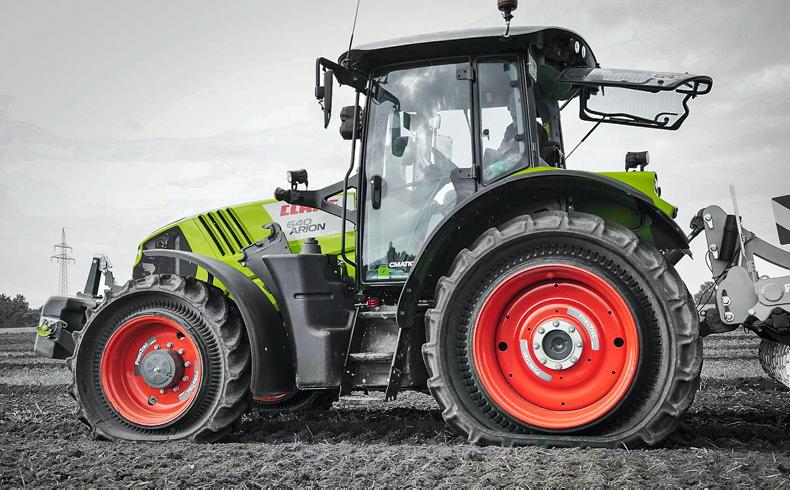
The tyre technology known simply as the “CupWheel” was developed by Galileo Wheel Ltd, with its primary aim being to fuse the key advantages of rubber tracks with the convenience of pneumatic tyres.
According to Yanir Schneider of Galileo, the concept emerged in the late 2010s and entered commercial rollout around 2019 with the launch of its products.
Galileo engineers, under CTO and designer Avishay Novoplanski, patented the tyre as a double-V cross-section sidewall (or “cup” shape) enabling exceptional vertical flexibility without sacrificing lateral stiffness, something not achievable with traditional radial tyre construction.
In 2022, Japan’s Marubeni Corporation acquired a stake in Galileo, signalling confidence in scaling the CupWheel technology globally.
Field trails are ongoing as of mid-2023 in various parts of the world to access performance in different terrain, farming practices, soil types as well as climate and field conditions.
However, a set has now reached Ireland for the first time to see how it performs firsthand for John Kennedy, who is a Tipperary-based agricultural contractor, where they will be trialed under various field applications.
Yanir notes that Ireland’s typically wetter climate significantly influences its soil characteristics, greatly affecting field operations. He believes that Galileo’s tyre technology may be transformational and help farmers in many ways.
Galileo has previously faced some production setbacks as it coincided with the global pandemic, but it is now in advanced negotiations to produce with a European manufacturer and to have tyres ready for Irish customers at some stage in 2026.
Design and technical principle
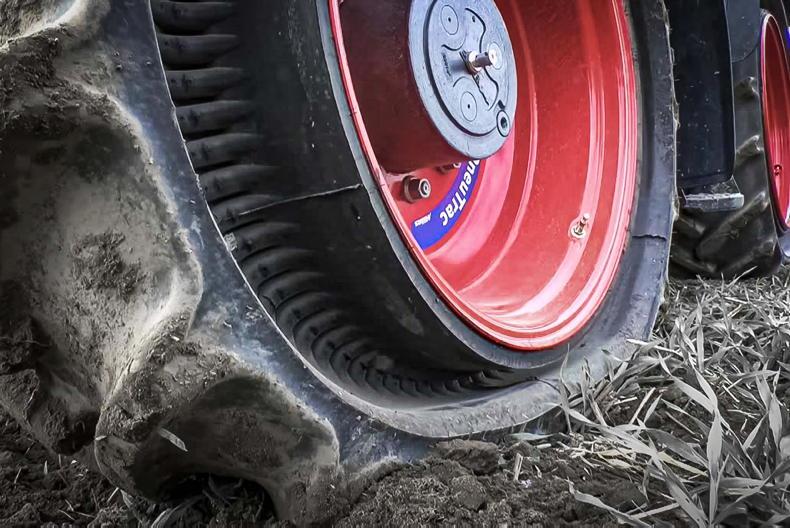
At the core of the CupWheel is its inverted double-V sidewall design: essentially two concave “cups” within the tyre’s cross-section.
Under load, these deform downward to form a flattened “omega” footprint, thus drastically increasing contact length while maintaining sidewall rigidity.
According to Yanir, this structure enables high radial flexibility and distributes the load evenly across a larger ground footprint. Another key benefit is the strong lateral stiffness, which prevents side-to-side deflection even on slopes or at road speed.
Also, unlike conventional tyres where rolling circumference shrinks under low pressure, the CupWheel retains circumference, maintaining distance per revolution and therefore improving fuel efficiency and work rate, he declares.
Fitment and compatibility
Yanir does state that while fitting these tyres on standard rims is possible, due to the high torque that ideally a DW type rim known as a “double well” shape or TW (triple well shape) rim on larger tractors should be used as they offer more surface area to help the tyre grip and prevent rim-slip but that these rims are on most of today’s modern tractors anyway.
Another point to note is the tyre equipment to fit this type of tyre on the rim needs to be substantial as there is not the same amount of flex like a typical tractor tyre, but he explains that experienced fitters who are used to fitting forestry type tyres have no issues once they follow the installation procedure recommended.
Benefits/performance advantages
Field tests to date have found up to 25% more traction over standard radials, and about 17 % improvement over IF (increased flexion) radials, with peak gains in sandy or loose soils.
“Under heavy load or tillage, gains may reach sometimes as high as 40% as the trye can run as low as 0.4 Bar or just under 6 PSI tyre pressure”, he says.
Soil protection/reduced compaction
The flattened footprint can be up to almost 50% larger than a standard tyre of equivalent size, distributing weight evenly and avoiding point-load compaction without having to go wider.
Uniform pressure prevents deep compaction, preserving soil structure and boosting crop yields over time as well as preventing field surface rutting.
Lateral stability and handling
According to Yanir lateral stiffness jumps by 167 % over a standard radial tyre, and far more versus IF radials, drastically reducing side-slip and improving steering on slopes or turning sharply on narrow roads.
This potentially means much safer, smoother field and road performance without needing to up pressure between field and road work, so an expensive central tyre inflation system is not necessary.
Ride comfort/operator experience
Yanir proclaims the flexible sidewalls act like a miniature suspension, smoothing out ground irregularities that would jolt conventional tyres and cause more power hop.
“Operators consistently report less vibration and fatigue in rough terrain and it’s far easier on the operator and the machine’s own running gear,” he says.
Run-flat and durability
This type of tyre can operate at ultra-low pressure and is driveable even at zero air if punctured, so machines can limp back for repair instead of halting operations.
Self-cleaning and easy inflation
Yanir also says the flexing motion helps shed mud and dirt, keeping treads clear more easily and traction consistent. This is something he states is an indirect potential safety feature with equipment often bringing a lot of soil debris onto public roads around fields entrances.
Another benefit is that this tyre technology has a 30 % smaller internal air chamber, meaning inflation is far quicker.
Currently there is no stock available, but Yanir is hopeful that as of early to mid-2026, Galileo technology will be rolling out for production.
“We hope to further expand our tyre range for all types of agricultural machines particularly for mid-sized tractors to larger machines.” 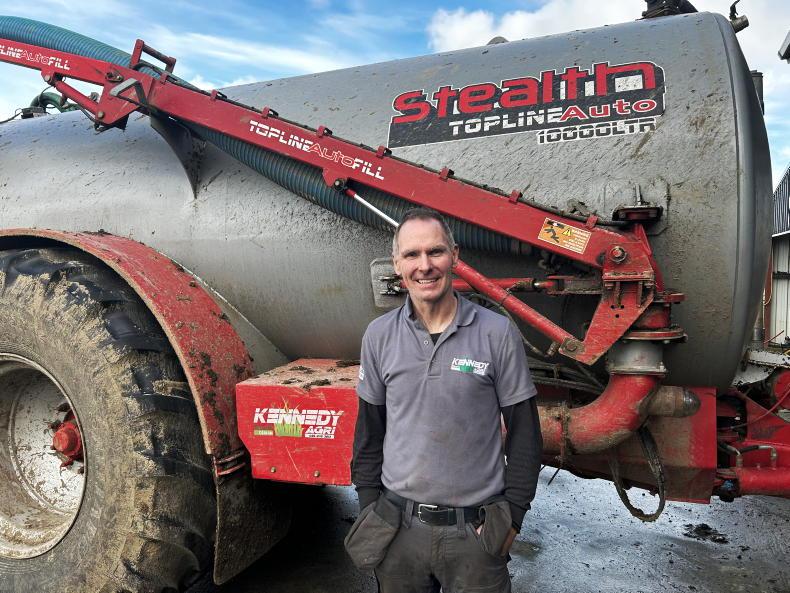
Irish trials
John Kennedy is a well-known agricultural contractor and machinery fabricator based outside Nenagh, Co Tipperary.
John is also the innovator behind the HiSpec Kompactor trailer range as well as the Tanco trailed butterfly mowers.
“I’m delighted to be able to get a set of CupWheels for testing here in Irish conditions and look forward to seeing how they perform,” he says.
According to John, he sees many potential benefits, and not having to adapt his tractor for a start being a primary example, it’s just stick them on and go.
“You’re getting the benefits of a track for close to the price of a high-quality tyre without the scrubbing when a track turns, but you can also move at speed with even better road and field stability than a LGP tyre,” he explains.
“This type of tractor tyre technology is a potential game-changer for a country like Ireland with the type of rainfall we can get, plus working on hilly terrain and narrow roads”, says John.
“This is something that potentially enables me to bring real value to my customers and look after their fields.”
Machinery is getting bigger and heavier, and farmers are becoming very aware of soil compaction he notes.
“As contractors we need to get work done as quickly and efficiently as possible, as time is money in this game and this offers something truly ground-breaking.
“In February, for example, I see myself spreading urea for customers when ground conditions would be 50/50 on normal tyres, my spreader can carry nearly four tonnes plus you have the tractor itself and the front weights”.
For hedge cutting season it’s permitted only in the wetter winter months when ground conditions may not be hectic.
“I find you often must do three rounds of the headland to finish the hedgerow and it’s really on the third pass that you see the marking of the field.
“Having a larger footprint will give farmers great peace of mind. The sidewall does not bulge outwards but is inverted too. This means less chance of getting punctures from gate hangers and therefore further cost and downtime when you’re busy.”
John shared with us how he intends to test these tyres.
“Last year I bought two identical New Holland T7.230 tractors. I will run one on its conventional tyres and the other on a full set of Galileo tyres; therefore, both machines will be on 710/70R38 on the back and 600/65R28 on the front.
“This will enable me to monitor a lot. I’ll also be doing certain tasks with engineers from the factory to check certain parameters.
And where does he see the market for them?
“I feel in this country that contractors in the west of Ireland could benefit from a set or two, particularly on the wet years, to travel without causing serious rutting especially at slurry work in springtime.
“Most other contractors I think will have a set and run them when needed like on heavy land or after wet spells of weather.
“There is certainly a great market for any of the tillage farmers here to help pull wider implements and prevent soil compaction.
“It’s great having all this power and mapping tractors for more torque and locking on boost but if you can’t connect it to the ground then it’s kind of pointless,” John explains.
In the coming months we will catch up with John to find out his thoughts once testing is under way.
Advantages



SHARING OPTIONS