


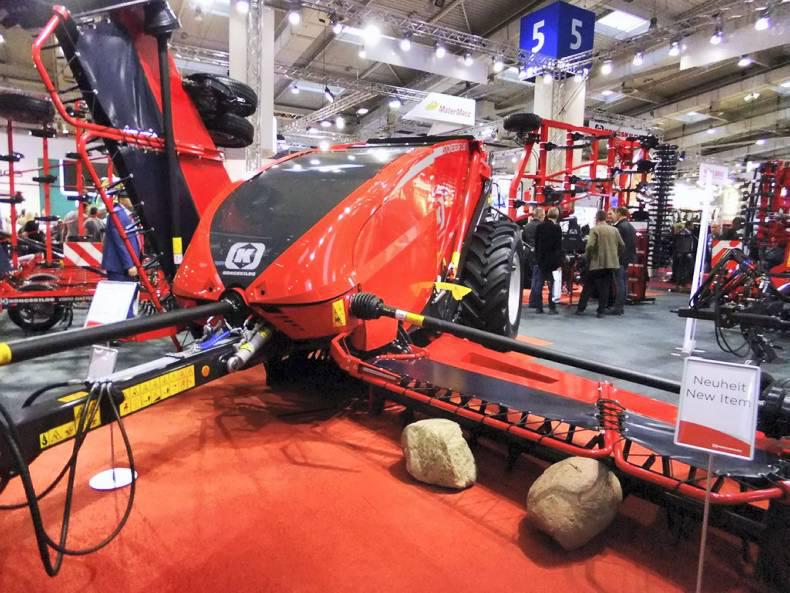
On many farms, unused parts of the fields have generally been left idle for good reason by previous generations. Improvements in drainage and land reclamation machines, that were not available in the past, are now making the job a lot easier. Labour is an issue, especially when the dreaded job of picking stones is mentioned. The good news is that there is a machine for it now and, in fact, several options.
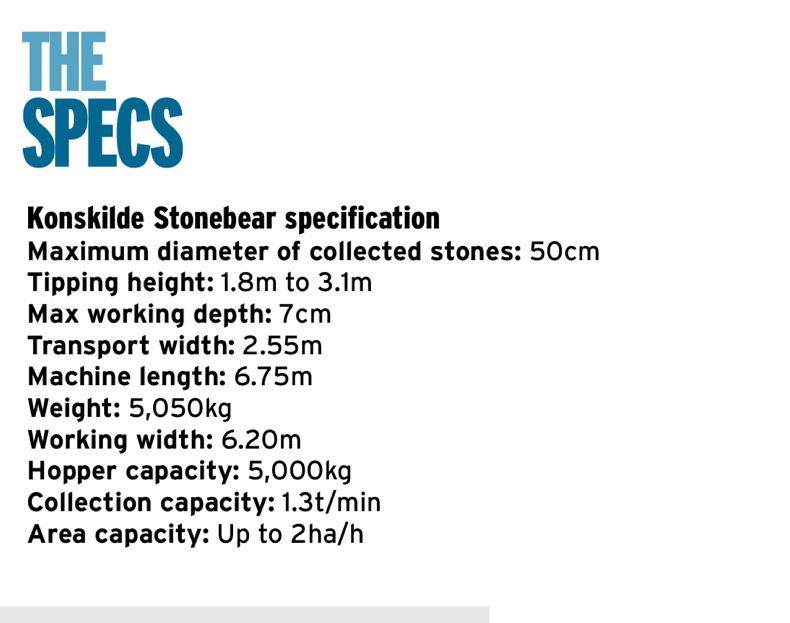
The Kongskilde Stonebear 2 comes with a working width of 6.2m. The stone picking rate is quoted at 1.3t/minute by Kongskilde. The Stonebear can handle stones of up to 500mm in diameter and it has a hopper tipping height of 3m. The manufacturer says that 400mm stones are ideally the biggest size. It works on a gathering principle where the two collections arms are unfolded for work in the field. Heavy-duty spikes, made of high-tensile steel in a spiral arrangement, draw the stones to the centre of the machine onto the sieve.
The stones are sieved by tines on a rotor over the exchangeable sieve after which tines lift the stones into the hopper. When the storage hopper is full, a hydraulic dumping system gives a tipping height up to 3m directly into a dump trailer, truck or pile. With the high-tipping feature, stones can be dropped straight into a truck. The hopper size can carry loads of up to 5t of stones.
The working depth in the soil is recommended to be 7cm for effective clearing of stones. The main rotor of the machine collects rocks into the hopper moved to the middle by the side rakes. The feed forks to the hopper brush the stones over the screen sieve available in sizes 30mm, 40mm, 50mm and 65mm. Small stones, soil and debris pass through the sieve and back to the land.
The gathering rotor rake and feed forks are driven by V-Belts which, according to Kongskilde, can absorb any shock loads on the system. The machine may only be operated at a maximum 350rpm rotational speed off the tractor pto.
Kongskilde says that the tractor power requirement is between 80hp and 120hp, making it suitable for use on most models. For safety, the manufacturer recommends that people should stay at least 20m away while the machine is in operation.
Depending on the stone content and conditions of the field, the driving speed can be from 0km/h to 5km/h. If there is high solid rock content or 15cm to 30cm stones, the driving speed should be minimal (0km/h to 2 km/h). In fields without solid rock and a general stone size of 4cm to 10 cm, the driving speed can be from 3km/h to 6km/h.
The Stonebear is designed to collect rocks from the topsoil cultivation layer to a depth of 0cm to 7 cm. Rock picking and its effectiveness can be further improved by removing stones larger than 50cm. The topsoil must be well cultivated – the soil is even and stones are loose in the aerated surface layer.
Flexxifinger’s rock picker
The Flexxifinger rotary rock picker is, according to its Canadian manufacturers, the world’s first rotary rock picker for skid loader use and allows farmers to pick rocks with ease.
Designed on a rotary combine principle, farmers can pick rocks with ease, picking rocks two to three times faster than rock buckets and it will fit on any skid loader with a quick-attach plate, the company says. Simply scoop, spin and the stones are picked clean.
The Flexxifinger quick picker will last the average farmer a lifetime, according to the manufacturer. They do need to have access to a skidsteer. The rock picker can pick rocks between 2in and 36in and it works in a range of soil conditions.
The cradle itself can hold up to a tonne of rocks, which the company says is three to four times more than the average loader bucket.
Terex sale
Terex Corporation has agreed to sell its German compact construction business to Yanmar Holdings Co Ltd for cash proceeds of approximately $60m. Terex’s German compact construction business manufactures and sells midi/mini excavators, wheeled excavators and compact wheel loaders.
Yanmar Holdings has a similar line of mini-excavators, small wheel loaders, and all-terrain carriers. Included in the transaction is the manufacturing facility located in Crailsheim, Germany, and the parts distribution centre located in Rothenburg, Germany. The sale, which is subject to government regulatory approvals and other customary closing conditions, is targeted to close in the second half of 2016.
JCB on the rental market
JCB Power Products is preparing to target the rental market by offering a full range of generators to suit any application.
The company’s QS Generator range covers power outputs of 20-220 kVA, while JCB’s Inteli-Hybrid Generators and B40 Battery Box provide an alternative power solution for customers looking to save fuel and costs.
And now JCB Power Products is preparing to launch a range of RS-branded generator sets, specifically designed for rental customers.
The RS range will sit alongside the existing QS line of generators, which can also be tailored for rental use with a host of industry-specific options.




SHARING OPTIONS