



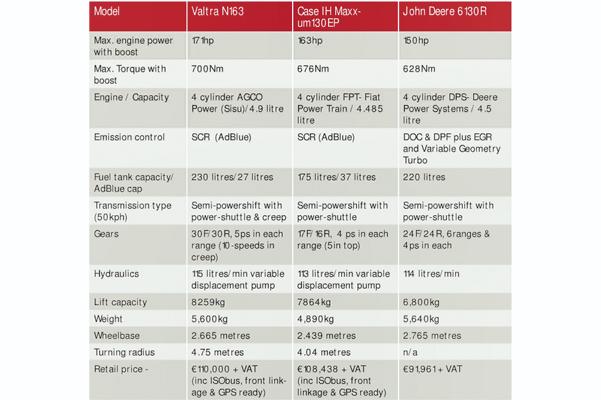
The N163 has a manufacturer quoted maximum power of 163hp, which rises to a maximum of 171hp in transport boost. Valtra, like so many manufacturers, now quote maximum power rather than power at rated (pto) speed. That aside, the N163 is still a powerful four cylinder tractor and weighing in at 5.6 tonnes (no fuel or weights), has one heck of a power to weight ratio.
Some readers may ask, but why? Well, once you get over the initial excitement of such a powerful yet relatively small tractor it has some practical applications. Its compact dimension and wheelbase of 2,665mm combined with a powerful punch should broaden its uses and applications, particularly here in Ireland.
I say that because we tend to be involved in more mixed farming enterprises and on older premises. Bigger tractors just aren’t nimble enough to get around without knocking half the place down. Turning radius is quoted as 4.75 metres, which is not class leading but is certainly very good taking the entire package into consideration (more than a metre less than Valtra six-cylinder models).
On a mixed farming enterprise of cattle and tillage, this tractor should be capable of handling a one-pass system or a large slurry tanker with equal ease.
I would foresee that most N163s would be purchased without a front loader on it for these types of mixed farms. An 115-litre/minute variable displacement hydraulic pump supplies more than enough for hydraulics and loader services. We tested the Valtra in between rain showers and also spoke to Graham Kavanagh who has just purchased one. We also put it thorough a Dyno test at independent garage, Nicholas Gainford Ltd and Dermot Forristal machinery specialist from Teagasc gives us his opinion on the results. To start, this week we get the results of our field test.
To work
The Tier-4i ‘N’series had a bit of a make-over with the N163 bonnet and front end bearing some family resemblance to sister brand Fendt. In fact, the front half-sub frame concept with integrated front linkage and hydraulic-based front suspension is ‘borrowed’ from Fendt.
With a sculpted bonnet and slimmer front suspension, the N163 has a tight front lock. In the cab, a new colour screen is used in the Valtra ARM arm-rest controller. Four wheel drive and pto switches have also been re-located to the Valtra ARM.
The cab of the N163 seems solidly built. Even the steel framed doors give the impression of strength. Its six-pillar design does not impede noticeably on visibility because doors are wide. They are also easy to handle, open and close.
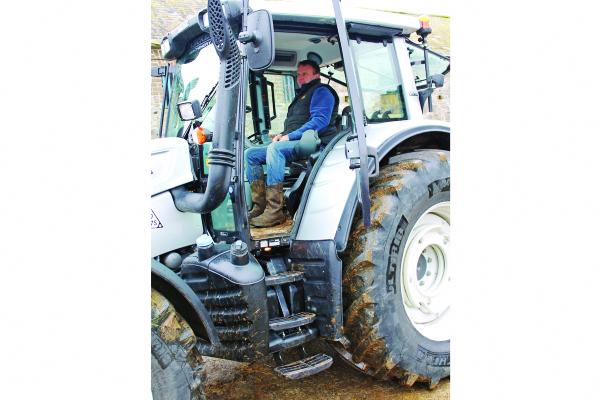
The route to seat is not straightforward. Some manoeuvring around the passenger seat is required and a handy foot pedal moves the steering wheel forwards. Visibility is good all round with adjustable exterior mirrors and an interior mirrors.
There are three digital displays in the cab, one on the dash, one on the front right-cab pillar and one on the Valtra ARM. Sounds a lot; it works very well displaying relevant data in each.
Comfort wise, there is cab suspension which at 50km/hour on our roads works very well. The air seat is a very high specification unit and has plenty of comfort adjustments, including heating.
The attached Valtra ARM has everything that it should have. Its adjustment is not enough for my long arms though; I could really do with it moving forward more.
The controls are very intuitive to use, even the potentially complicated ones. That provides a good chance that the end user will get the best out of the tractor. And a ‘non-techie’ could operate this potentially complicated tractor with just a little help.
It would be easy to see a loader fitted to this tractor. Valtra includes a clutching facility on the brake pedal which can be selected on the right-hand control panel. This may be useful for loader work and definitely useful for stop start operations like round baling.
The first couple of days it rained so hard that we just brought the N163 out for a very long drive. With two gringos in the cab, the heating and ventilation system managed to keep all the glass clear.
The auto-shift facility is a very nice transmission function; it worked really well up and down through the five power-shift speeds. Range changes required an extra button on the underside of the Valtra ARM to be pressed and the + or – button on top to go up a range or down a range.
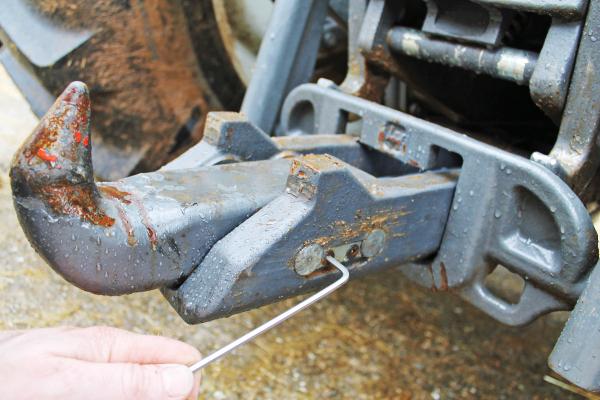
Next, we hooked up a trailer to move a load of hay. Operating the hitch release is done hydraulically by a switch.
The sequence for some reason seemed to confuse me and the ‘brother’.
A second rocker switch telescopes out the hook. Both of these services are integrated into the double acting spool valve at the bottom of the valve stack. This slice has its oil flow reduced to just 10% permanently for operations like the hitch or a hydraulic top link.
It is very cleverly done, and it doesn’t end there. For hooking to a pto or trailer in the dark, Valtra has also incorporated a light into the pto shaft cover.
With the trailer loaded, the one thing you will notice is that despite the tractors horsepower the four-cylinder N163 lacked the six-cylinder low down, tick-over grunt or momentum for taking off. But it is what it is; a four-cylinder and you can’t have everything.
Working its way up the engine rpm range the N163’s horses pull together, plus the few that have been corralled in the transport-boost section and combined with auto shifting works well on all but the sorest of hills.
Stopping is not a problem; boosted brakes require less effort to stop quicker. The N163 uses multi-disc brakes, five on each side, which are compressed by an expander to provide the friction for stopping.
This type of braking system can take a little more abuse than other systems out there, not that that is a license to do so. Versu and Direct models incorporate electronically controlled brake cooling.
This comes on when you press the brakes above 15km/hour and operate the brakes for longer than five seconds. After releasing the brakes, the system continues to pump oil in for another 15 seconds.
Examining maintenance aspects of the tractor required analysing the manual. Topping up any of the backend oils is not easy. The hydraulic oil has to be topped up through the hydraulic return coupling. This ensures though that no contaminants enter the system manually. Topping up coolant again looks tricky.
Go ploughing
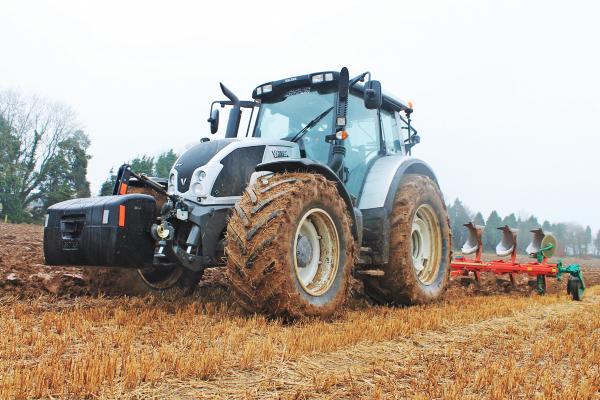
From the outset, we knew that ploughing with Kverneland ES85 five furrow hydraulic vary-width reversible plough would be a big test for the four-cylinder tractor. Hooking up was no problem; the Valtra stabilisers are simple yet effective, a square bar inside of square box section.
Lift capacity is quoted at 81kN which is a little over eight tonnes. Lifting the five-furrow reversible plough was no problem and the whole outfit was quite stable, aided with 650kg weight on the front linkage.
The top link space between the left and right hand quick/release couplings was very tight with the plough raised to the full.
If the top link adjusting bar was in the wrong place, it could have very easily caused damaged to a coupling or dis-lodged the stack.
Care is needed in hooking up to implements and ensuring all linkages, hydraulic pipes and cables are positioned properly. Once set up though, all was well.
Ploughing (between showers) went well; the hydraulics and lift were both very nice to use.
The tractor probably could have done with more ballast on the rear wheels and a heavier weight out front to improve traction when the going got very tough.
It had that much power on tap it was inclined to run out of traction rather than run out of power. Then the weather deteriorated too much to continue ploughing, and before we could programme and use Valtra’s U-Pilot headland management system.
Suffice to say, it seems relatively easy to set up and there are now two buttons; into work sequence and an out of work sequence, rather than the one on older models. Engine cruise control got a work out though and is very useful.
REVERSIBLE
Carrying the five-furrow reversible on the road, the whole combination felt a bit giddy; I wasn’t entirely comfortable with it. It could have done with a heavier front weight.
Paddy Cantwell, of Valtra, has pointed out to me that I should have switched off the front suspension, effectively adding extra ballast frontwards. Instead of the front axle trying to reach for the ground all the time, it becomes a fixed weight. Lesson learnt.
Specifications:
Valtra N163 test tractor
Model: N163 Versu with front linkage.
Power: 163hp rising to 171hp on boost.
Torque : 650Nm rising to 700 Nm on boost.
Engine : T4i/Stage3B, 4-cy, 4.9 litre AGCO-Sisu, four valves per cylinder.
Injection and AdBlue system Bosch.
Emission control: DOC and SCR (AdBlue).
Transmission: Power-shuttle, with five-speed powershift, four ranges plus creep 30F/30R speeds.
Cab: Mechanical suspension, seat suspension, Valtra ARM (arm rest controls), ISO and GPS ready.
Brakes: Boosted, oil immerses multi-disc (five friction per side) with electronically controlled cooling.
Lifting capacity: Rear 81kN (A little over 8.2 tonnes). front: 35kN (little over 3.5 tonnes).
Hydraulic: Variable displacement pump 115l/minute.
Spool valves: 4 d/a with flow control + 1d/a with 10% flow rate for hitch extension, hyd top link, etc, also fitted with power-beyond couplings.
PU-Hitch: Telescopic hitch from Sweden, Dromone available.
Rear tyres: Michelin Multibib 650/65R38’s.
Front tyres: Michelin Multibib 540/65R28.
Wheel base: 2,665mm.
Turning radius: 4.75m.
Weight (unballasted): 5,600kg.
Weight block: 650kg.
Price: €110,000 plus VAT.
POSITIVE
√ Compact power package.
√ Cab well put together.
√ Lots of practical extras.
√ Intuitive controls.
NEGATIVE
X Top links close proximity to valve stack.
X Route to seat hindered a bit by passenger seat.
X Maintenance access not easy, especially for topping up hydraulic or transmission oil.
X LH telescopic hitch — changing the hook.
THE VERDICT
To begin with, the N163 looks really well and has a well-built feel about it. It’s not a compromise tractor; it does what you reasonably expect from it.
There are lots of little things, practical extras that make it both an interesting and practical tractor to work with.
It provides a massive punch for a relatively small and light tractor. It has a massive lift capacity and with sensible ballasting could easily perform all manner of tasks.
Equipped with a loader, I would see this tractor comfortably operating on mid-sized tillage and livestock farms.
Next week, we get the views of Paddy Cantwell, technical service specialist for Valtra and Fendt, and we talk to tractor buyer Graham Kavanagh and Teagasc tractor expert Dermot Forristal about the Valtra N163.


SHARING OPTIONS