


We will begin with the 1940s, a decade in which the world was at war, when tractor production was severely affected by steel shortages, and when many machines were imported into Britain from America under the “Lend-Lease Agreement” signed in 1941.
During the first half of the decade, the tractors farmers had to choose from included the veteran Fordson Standard, David Brown VAK1 and Marshall Model M, together with machines such as the Ford 9NAN and Farmall M which were imported to assist Britain in its quest to put as many acres as possible ‘under the plough’.
Following the war, many new machines were introduced by tractor manufacturers.
Fordson launched the E27N Major to replace the long-serving Standard N in 1945. This tractor was initially only available with a petrol/tvo engine, the six-cylinder diesel Perkins P6 model becoming available in 1948.
Many E27Ns were converted from tvo to diesel power using this 45hp Perkins power plant. Tractors that had a factory-fitted P6 engine can be identified by their single cap fuel tank, narrow front grille bars, large dome-shaped air filter pre-cleaner, electric starting and lighting kit, and a cranked gear lever which was bent to avoid fouling the large battery carrier mounted behind the steering wheel. The E27N was available with either a Smith or Varley hydraulic system.
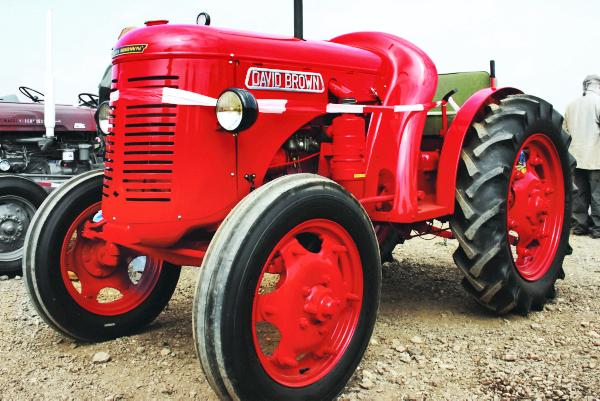
David Brown introduced the VAK1A tractor in 1945. This model was very similar to its predecessor, the VAK1, the main distinguishing styling feature being the tractor’s new steel slatted as opposed to cast or ‘bullet hole’ design front grille.
The VAK1A was soon replaced by the superior VAK1C in 1947, a tractor more commonly known as the Cropmaster, and one of the most popular models ever launched by the company. The Cropmaster was powered by a 35hp petrol/tvo engine and although similar to the VAK1A in appearance, was a much more substantial looking machine with larger rear mudguards and many new features such as a high/low gearbox that provided six forward and two reverse speeds.
The Cropmaster Diesel was introduced in 1949, and this was the first British tractor fitted with a diesel engine designed and built ‘in house’.
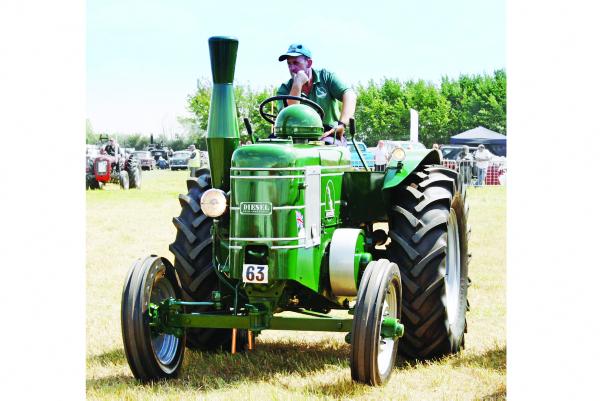
The single-cylinder Field Marshall Mark 1 was launched in 1945. This tractor was powered by a 38hp diesel engine and was fitted with a three-speed gearbox.
A threshing contractor’s version of the Field Marshall known as the Mark II was also available. This was fitted with a canvas canopy, a higher speed top gear (9mph), a winch, additional brakes, and a CAV lighting kit consisting of two mudguard-mounted sidelights, a large headlamp and a tail light.
The Field Marshall Series II was introduced in 1947, boasting a 2hp power increase, a larger clutch than its predecessor, independent brakes, a larger seat with a round back, and an improved cooling system. This model was superseded by the Series III in December 1949.
Nuffield tractors also became available during the 1940s, with the first M3 (three-wheel) and M4 (four-wheel) models rolling off the production line in late 1948. Powered by a 38hp tvo Morris commercial engine, the new machines were relatively basic, and were not even fitted with hydraulic power lift.
The Ferguson TE20 was introduced during the 1940s, and was built at Banner Lane, Coventry, from 1946. The tractor was initially fitted with a 20hp Z120 four-cylinder engine manufactured by the US-based Continental Motor Corporation. Tractors fitted with this engine can be quickly distinguished from later models by their kinked down-swept exhaust pipes.
The Continental engine was replaced by a new petrol power plant designed by the Standard Motor Company in 1947. At that point, the petrol TE20 became known as the TEA20 while the tvo model launched shortly afterwards was designated TED20.
The TE20 was undoubtedly the most significant tractor launched during the 1940s, its hydraulic system and vast range of implements revolutionising farming in Britain and abroad.
*robertkierans@hotmail.com




SHARING OPTIONS