The ongoing lack of supply, coupled with the rising cost of construction, means housing continues to be the biggest issue facing rural Ireland, with younger farmers particularly affected.
Getting a foot on the property ladder has always been a struggle for first time buyers but with more and more adult children returning to their family homes, due to rising rents, insecure tenancies and no sign of property prices plateauing, the odds are stacked against many trying to afford a home of their own.
Government efforts to relax planning conditions for smaller dwellings, such as modular homes and home extensions were announced last April by Minister of State for Local Government and Planning, John Cummins.
The Waterford TD has proposed an exemption on planning permissions for stand-alone structures, which currently require permission if they are larger than 25sq m. The Minister wants to increase this to 45 sq m, five sq m larger than the current maximum for an extension on to an existing property.
The new regulations were due to be implemented by the end of last year, but it is now expected it will be closer to the summer before any changes are made to planning laws.
Removing red tape
Speaking in the Dáil last week, Minister Cummins acknowledged that the measures are not a solution to the housing crisis, but says they will help to make the current planning process more flexible.
“I have never once said that this is a solution to the housing crisis, this is about providing options for people where they feel it appropriate,” he said.
“There will be restrictions and limitations across a number of areas and they are being worked through. The positive interaction of the public with the public consultation that took place in relation to these exemptions has been very welcome.
“We have received significant support for these measures to allow modular-style homes up to 45 sq m to the rear of the dwelling, particularly from people with disabilities. They have told us this would be life changing as it would allow them to live independently but with family in close proximity for support.”
Minister Cummins says that until the new laws are enacted, the existing planning requirements remain in place for all dwellings.
“We have indicated our intention to bring forward this proposal but we haven’t set out the exact parameters of that. The current rules in terms of planning are in place until they are exempt and I have indicated that to the joint Oireachtas committee.
“This is a proactive and sensible approach to providing options for people where they choose, and who is anybody to tell somebody that this is not an appropriate option for them if they choose to progress a home of this nature?
“It is about removing red tape from the planning system so that planning authorities can actually deal with important planning applications and introduce flexibility and common sense to the planning system.”

John Cummins TD, Minister for Planning and Local Government.
One rural couple’s experience
One couple who have decided to go down the modular home route are Isobel Hyland (29) from Athy, Co Kildare and her partner Des Booth from Castlecomer, Co Kilkenny.
Currently living separately in their family homes, the couple hope that by opting for a log cabin they will be living together in their new home by the summer.
“We have opted for a three-bedroom log cabin over a traditional house because we are putting the cabin on my boyfriend’s family farm as he will eventually take over the farm. It didn’t make sense for us to build a house when Des is the youngest and he’ll inherit the family home,” she explains.
“We didn’t want to put the guts of half a million euro into building a home that we can’t afford. Also, we don’t want to be tied down with a mortgage for the bones of 35 years.”
Isobel concedes that the couple are fortunate that they have a site and says their other main motivation for choosing the log cabin was a quick lead in time to securing their first home.
“It is obviously handy that Des lives on a farm and we have the land. We could have built a house but that wasn’t something we were ready for. We live separately at the minute and we wanted to do something that could happen relatively quickly.
“I felt overwhelmed by the thought of building a house even though I am 29, and that is the age you probably do it but I still don’t feel I am at the stage where I should be making these decisions. It was just daunting.”
Isobel says it was hard to get feedback from others who have gone down the modular home route as many people are going ahead with projects where they have not secured planning permission.
“Before we started this process, I didn’t know a lot about modular homes other than what we saw online,” she says.
“While there are so many out there, not a lot of people have planning permission that I know of anyway. We would have liked to have known more but people are very hush, hush and not very forthcoming about it. The ones we do know about aren’t visible from the road.
“Once I started to say I was doing it, I had people tell me about their family or friends who have done it too.

Des Booth and Isobel Hyland,with her dog Ruby. The couple are building their first home, a log cabin, on land at Des' farm in Castlecomer, Co Kilkenny.
“My boyfriend’s friend and his girlfriend went down the log cabin route, with the same company we are using, so when we looked at theirs last March, we were sold on it. We always liked the look of the cabins and after visiting a few showrooms we made the decision that this was the right option for us.”
While she and Des knew the size of their log cabin would require permission from the local authority, the couple found the whole planning experience frustrating and time consuming.
“It took six months to get our planning, it came through just before Christmas,” she adds.
“We started 4 July 2025, and had to go back three times to Kilkenny County Council’s planning section with more information. The hold ups had nothing to do with the cabin itself, it was all to do with Uisce Eireann’s water connection and proving that Des owned the land.
“We will have a shared entrance with the farm so there was no issue with the road, but it took weeks to get the information we needed and then having to wait 30 days for an answer after each submission was very frustrating.”
Public consultation
Isobel said both her and Des’ families have been very supportive of their decision and said the cost saving in opting for a log cabin over a conventional home made it a “no brainer”.
“Our families are all for it, they don’t see why we wouldn’t go down this route when it is literally the quarter of a price of buying a house, it’s a no brainer,” she says.
“The other option was to buy a three bed semi-detached house in an estate in Athy for €450,000, so there’s no comparison. By the end of this process I would say we will have spent in and around €100,000 so it’s not really cheap either.”
A spokesperson for the Department of Housing said significant progress has been made on the review of exempted development.
“A successful public consultation was undertaken last summer. There was significant engagement with the public and relevant stakeholders on exempted development regulations, with almost 1,000 submissions received via an online consultation portal,” he said.
“These submissions have been reviewed and will inform the new draft of Exempted Development Regulations, which will be implemented on a phased basis, by theme, with the exemptions relating to domestic dwellings, including modular-style homes being prioritised for publication early this year.”
It is intended that new Regulations under the Planning and Development Act 2024 (Act of 2024) will be signed into law in tandem with the commencement of Part 2 and Part 4 of the Act of 2024, and the updated exempted development provisions will form part of the new regulations.
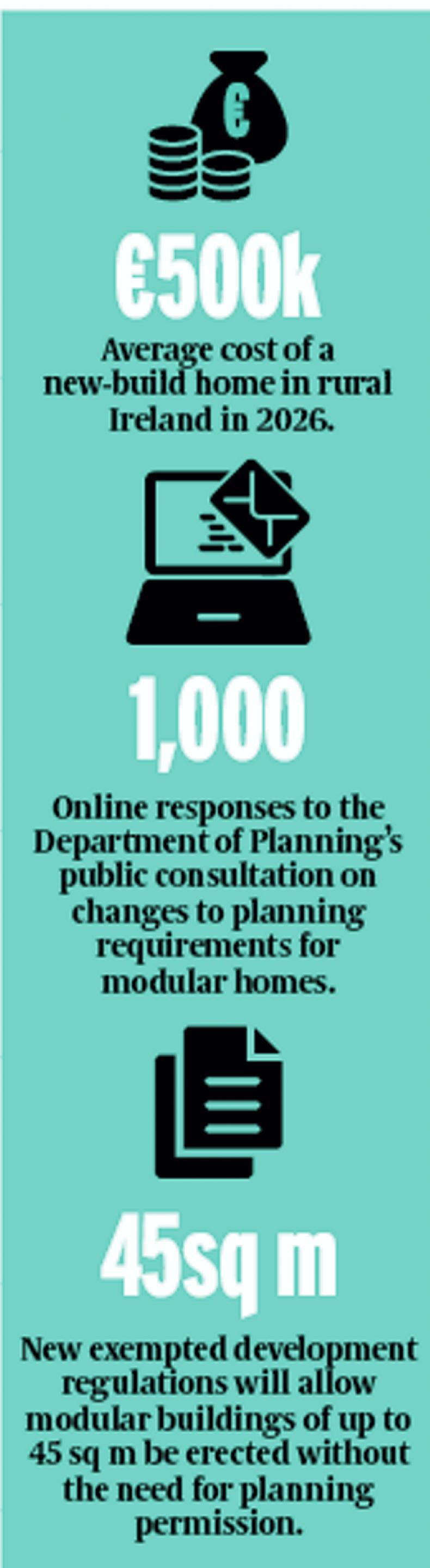
Figure 1.
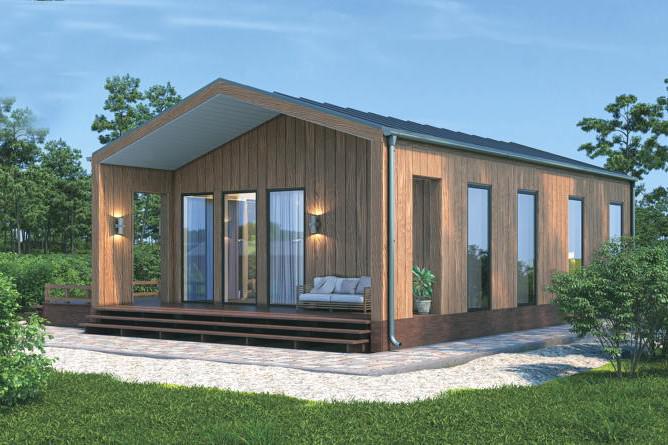
Modular homes are permanent residential dwellings constructed off-site and assembled on a permanent foundation. They can be made from steel, timber, or concrete (frames) and offer improved energy efficiency and faster construction time lines.All buildings must satisfy minimum standards for design, construction and material alterations, as per the Building Control Acts 1990-2014. Key requirements include structural integrity, fire safety, ventilation, and energy performance.
The ongoing lack of supply, coupled with the rising cost of construction, means housing continues to be the biggest issue facing rural Ireland, with younger farmers particularly affected.
Getting a foot on the property ladder has always been a struggle for first time buyers but with more and more adult children returning to their family homes, due to rising rents, insecure tenancies and no sign of property prices plateauing, the odds are stacked against many trying to afford a home of their own.
Government efforts to relax planning conditions for smaller dwellings, such as modular homes and home extensions were announced last April by Minister of State for Local Government and Planning, John Cummins.
The Waterford TD has proposed an exemption on planning permissions for stand-alone structures, which currently require permission if they are larger than 25sq m. The Minister wants to increase this to 45 sq m, five sq m larger than the current maximum for an extension on to an existing property.
The new regulations were due to be implemented by the end of last year, but it is now expected it will be closer to the summer before any changes are made to planning laws.
Removing red tape
Speaking in the Dáil last week, Minister Cummins acknowledged that the measures are not a solution to the housing crisis, but says they will help to make the current planning process more flexible.
“I have never once said that this is a solution to the housing crisis, this is about providing options for people where they feel it appropriate,” he said.
“There will be restrictions and limitations across a number of areas and they are being worked through. The positive interaction of the public with the public consultation that took place in relation to these exemptions has been very welcome.
“We have received significant support for these measures to allow modular-style homes up to 45 sq m to the rear of the dwelling, particularly from people with disabilities. They have told us this would be life changing as it would allow them to live independently but with family in close proximity for support.”
Minister Cummins says that until the new laws are enacted, the existing planning requirements remain in place for all dwellings.
“We have indicated our intention to bring forward this proposal but we haven’t set out the exact parameters of that. The current rules in terms of planning are in place until they are exempt and I have indicated that to the joint Oireachtas committee.
“This is a proactive and sensible approach to providing options for people where they choose, and who is anybody to tell somebody that this is not an appropriate option for them if they choose to progress a home of this nature?
“It is about removing red tape from the planning system so that planning authorities can actually deal with important planning applications and introduce flexibility and common sense to the planning system.”
John Cummins TD, Minister for Planning and Local Government.
One rural couple’s experience
One couple who have decided to go down the modular home route are Isobel Hyland (29) from Athy, Co Kildare and her partner Des Booth from Castlecomer, Co Kilkenny.
Currently living separately in their family homes, the couple hope that by opting for a log cabin they will be living together in their new home by the summer.
“We have opted for a three-bedroom log cabin over a traditional house because we are putting the cabin on my boyfriend’s family farm as he will eventually take over the farm. It didn’t make sense for us to build a house when Des is the youngest and he’ll inherit the family home,” she explains.
“We didn’t want to put the guts of half a million euro into building a home that we can’t afford. Also, we don’t want to be tied down with a mortgage for the bones of 35 years.”
Isobel concedes that the couple are fortunate that they have a site and says their other main motivation for choosing the log cabin was a quick lead in time to securing their first home.
“It is obviously handy that Des lives on a farm and we have the land. We could have built a house but that wasn’t something we were ready for. We live separately at the minute and we wanted to do something that could happen relatively quickly.
“I felt overwhelmed by the thought of building a house even though I am 29, and that is the age you probably do it but I still don’t feel I am at the stage where I should be making these decisions. It was just daunting.”
Isobel says it was hard to get feedback from others who have gone down the modular home route as many people are going ahead with projects where they have not secured planning permission.
“Before we started this process, I didn’t know a lot about modular homes other than what we saw online,” she says.
“While there are so many out there, not a lot of people have planning permission that I know of anyway. We would have liked to have known more but people are very hush, hush and not very forthcoming about it. The ones we do know about aren’t visible from the road.
“Once I started to say I was doing it, I had people tell me about their family or friends who have done it too.
Des Booth and Isobel Hyland,with her dog Ruby. The couple are building their first home, a log cabin, on land at Des' farm in Castlecomer, Co Kilkenny.
“My boyfriend’s friend and his girlfriend went down the log cabin route, with the same company we are using, so when we looked at theirs last March, we were sold on it. We always liked the look of the cabins and after visiting a few showrooms we made the decision that this was the right option for us.”
While she and Des knew the size of their log cabin would require permission from the local authority, the couple found the whole planning experience frustrating and time consuming.
“It took six months to get our planning, it came through just before Christmas,” she adds.
“We started 4 July 2025, and had to go back three times to Kilkenny County Council’s planning section with more information. The hold ups had nothing to do with the cabin itself, it was all to do with Uisce Eireann’s water connection and proving that Des owned the land.
“We will have a shared entrance with the farm so there was no issue with the road, but it took weeks to get the information we needed and then having to wait 30 days for an answer after each submission was very frustrating.”
Public consultation
Isobel said both her and Des’ families have been very supportive of their decision and said the cost saving in opting for a log cabin over a conventional home made it a “no brainer”.
“Our families are all for it, they don’t see why we wouldn’t go down this route when it is literally the quarter of a price of buying a house, it’s a no brainer,” she says.
“The other option was to buy a three bed semi-detached house in an estate in Athy for €450,000, so there’s no comparison. By the end of this process I would say we will have spent in and around €100,000 so it’s not really cheap either.”
A spokesperson for the Department of Housing said significant progress has been made on the review of exempted development.
“A successful public consultation was undertaken last summer. There was significant engagement with the public and relevant stakeholders on exempted development regulations, with almost 1,000 submissions received via an online consultation portal,” he said.
“These submissions have been reviewed and will inform the new draft of Exempted Development Regulations, which will be implemented on a phased basis, by theme, with the exemptions relating to domestic dwellings, including modular-style homes being prioritised for publication early this year.”
It is intended that new Regulations under the Planning and Development Act 2024 (Act of 2024) will be signed into law in tandem with the commencement of Part 2 and Part 4 of the Act of 2024, and the updated exempted development provisions will form part of the new regulations.
Figure 1.
Modular homes are permanent residential dwellings constructed off-site and assembled on a permanent foundation. They can be made from steel, timber, or concrete (frames) and offer improved energy efficiency and faster construction time lines.All buildings must satisfy minimum standards for design, construction and material alterations, as per the Building Control Acts 1990-2014. Key requirements include structural integrity, fire safety, ventilation, and energy performance. 




SHARING OPTIONS