



Last week I met up with Donal Crowley of Roadstone Ltd to discuss the issue of best practice in the use of concrete. Donal is the company’s national technical manager – in plain language, his focus is on the specification and quality of the concrete put out by its 23 batching plants and on how the concrete is subsequently used on site. He knows concrete and in particular has a passion that it is poured and laid correctly so as to give the buyer all the strength, durability and long working life that he or she is paying for. Donal will be giving presentations each day on the Roadstone stand at the Ploughing on this subject. He will highlight good practice but also outline bad practice and he will answer questions on technical matters. Here I outline some of the issues he will touch on.
The mix
The strength of concrete is largely dependent on the material put into it, particularly the amount of cement and water. Buyers are protected by EU standards which, if adhered to, guarantee quality. The Irish and EU standard in question is EN206. It governs all aspects of concrete production including minimum cement content per m3 for various applications.
Irish farmers have the additional benefit of the specification laid down by the Department of Agriculture to enable concrete cope with the particular demands of silage acid and slurry. Donal said it is possible to produce 35N or 40N concrete mixes without complying with Department or even the EU specifications.
However, concrete made to these specifications is made to standards that ensure higher performance. A typical 35N concrete will consist of (by weight) 43% coarse aggregate, 37% fine aggregate, 13% cement and 7% water (see Figure 1). All these constituents have to meet exacting specifications, even the water.
It will also contain admixtures. These are added mainly to improve the properties of fresh concrete, while it is being laid, and to enhance its performance when hardened. For example, plasticiser can be added to make a concrete mixed more fluid and workable.
An admixture can be added to delay setting and hardening or, conversely, a different one could be added to accelerate the setting and hardening process. Continual progress is being made in development of new admixtures with higher performance. Concrete will also contain entrapped air which enters in the batching phase when ingredients are being mixed.
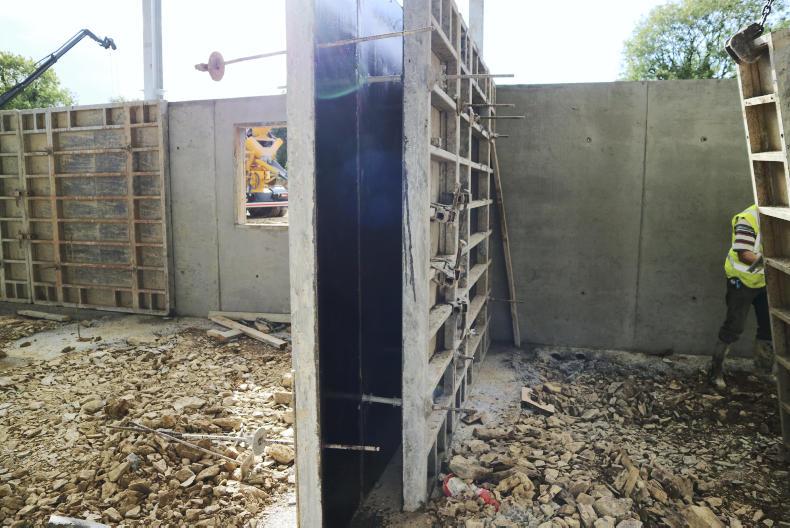
Excess air bubbles weaken concrete and must be removed by vibration during the pour. It is relatively easy to remove air bubbles from a yard or floor slab with a vibrating screed. A slab is typically just 4in to 8in deep so the air bubbles do not have too far to travel to reach the surface. However, more effort is required when pouring a wall to get excess trapped air out. The correct practice is to pour concrete in layers of approximately 400mm deep and to vibrate the layer with a poker vibrator before pouring the next layer.
The mortal sins
Donal outlined the four main types of poor practice which result in less than optimum concrete. “These are ordering the wrong mix, adding water on site, poor vibration and no curing.”
The concrete mix ordered from a batching plant must be suited for the job on hand. For example, if the concrete is to be poured into complex wall areas with a lot of steel reinforcing bars, a manufacturer could adjust the mix to increase the slump to make it more pourable. This could be done by using an admixture and reducing the aggregate size to 10mm.
Adding water on site, from the water tank on the concrete lorry, can seriously reduce the strength and durability of concrete. Contractors or work teams used routinely ask the lorry driver to add water to make the concrete more workable. This made pouring the slab easier and perhaps quicker. It helped if the team were tired or shorthanded relative to the amount of concrete to be poured that day. It also slowed down the hardening of the concrete and therefore gave the crew more time to get a slab or wall finished.
A decade ago manufacturers introduced a requirement that the site manager/owner had to sign the delivery docket accepting responsibility for any reduced quality, before a driver would add water. This, and greater awareness of good practice, have led to a reduction in the practice – but it still takes place. The best way to cut out this practice is to educate the customer of the downsides of adding water on site to expensive concrete.
If a contractor or work team want very workable concrete this can and should be ordered and made accordingly in the batching plant by adjusting aggregate size or adding plasticiser. Plasticiser can be added on site.
This might arise if there were delays on site slowing the pour or if the truck was delayed in traffic or the day became warm, accelerating hardening of the concrete. Adding plasticiser on site will increase workability of the mix but not decrease its strength.
Poor vibration
Poor vibration tends to be more of a problem for shuttered walls than for open slab areas. There is plenty of access to the slab area to vibrate the concrete. One pass of a vibrating screed is usually sufficient to vibrate a slab area, Donal said. In contrast presence of the shutters makes it less easy to vibrate the concrete in a wall pour. A poker vibrator is used which impacts on a relatively small area of the poured concrete.
It’s hard to get effective vibration under the tie-bars which hold the shutters in place. Poor vibration leads to voids and honeycombing which can mean a weakened structure, potential for leaks and which look unsightly.
Curing
Curing involves protecting the surface of the newly poured concrete from premature drying out. If it does dry out too fast, the surface layer will not achieve its potential hardness. The strength of the whole slab is now reduced. The top surface may be at risk of damage under heavy machinery or aggressive materials such as silage acid or animal slurry.
Figure 4 shows the importance of curing on strength of concrete. Curing is a more important issue with open floor slabs that with shuttered walls. The shutters are left in place for the first 24 hours, at least, giving protection to the wall surface for that length of time. Curing can be done in a number of ways. This includes repeatedly wetting the newly laid slab with a water hose. It can be covered with plastic sheeting, straw or other materials – while wet - to keep it damp. The slab can be sprayed with a curing compound, via a knapsack sprayer, and this will prevent the moisture from evaporating.
The effects of poor practice on the strength of concrete are shown in Figure 2. A concrete mix arrives on the farm with potential to reach 35N strength after 28 days. At the request of the contractor or his team water is added – a total of 25 litres (approximately 5 gals) per m3 of concrete. This reduces the 28-day strength of the concrete by 6N/mm2. The potential strength of the concrete at 28 days has now been reduced from 35N to 29N.
In addition, the slab is not cured properly and instead is allowed to dry out in a warm breeze. This results in a 30% loss in strength. The potential 28-day strength of the concrete is this slab is now cut to just 20N. Poor practice like this on site can lead to catastrophic failure of farm structures such as underground tanks, Donal said.
When 35N concrete arrives on farm it is soft, with no strength. “Some people think that 35N concrete is 35N the next day. It’s not – it takes 28 days to reach full design strength. After three days concrete will have reached 50% of its 28-day strength. After seven days it will have reached 75% of its strength. After 28 days it will be at close to 100% of final strength.
Concrete can continue to slowly strengthen further, over many years. Indeed, contractors who groove concrete to give grip to dairy cows are familiar with the phenomenon of old yard or shed floors that have become so hard that they are difficult to groove.
Donal said that three type of fibres are now in use in concrete. Polypropylene fibres can help reduce plastic shrinkage cracking. But they do not increase structural strength. “Plastic shrinkage is not structural,” said Donal, “it’s cosmetic. The way to treat it is to brush in neat cement powder. It will then self-heal as there is still enough water present.
“We supply steel fibres, mainly for industrial sites. They are included at a rate of 20k to 40kg per cubic metre and become dispersed in the full depth of the slab. “They are used in a few farming applications, for example roadway, at 20kg rate. Steel fibres increase the structural strength of a concrete structure and can replace reinforcing steel in flat slab areas. Steel fibres cost up to €40 per cubic metre.”
The final type is high-performance plastic fibres. “These give strength without the downsides of steel fibres. Steel fibres must be compacted down from the top surface or they rust and look unsightly.





SHARING OPTIONS