



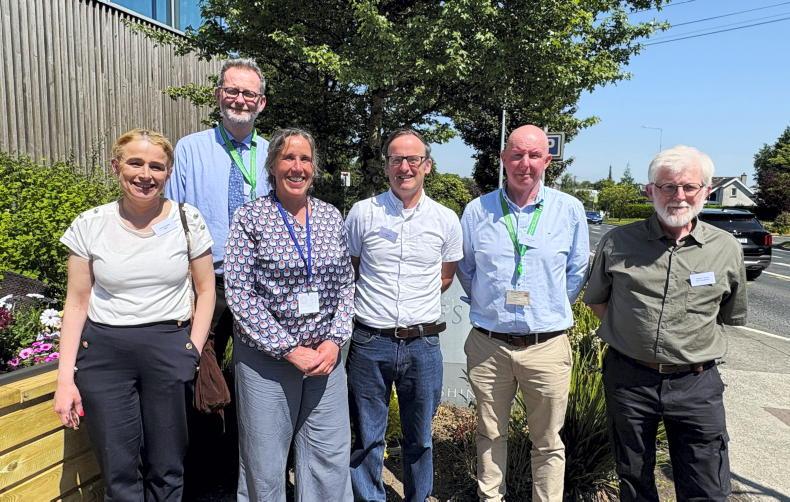
Last week, foresters from around the country met in the Killeshin Hotel, Portlaoise, to attend a workshop on iPLAN, which is the new electronic forest planning scheme to achieve standardised online forest management plans (FMPs) for private forest owners. While standardised FMPs are essential in their own right, the iPLAN scheme is designed to create forest certification compliant plans (see panel). The workshop was organised by the Irish Forest Owners (IFO) in partnership with the Department of Agriculture, Food and the Marine (DAFM).
Achieving forest certification is now essential for all owners of forests at or approaching the productive phase, which could be as early as year 12 to allow sufficient time to achieve roading and felling licences before operations begin.
Workshop presenters outlined the various steps in achieving an iPLAN whose objectives are to:
Questions from the participants demonstrated that iPLAN is a workable scheme and flexible enough to allow for changes as it develops. Having an iPLAN does not guarantee certification for forest owners in producer groups, but the details in the scheme, as outlined by DAFM officials, Kathleen Lucey, IFO and forestry consultant Padraig O’Tuama, tick virtually all the boxes required for PEFC, FSC or dual certification.
For example, the plan requires details on ownership, species, compartment and sub-compartment divisions, forest history, inventory data, harvest and road plans, biodiversity, bio features, water catchments and work plan as required for certification.
Foresters who are used to producing FMPs will be familiar with these, but now the iPLAN provides a standardised document which offers clarity to foresters, forest owners, Forest Service inspectors, certification auditors, timber buyers, contractors and other stakeholders that interact with the forest from time to time, including ecologists and archaeologists.
These will be able to avail of forest maps with detailed information on landscape designation, water catchments, biodiversity, harvesting plan and long-term forest restructuring.
Department officials are confident it will provide enhanced forest resilience to a wide range of threats, such as wind, storms, pest, disease and fire, if implemented properly. It should also encourage greater mobilisation of timber by forest owners in facilitating the timely scheduling of forest operations.
As it progresses over five-year cycles, it should also provide vital national data on harvesting volumes and reforestation for the private sector which is lacking at present.
Alongside support for Knowledge Transfer Groups, the journey towards a national group certification scheme is now underway.
In brief
When former Minister of State Michael Healy-Rae launched the iPLAN forestry scheme last November, he stressed its importance “to enable easier access to forest certification” for private forest owners. This theme was taken up by Kathleen Lucey, group certification manager, IFO at the workshop. She told the audience that “only 35,834ha of private forests are certified” out of a 411,394ha private forest estate. All Coillte, Northern Ireland Forest Service and IForUT forests are certified but only two group schemes operate on behalf of private forest owners.
Forest certification verifies that forests and woodlands are managed according to principles of sustainable forest management (SFM). Certified forest are independently inspected and evaluated according to strict environmental, social and economic principles and criteria as agreed by an internationally recognised accredited certification body.
Timber processors – sawmills and board mills – that have chain of custody (CoC) certification must be able to demonstrate to customers, especially in export markets, that at least 70% of timber comes from certified forests. As timber from privately owned forests increases, some mills are at the 70% threshold already, so cannot purchase anymore from uncertified forests.
As a result, the pressure is on all growers with productive forest to achieve certification if they wish to maximise their market share when selling timber to sawmills and other processing mills with CoC certification. Without certification, sales outlets will be restricted to small non-exporting sawmills, with less than 5% market share.
The only way to achieve certification is through a group scheme, as the cost is too prohibitive for individual forest owners. And the only way forest owner groups can provide certification is to have sufficient numbers of owners with forest management plans (FMPs) through the iPLAN scheme.
This template provides a standardised management plan, which is recognised by DAFM and independent auditors.
iPLAN is open to all forest owners, but those with plantations approaching production should seriously consider contacting a registered forester – forestry consultant or forestry company – to complete an iPLAN. There is no charge to the forest owners, as the cost – €1,200/plan – is covered by DAFM.
There is a wide range of information options available to those who wish to avail of certification. Information sheets, produced by Mechteld Schuller, ITGA can be downloaded (www.groupcertification.ie) while IFO provides information on its group scheme (irishforestowners.com). Google iPLAN forestry to access further information.
The winners of the Forest Industries Ireland (FII) Future Timber Design Awards were announced recently at University of Galway.
“The projects focused on using homegrown timber as the key structural material, keeping in mind real-world challenges or design constraints,” said Des O’Toole, head of marketing and promotion at Coillte Forest.
Six students received awards for projects ranging from cross-laminated timber use to specifying home-grown timber in sustainable construction.

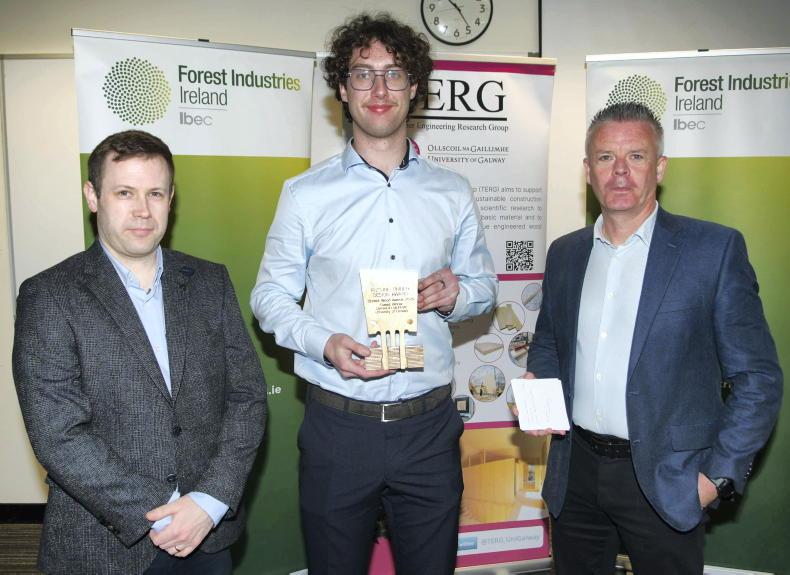
The overall winner was Diarmuid Murray, a master of engineering (civil) student, for his project on addressing the growing need for improved onshore facilities at a local sailing club. He created comprehensive timber building designs for a clubhouse, boat shed and pavilion. He also incorporated an innovative sensing system for timber elements, a biodiverse green roof and solar panels contributing to on-site renewable energy.



SHARING OPTIONS