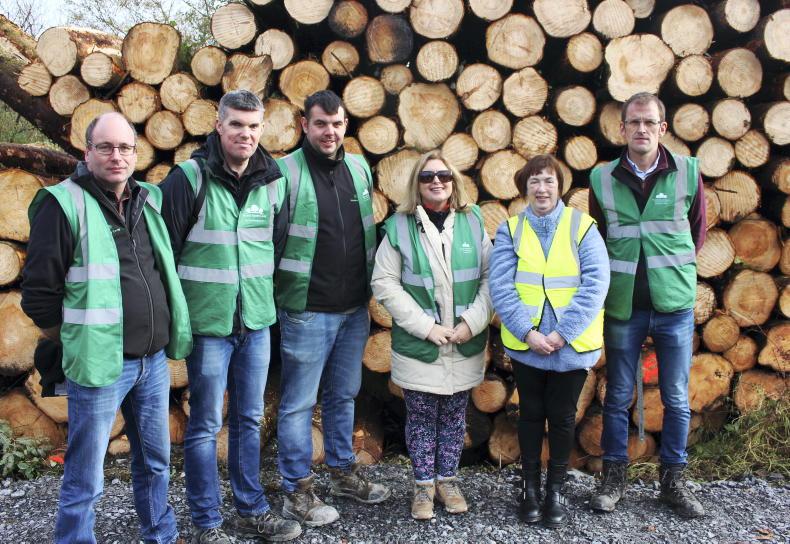
The enormous challenges facing forest owners in the aftermath of storm Éowyn were demonstrated recently in two Co Sligo forests, during a field day organised by Western Forestry Co-op (WFC) and the Irish Timber Growers Association (ITGA). The forests, owned by Verena Bailey and Martin Beirne, are typical of the private windblown forests that need to address the following post-storm issues:
Windblow planning, site preparation.Selling and harvesting windblow. Replanting the windblown areas.Although 65% of windblown sites have felling licences, many sites still require both felling and roading licences. These are being fast-tracked by DAFM, but once approved the real work begins in accessing windblown sites. Where roads are needed, these have to be constructed to the highest standards, regardless of property size, requiring sufficient loading bays, turning areas and bellmouth entrances when exiting at public roads, unlike other European countries, where logs are loaded on public roads after major storm damage.
Selling and harvesting
Access was already in place in Verena Bailey’s windblown forest outside Coolaney. In all, she has 14ha of forests.
“The forest is fragmented and as five out of six plots had more than 50% of the area blown, all trees need to be removed,” said Victor Barber, harvesting manager with WFC. In large forest compartments, typical of the Coillte estate, harvesters can return later to remove the remaining standing trees. Private owners don’t have the same flexibility, as the average forest size is 7.5ha. In the case of Verena Bailey’s forest, returning to harvest isolated blocks of standing trees at a later date would be cost prohibitive, while the remaining crop would be vulnerable to further windblow.
Selling and harvesting go hand in hand as outlined by Victor Barber.
“You have to join the two together – unless you have a buyer, you don’t harvest,” he said. Log purchasers still include sawmills, board mills and wood energy outlets, but WFC now rely on exports. He acknowledged the sawmills and Bord na Mona (BnM) for increasing intake from private sales especially in the immediate aftermath of storm Éowyn, but their mills and storage depots are now full.
However, he said the prices paid by sawmills during the early period after the storm were important in setting a baseline for European traders to follow.
Maximising revenue depends on securing the best price from exporters. “In this respect, the harvesting crew are the most important people” in the value chain, he said. WFC directly employ harvesters, such as Raitis Vietnieks and David Crowley, both experienced timber harvesters operating in WFC managed forests.
They’re main objective is to maximise the quality of log category sizes for the forest owner.
“The lazy decision is to cut the timber in to pulpwood, but the harvesters here maximise sawlog,” said Victor Barber. “This means assessing log quality quickly for size and straightness, to maximise medium to large sawlog output.”
WFC had to adapt quickly to demand from export agents log requirements. Once the decision is made to export, there is no going back as European log dimension are different from Irish and UK markets.
Pulp and stake are still measured in tonnes regardless of market but large sawlog is purchased by m3 measured under bark. Irish measurement by tonne is proving to be contentious, especially for windblow, as the conversion factor of 1.16 to the tonne had increased to 1.4 by the end of what was a very dry summer.

Victor Barber, WFC with forest harvesters Raitis Vietnieks and David Crowley who are employed by WRC to carry out its felling and extraction programme. \Donal Magner

R&W Contractors, chipping lop and top in Martin Beirne's forest near Sooey, making the site easier to replant after storm damage. \ Donal Magner
Replanting windblown areas
The second site visited during the Sligo field day explored the challenges in restoring and replanting the windblown forest owned by Martin Beirne who is also a forestry technician with WFC, specialising in afforestation and reforestation. Removing lop and top or brash after clearfelling was important to provide a more accessible and better quality site for planting contractors to work in. During the field day, removed brash was being chipped on site for energy generation by William Nobel, R&W Contractors – the Enniskillen based company owned by the Nobel family.
William Nobel outlined the difficulties in processing this material, particularly in a wet site where larger than usual brash mats had to be placed on the harvester extraction tracks to protect the forest surface soils from damage. A greater proportion of these had to be left on site compared with a normal clearfell, as they had too high a proportion of soil and stones, which damage the onsite chipper.
While the chipped material provides no income for the forest owners, the lop and top removal was important in providing a more replanting-friendly site as outlined by Colm Gilheaney, WFC establishment manager.
“Labour is the biggest challenge when replanting, so we need to make it as easy as possible to plant the site,” he said. “Good access is needed, so distribution of plants by quad bikes is important in this work.”
“In my experience the removal of brash, also reduces the potential of pine weevil damage, when accompanied by planting chemically treated plants in the nursery,” said Donal Whelan, ITGA technical director. He maintained that lop and top left on site can be an additional breeding habitat for the weevil, which is the biggest threat in replanting sites.
Tree species selection in windblown sites was discussed at the Sooey site.
“I don’t gamble, but I will go with Sitka again as I want a commercial crop, but I will plant 20% broadleaves, which is my bit for the environment,” said Martin Beirne.

Colm Gilheaney, WFC establishment manager outlines the challenges in restoring and replanting windblown forests at Sooey. \ Donal Magner

Donal Whelan, technical director, ITGA makes a presentation to Martin Beirne, who welcomed field day visitors to his windblown forest at Sooey. \ Donal Magner
Reconstitution grant
Victor Barber said that timber is being removed and sold but will take well into 2027 to complete this operation.
“The storm has been disastrous for forest owners with virtually no income from forests in the 20-year-old age group”, he said. “Even in productive forests up to 25 years, income is at best €5,000/ha compared with €20,000ha for 30-year-old standing crops.”
The promise of a reconstitution grant is encouraging, he added, but “it’s implementation needs to be simple, fast and flexible”. The view of the field day attendance was that the reconstitution scheme should reflect the harvested area – both blown trees and standing trees that need to be felled – rather than going through a mapping exercise of isolating blown trees. One member of the audience pointed out that there was precedence for this approach, when a reconstitution scheme was applied to windblown forests damaged by the St Stephen’s Day storm in 1998.
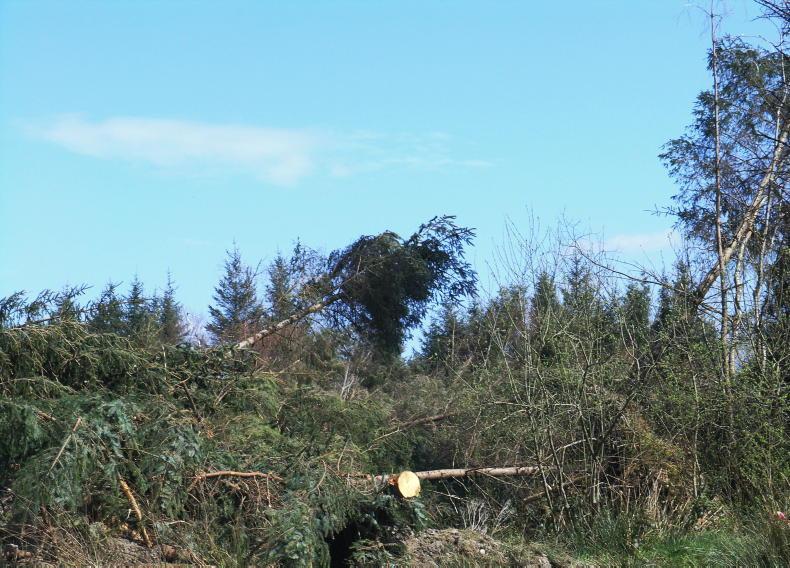
The enormous challenges facing forest owners in the aftermath of storm Éowyn were demonstrated recently in two Co Sligo forests, during a field day organised by Western Forestry Co-op (WFC) and the Irish Timber Growers Association (ITGA). The forests, owned by Verena Bailey and Martin Beirne, are typical of the private windblown forests that need to address the following post-storm issues:
Windblow planning, site preparation.Selling and harvesting windblow. Replanting the windblown areas.Although 65% of windblown sites have felling licences, many sites still require both felling and roading licences. These are being fast-tracked by DAFM, but once approved the real work begins in accessing windblown sites. Where roads are needed, these have to be constructed to the highest standards, regardless of property size, requiring sufficient loading bays, turning areas and bellmouth entrances when exiting at public roads, unlike other European countries, where logs are loaded on public roads after major storm damage.
Selling and harvesting
Access was already in place in Verena Bailey’s windblown forest outside Coolaney. In all, she has 14ha of forests.
“The forest is fragmented and as five out of six plots had more than 50% of the area blown, all trees need to be removed,” said Victor Barber, harvesting manager with WFC. In large forest compartments, typical of the Coillte estate, harvesters can return later to remove the remaining standing trees. Private owners don’t have the same flexibility, as the average forest size is 7.5ha. In the case of Verena Bailey’s forest, returning to harvest isolated blocks of standing trees at a later date would be cost prohibitive, while the remaining crop would be vulnerable to further windblow.
Selling and harvesting go hand in hand as outlined by Victor Barber.
“You have to join the two together – unless you have a buyer, you don’t harvest,” he said. Log purchasers still include sawmills, board mills and wood energy outlets, but WFC now rely on exports. He acknowledged the sawmills and Bord na Mona (BnM) for increasing intake from private sales especially in the immediate aftermath of storm Éowyn, but their mills and storage depots are now full.
However, he said the prices paid by sawmills during the early period after the storm were important in setting a baseline for European traders to follow.
Maximising revenue depends on securing the best price from exporters. “In this respect, the harvesting crew are the most important people” in the value chain, he said. WFC directly employ harvesters, such as Raitis Vietnieks and David Crowley, both experienced timber harvesters operating in WFC managed forests.
They’re main objective is to maximise the quality of log category sizes for the forest owner.
“The lazy decision is to cut the timber in to pulpwood, but the harvesters here maximise sawlog,” said Victor Barber. “This means assessing log quality quickly for size and straightness, to maximise medium to large sawlog output.”
WFC had to adapt quickly to demand from export agents log requirements. Once the decision is made to export, there is no going back as European log dimension are different from Irish and UK markets.
Pulp and stake are still measured in tonnes regardless of market but large sawlog is purchased by m3 measured under bark. Irish measurement by tonne is proving to be contentious, especially for windblow, as the conversion factor of 1.16 to the tonne had increased to 1.4 by the end of what was a very dry summer.

Victor Barber, WFC with forest harvesters Raitis Vietnieks and David Crowley who are employed by WRC to carry out its felling and extraction programme. \Donal Magner

R&W Contractors, chipping lop and top in Martin Beirne's forest near Sooey, making the site easier to replant after storm damage. \ Donal Magner
Replanting windblown areas
The second site visited during the Sligo field day explored the challenges in restoring and replanting the windblown forest owned by Martin Beirne who is also a forestry technician with WFC, specialising in afforestation and reforestation. Removing lop and top or brash after clearfelling was important to provide a more accessible and better quality site for planting contractors to work in. During the field day, removed brash was being chipped on site for energy generation by William Nobel, R&W Contractors – the Enniskillen based company owned by the Nobel family.
William Nobel outlined the difficulties in processing this material, particularly in a wet site where larger than usual brash mats had to be placed on the harvester extraction tracks to protect the forest surface soils from damage. A greater proportion of these had to be left on site compared with a normal clearfell, as they had too high a proportion of soil and stones, which damage the onsite chipper.
While the chipped material provides no income for the forest owners, the lop and top removal was important in providing a more replanting-friendly site as outlined by Colm Gilheaney, WFC establishment manager.
“Labour is the biggest challenge when replanting, so we need to make it as easy as possible to plant the site,” he said. “Good access is needed, so distribution of plants by quad bikes is important in this work.”
“In my experience the removal of brash, also reduces the potential of pine weevil damage, when accompanied by planting chemically treated plants in the nursery,” said Donal Whelan, ITGA technical director. He maintained that lop and top left on site can be an additional breeding habitat for the weevil, which is the biggest threat in replanting sites.
Tree species selection in windblown sites was discussed at the Sooey site.
“I don’t gamble, but I will go with Sitka again as I want a commercial crop, but I will plant 20% broadleaves, which is my bit for the environment,” said Martin Beirne.

Colm Gilheaney, WFC establishment manager outlines the challenges in restoring and replanting windblown forests at Sooey. \ Donal Magner

Donal Whelan, technical director, ITGA makes a presentation to Martin Beirne, who welcomed field day visitors to his windblown forest at Sooey. \ Donal Magner
Reconstitution grant
Victor Barber said that timber is being removed and sold but will take well into 2027 to complete this operation.
“The storm has been disastrous for forest owners with virtually no income from forests in the 20-year-old age group”, he said. “Even in productive forests up to 25 years, income is at best €5,000/ha compared with €20,000ha for 30-year-old standing crops.”
The promise of a reconstitution grant is encouraging, he added, but “it’s implementation needs to be simple, fast and flexible”. The view of the field day attendance was that the reconstitution scheme should reflect the harvested area – both blown trees and standing trees that need to be felled – rather than going through a mapping exercise of isolating blown trees. One member of the audience pointed out that there was precedence for this approach, when a reconstitution scheme was applied to windblown forests damaged by the St Stephen’s Day storm in 1998.
SHARING OPTIONS