



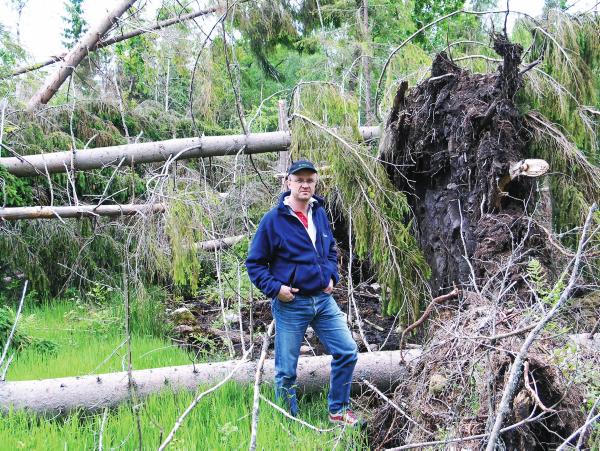
Over 200 million trees were felled on the night of 8-9 January, during the worst storm in living memory.
Soon after the train crossed the 8km Oresund Bridge that links Denmark to Sweden and made its way north to my first stop, Hasselholm, the enormity of the challenge facing Sweden’s forestry and forest products industry quickly became obvious.
Mile after mile of trees were strewn on the forest floor, while most of the remaining stems had been shattered like matchsticks. Already, fields were stockpiled with logs, which acted as temporary storage depots, some containing over 700,000m3 of logs. Rather than flood the market with cheap timber, the Swedes stored the logs and preserved them using sprinkling systems to keep the timber wet, to preserve it for up to two years.
As a result, the timber was released into the market in an orderly way. Although the storm damage represents a quarter of a century harvesting in Irish forests, it was little more than one year’s cut in Sweden.
Now, eight years later, I am making the same journey, this time in the company of members of the Society of Irish Foresters. As we travel through the flat forested terrain of Götaland, there is little indication of the damage caused by the storm, which reached hurricane proportions on that fateful night.
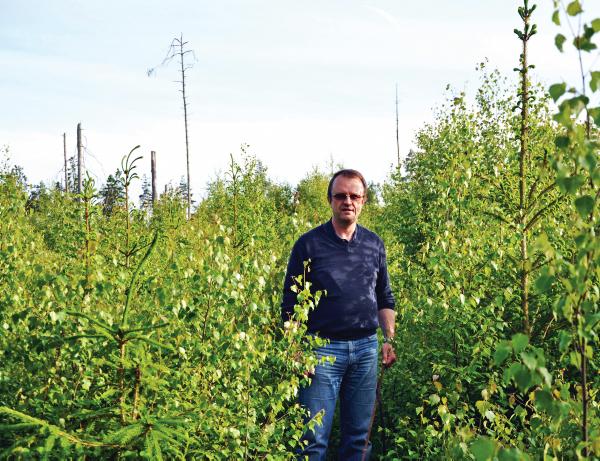
To the forester’s eye, the large tracts of young forests provide clues that this is a landscape that has been thrown dramatically off kilter in the recent past. The age profile of the mainly Norway spruce and the competing naturally regenerating birch indicate that a large-scale reforestation programme has been carried out only a few years previously.
SALVAGE
Within days of the storm, the salvaging operation was under way. The salvaging process was tackled with a mixture of Swedish efficiency, resilience and co-operation between all stakeholders. Sveaskog, the State forestry company, Södra, the private forestry association, co-operatives and other stakeholders collaborated in a massive concerted national salvage operation. Timber needed to be removed rapidly before it began to decay and to avoid massive further damage by increased infestation of spruce bark beetle (Ips typographus).
A huge drive to remove the timber required the help of the harvesting sector throughout Sweden and abroad. Harvesting was delayed in northern Sweden as machine operators headed south to help their compatriots.
Some 4,000 employees from 16 countries – including Ireland – relocated their harvesters, extraction units and trucks to Sweden. While I was there, I visited terminals where 100 trucks delivered timber around the clock carrying enormous loads. The Swedish government had introduced emergency legislation allowing the transportation of above average load weights.
Within 10 months, an estimated 50m m3 had been salvaged and almost all timber was removed by mid-2006
During my stay in Sweden in 2005, the social and economic implications of the disaster were apparent everywhere. Forestry is a way of life in Sweden, which has 66% forest cover. Total tree cover is 27m ha, including 23m ha of productive forests.
The state and forestry companies own half the forests, with the remainder owned by farmers and other landowners. However, state and large-scale companies are heavily concentrated in northern Sweden, while most of the forests in the south are privately owned farm forests, which is where all the storm devastation occurred.
In 2005, I heard harrowing accounts of farmers who had restored plantations after the storms of the 1960s and had once again witnessed the destruction of the reforested crops. Many owners faced bankruptcy, especially those who had no insurance. However, most of the stories were positive as owners reacted quickly to the catastrophe.
Mats Löfgren, who has a 38ha holding – including 30ha of forest – near Vederslöv, adopted this approach. While 10ha of his forest was blown, it represented 70% of the growing stock because the worst damage was in the high volume older stands of Norway spruce, some of which were almost 100 years old.
When I met Mats in 2005, he described how he and his neighbours cleared the blown trees from the roads around Vederslöv to allow access by ambulances and other emergency services. He then concentrated on harvesting the blown trees.
Mats is not totally dependent on the forest and works as a forest adviser and was also fortunate to be among the 25% of owners who had their forests insured.
Despite the national effort to harvest all blown areas, Mats realised that it would be some time before harvesters reached Vederslöv, so he and his neighbours pooled their resources to carry out their own harvesting. “Four of us purchased the machinery and began harvesting in 2005,” he said. “We then sold on the machinery after harvesting was complete in 2006.”
The 10ha of blown forest yielded 30,000m3 and Mats was in a position to reforest the area by the end of 2005. The price he received for the logs from Södra along with his insurance cover provided an average of €35/m3.
SPECIES
Mats is a member of Södra and the emphasis on greater species diversity is in line with the co-operative’s approach. The species mix comprises 7ha Norway spruce, 1.5ha Sitka spruce, 1ha aspen and 0.5ha beech.
He faces the same problems as most forest owners in removing the vigorously competing birch during reforestation. He cleared the birch with a brushcutter around the reforested trees and believes that two clearances will be sufficient.
Despite the species shift towards diversification, Norway spruce is the main commercial species in Sweden, especially in Götaland where it comprises 49% of the forest area, followed by Scots pine at 29%, while birch cover is estimated at 10%. The remaining 12% includes aspen, oak, beech, mountain ash and other native species, as well as exotics such as Douglas fir and Sitka spruce.
Mats says that the Sitka spruce is not performing as well as the Norway spruce because of frost damage and dry conditions. The average precipitation in this inland area of Sweden is 500 to 600mm compared with 750 to over 1,200mm in Irish forest sites where Sitka is the dominant species.


SHARING OPTIONS