


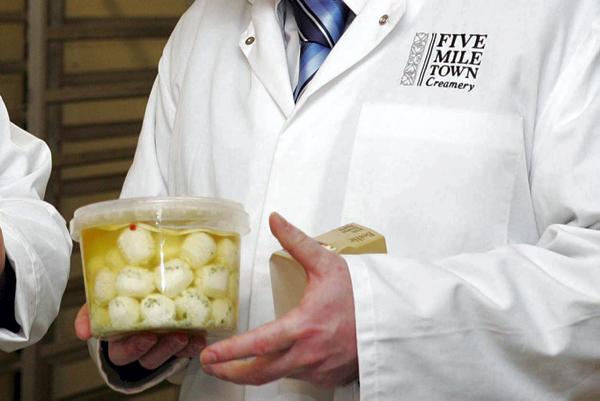
There has been speculation in recent weeks about a possible sale of Fivemiletown Creamery, its milk pool, its cheese brands or its stores business. This speculation has heightened as a number of sales and marketing staff were made redundant in the latter part of 2013. There had been up to three people employed in sales from a base in north Wales, as part of the previous strategy of building sales of speciality cheeses. All of these staff have gone and so has the commercial manager.
Also, over the past year or more, there has been some leakage of suppliers and the business has been trading a significant part of its milk supply rather than processing the milk on site in Fivemiletown. Most recently, the Donegal/Aurivo business has been a major customer. Lakeland Dairies has also bought milk and whey from Fivemiletown and was formerly a customer for cheese.
On enquiry by the Irish Farmers Journal, Guy Simpson, general manager at Fivemiletown, said that negotiations are ongoing to trade milk to processors based in the Republic of Ireland. Simpson added that Fivemiletown is a small business attempting to be a sustainable co-operative in extremely challenging times (of high prices for milk).
The current ‘milk pool’ is believed to be just under 30 million litres per year.
Much of the milk trading is at a time when there has been good demand for milk, driven by some seasonal shortages in Britain and the overall strength of world markets for dairy commodities during the past year. That good demand has been timely for the Fivemiletown Co-op, enabling the business to pay a competitive price for milk purchased from its members and allowing time for the management to consider options for the business.
In 2011, the business published record sales figures and followed this up with the acquisition of Causeway Cheese, a farmhouse cheese business in 2012. However, problems arose when Fivemiletown lost a contract to supply the Kerry Group with cheese curd in spring 2012, a contract that was believed to account for 60% of revenue. This was followed by the resignation of chief executive Mervyn McCaughey in October 2012.
At that time, the company had become renowned for a strong PR and marketing push using social and mainstream media but, since September 2013, these campaigns seem to have dried up.
According to the PR, Fivemiletown had focused on sales of speciality hand-crafted cheeses, targeting independent ‘deli’ outlets and farm shops in Britain, along with wholesalers and major retailers in Britain, Ireland and further afield (including headlines about export customers in New York and Hong Kong).
Could UK milk output exceed quota in 2014-15?
The possibility that Britain could exceed its milk quota in the 2014-15 milk year (the final year of the EU quota system) has been signalled by Town of Monaghan Co-op chief executive, Vincent Gilhawley, in his most recent article in the monthly Farm News that goes to the co-op’s milk suppliers.
This follows a bogus suggestion in Britain that the UK quota could be exceeded in the current milk year ending March 2014, which is impossible. It would require supplies in the January to March quarter of 2014 to be around 5.1 billion litres, which is 60% above the same period of 2013, or 50% above the highest ever UK milk production during those three months.
Latest figures indicate January 2014 supplies were up by around 10.5% and wet weather in early February pegged the increase back to 9.2%. But the chance of milk output filling the UK quota in 2014-15 is not beyond the bounds of possibility, if the weather is favourable and milk prices provide the incentive that is driving production upwards. Recent reports indicate that the milk price-to-feed price ratio is at its most favourable since 2007. It would require a lift of 15% in milk production to put the UK into a superlevy position in 2014-15. New entrants to milk production in Northern Ireland and Britain will add to the output.
Gilhawley points out that, during 2013, milk production in NI during the first six months was down by 4% on the same period of 2012, but the second half of the year saw output 5% above the record levels of 2012.
‘Distress milk’ in England
While world markets for dairy products have remained remarkably strong since July 2013 and Global Dairy Trade internet auction prices indicate similar price levels through to July 2014, there is still a possibility of pressure on prices locally during the peak supply period of April to July. This depends on weather, which can significantly affect production. It also depends on the possibility of ‘distress milk’ being shipped into NI from England, where the available processing facilities could be overstretched.
Milk powder production capacity at the Westbury site, now majority owned by Arla, is being used for drying concentrated skimmed milk brought in from Germany, where Arla Foods has a drying facility out of action following a fire and explosion on site. This ‘temporary’ use of Westbury to process skimmed milk powder (SMP) is said to be likely to go on for up to three months from mid-February.
The resulting SMP from this arrangement will be exported to markets outside the UK.
New exports for Fane Valley
New export business worth more than £40m in China, Indonesia, Algeria, Venezuela, Cuba and Europe has been claimed by Fane Valley Dairies.
The company, which specialises in milk powders, butters and anhydrous milk fat (butter oil), exports products to over 25 countries. The new contracts are a reflection of strong demand for dairy products, particularly in developing economies around the world.
Trevor Lockhart, chief executive, said that population growth, rising incomes and an associated change in diet within the rapidly rising middle class in China and Asia is driving the demand. Lockhart commented on the importance of being able to provide assurances of product safety and traceability. He said that this has been underpinned by the development of Fane Valley’s own direct supply milk pool and a programme of ongoing investment in the quality and functionality of the ‘Mourne Maid’ products.
“While future market returns will be dictated by the extent to which the growth in supply and demand can be kept in balance overall, the future prospects for dairy ingredients both in Europe and around the world looks encouraging,” said Lockhart.






SHARING OPTIONS