Where dairy farmers have repeated problems with Total Bacterial Count (TBC) or thermoduric bacteria, it is important to investigate issues with a milk quality adviser or equipment technician, rather than just increasing the strength of chemicals used, a researcher in dairy hygiene has said.
Addressing an online event organised by the Society of Dairy Technology, Dr Aoife Mulry from Teagasc Moorepark highlighted the various factors which contribute to milk hygiene results on farms.
The starting point is to maintain a clean environment, with cow tails clipped at least three times per year, cubicles properly bedded and teats wiped with individual dry paper towels.
Liners should be changed every 2,000 milkings or every six months, and long tubes replaced every two to three years. Silicon tubes are more durable and should last three to four years.
Water
When it comes to washing equipment, she said it was vital to use clean water.
“If the water is not fit to drink, it is not fit to clean with,” she said.
In some areas, hard water is an issue, with elevated levels of calcium and magnesium reacting with chemicals and reducing their effectiveness, while also leading to a build-up of mineral deposits and milkstone inside equipment. In these cases, it may be necessary to include more acid washes or consider water treatment using softeners or filters.
Residues of fats and protein can also build up inside equipment and along with mineral deposits they provide an ideal environment for bacteria to multiply and grow. Lactose from milk provides a “pure feed” for these bacteria, said the Teagasc researcher.
She outlined how, as bacteria multiply, they develop a protective shell (a biofilm) which is often resistant to disinfectants. This biofilm can harbour pathogens and heat-resistant thermoduric bacteria, which survive the resultant pasteurisation process.
The biofilm will release bacteria into milk, thereby lifting bacterial load while also exposing cows to infections such as mastitis.
Monitoring of the build-up of biofilm should be regularly done at various key areas within the milking plant such as the sanitary trap, the receiver tank and the bulk tank outlet.
“A good indication is also what deposits are in the claw bowl – organic deposits signify that insufficient detergent [alkaline] has been used in your cleaning routine.
“If you run your finger along the inside of the claw, the biofilm of bacteria feels like butter or fat – it will feel slimy,” said Mulry.
On the other hand, mineral deposits in the claw bowl suggest not enough acid is being used and will feel more like chalk or dust when rubbed between the fingers.
Rinse
To properly deal with the build-up of biofilm and scale in the likes of the claw bowl, she maintained that sometimes “old fashioned physical scrubbing” is what will work best.
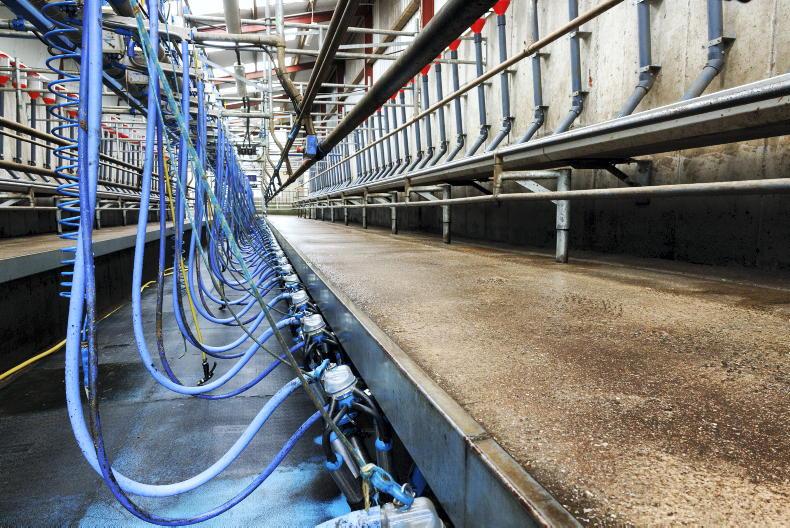
Washing of all equipment should be done immediately after milking, with initial rinse water of 14l per unit and a wash volume of 9l per unit.
“It’s really important to choose the right chemical. You cannot clean with a disinfectant and you cannot disinfectant with a detergent. Check detergent concentration and use correct alkaline and acid products,” she said.
Teagasc recommend at least seven hot washes are done each week to help disrupt fatty solids, with eight to 10 minutes of circulation, starting with water of 75 to 85°C and finishing with water at 45 to 55°C.
Five examples of chlorine-free cleaning routines applicable to different production systems are available on the Teagasc website (teagasc.ie).
Peracetic acid
With the move away from using chlorine, some wash routines now include a final rinse with peracetic acid, as it is the only detergent available that will kill bacteria, said Dr Aoife Mulry. When out on-farm to investigate a high TBC or high thermoduric counts, she said her advice would be to try peracetic acid once all other issues have been corrected. However, she said it should be added in at the evening milking to give it time to evaporate within the milk lines.
“You need to make sure there isn’t the potential of residues entering your bulk tank. It is quite effective at killing bacteria.”
Don’t dither on genomics, NI farmers told
A two-month-old genomically tested heifer will have “deeper, more reliable data” on key traits than a non-tested cow, milking two years, fully milk recorded and classified, Richard Miller from National Milk Records (NMR) told the Society of Dairy Technology online event.
But as well as genomics identifying the best animals for breeding, the widespread use of sexed semen means even more rapid generational progress can be made.
According to Miller, nearly 90% of dairy semen in the UK is now sexed, which is well ahead of other major dairy-producing countries at around 50%.
To illustrate gains made, Miller compared NMR data from genomic tests on UK dairy heifers in 2022 and 2025. Over the period, maintenance requirements, lifespan, feed efficiency, milk yield and milk solids have all significantly improved.
“We are breeding smaller, efficient, high health, high productivity cows – it shouldn’t surprise us they are better for the environment. It really is powering progress,” he said.
“The farms that have been engaged in genomics for quite a while, really are opening up serious daylight from those still dithering and thinking about it. It really is quite stark,” he added.
Miller said each year an additional 10% of UK dairy heifers are being genomically tested, but he expects this to rise sharply due to the Bovine Genetics Programme in NI. More animals tested, means more reliable data.
“This is where it gets exciting, because it is the gift that keeps giving,” he said.
He also pointed out that genomics opens up other possibilities. In fully genomically tested herds, the NMR GenoCells milk test can be used to provide an SCC result for all cows simply from a 40ml milk sample taken from the bulk tank.