



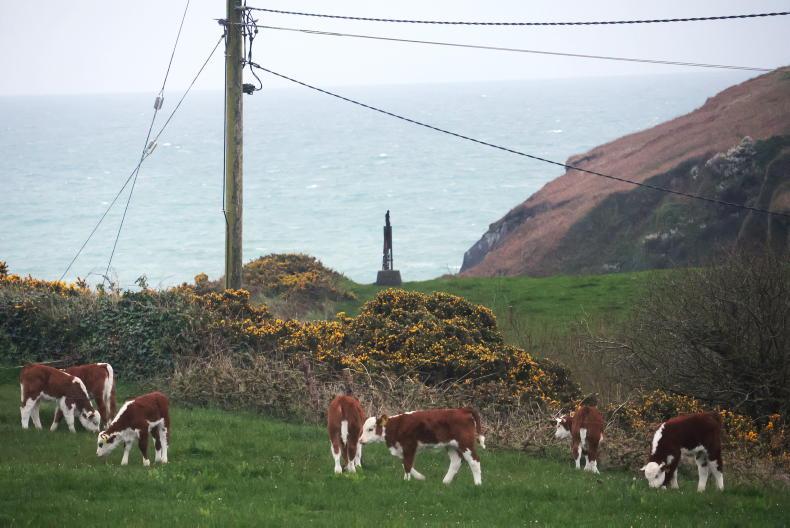
The rain always stops. It’s a little mantra that I find applies to an array of challenging situations, and one that went back to its roots for the past month.
The rainfall recorded by the weather station on Sherkin Island was 375.6mm of rain for the first quarter of the year, which makes it almost double for the same period last year and 45mm above the long-term average figures.
Whether the next three months will balance out the wet spell is unknown, but worth bearing in mind when planning ahead.
Persistant rain meant grazing and housing plans were adapted and hopefully pressure will come off the home ground over the next fortnight as cattle move to the out farm.
Next Sunday will mark week six of calving. The number left to calve is down to single figures now,and there could be a handful left by then.
The frustrating part is those last few may not calve for another few weeks. Most years that’s not much of an issue but after experiencing a compact calving block, dragging out the end isn’t very appealing.
The focus on culling hard for fertility paid off and despite the weather making conditions difficult, it was one of the more enjoyable calving seasons, even allowing for a share of disappointments.
Breeding
The focus now moves to trying to get cows and heifers in good condition ahead of breeding.
The weanling heifers will be held in for another week in order to leave grass build up and, in a shake up of the annual grazing plan, those heifers are staying at home instead of going to the out-farm and a group of dry cows will take their place.
With the exception of a handful of pedigree heifers who will stay with the AI group of cows, every other heifer will go near the village for the summer and a bull will join them in six weeks’ time.
There are a number of reasons for the change. Firstly, replacement options are limited as the ratio of bull to heifer calves last year was 2:1, so all heifers will get a chance. Who is culled will depend on the bull and scanning.
Secondly, every year there is a plan to remove the bull from the heifers, but it gets put on the long finger as moving stock on the road to get to the yard where they are requires at least three people.
As a result, we end up with a heifer or two calving near the end of the season. Keeping them home makes it a one person job.
Most heifers calved in the first three weeks and went out once there was a small window of fine weather. Along with their calves, they experienced some of the worst weather, but sought out the sheltered spots.
As bad as the rain was, experience taught me that sucklers and calves in sheds for too long can be a recipe for disaster.
After toying around with the calving date over the last 15 years, we’re back to where we were in our pre-shed days, starting around the last days of February and tailing off in early April.
There were moments when the rain was lashing down when I questioned whether I should be pushing breeding out by another week, but given the make-up of the farm this seems to work well. Fine tuning to make the system more simplified will be the next focus.



SHARING OPTIONS