



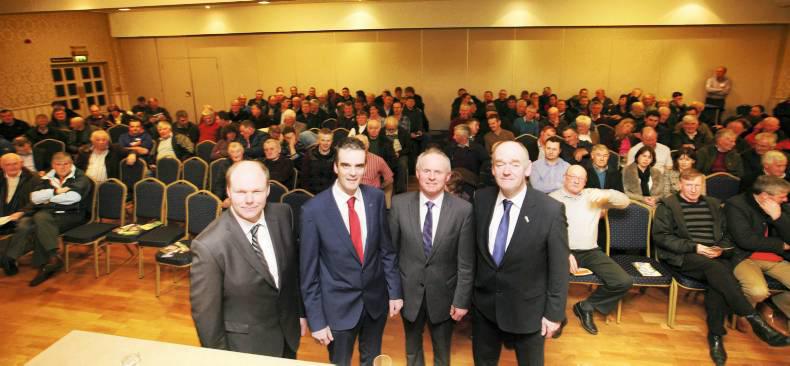
The Dublin husting for the IFA elections was one of the smaller ones in terms of seats and crowd numbers – but it was interesting nonetheless. There was a clear focus on moving forward, on uniting the organisation, on getting it back on the track of fighting for farmers.
Dublin farmers were very clear on what the main focus of IFA and its president and deputy president should be: farm incomes. The issue was touched on by many farmers from the floor.
Farming in this county is probably best known for grain and other field crops. But ironically it was the sheep farmers from the south of the county, on the Dublin hills, who were most vocal. A number spoke of the importance of unity among hill farmers going forward. The candidates pledged to try have this sector better represented in IFA. The problem of dog attacks was also discussed, as was chipping, etc.
Other issues to be discussed included milk supply agreements, prices, live cattle exports and retail dominance. The former general secretary was not mentioned once.
Meanwhile, it’s noticeable that all six of the candidates have toughened and sharpened up and are able to answer any question put to them by the floor. They’ve lost any shyness too: “Give me your number one vote – that’s the most important thing to know!” All have become good candidates.
As usual, each had supporters here in the form of various drivers, friends, campaigners, leaflet-hander-outers and - best of all – loyal wives and children. At the end of the night, everyone had the cup of tea and chatted.
The sixth week of the hustings start on Monday in Co Longford. As always, you will be able to follow all the action on www.farmersjournal.ie.
You can follow the action from the Dublin hustings as it happened in our live blog below.
11.10pm
Chairman Larry Ward calls time on the meeting. The candidates have rousing, final words and get a big round of applause from the appreciative audience.
11.05pm
The final question of the night was about the next general secretary of the organisation. Would the candidates appoint someone from inside the organisation? The farmer also asked: as president will you strive for better market price or better subs to help our incomes?
Flor said that the best person should be appointed. That person would have to be a tough negotiator for members and would be employed on a three year rolling contract. “I will look for a better funded CAP budget. But we must also work to maximise prices and the share of the retail price that farmers get.”
Joe Healy said that organisation has to be fair and transparent. The job has to go to the best person, whether that person comes from inside or outside. The next general secretary has to be a good listener but tough.
“My own preference would be to drive the market price. If we could do that and keep the subs at the same time we’d all be in a better place.”
Henry said: “We’ve to draw up a good job spec showing what we want from the next general secretary to move the organisation forward. We shouldn’t be afraid to look far and wide to get the right person.”
“You’d need €6/kg for beef to survive on price alone. That price doesn’t exist anywhere in the world. It’s a balance of the two. But certainly we do need help in the market place as it’s become very unbalanced. We need regulation on the supermarkets.”
10.55pm
A farmer asked about live cattle exports to NI and the dangers of Brexit. Joe Healy said that we need to make sure that if Brexit happens Ireland gets special trade agreements with the UK. We would be at risk of losing out big time otherwise if there is a Brexit.”
Henry Burns said: “We can lobby a bit on this. Farm leaders came out the other day and made a statement the other day – finally – saying that Brexit would be bad for farmers there, and bad for the UK. All the service and industry people need to come out and explain to people the dangers involved.
“There also a danger in them staying in. They’ll need something in return for it. We’ve to watch that it is not something that is damaging to the CAP.”
Flor said that Ireland needs to put more pressure on Commissioner Phil Hogen to get live cattle exports going to the UK. “It has to be one market.”
On Brexit, he warned that it could affect our single payments as the UK is a large contributor to the EU purse.
10.50pm
Tillage farmer John Rogers outlined the difficulties of vegetable growers faced with retailers slashing prices. How do we stop this monster, he asked. Farmers would rather be working their farms than protesting.
Flor said that Richard Bruton dragged his feet on this issue. “We don’t have an ombudsman yet.” IFA would have to maintain the pressure, he said.
Henry Burns said that IFA and farmers would have to keep up their protests. “Vegetable growers are down to small numbers and they need the support of other farmers. That is a strength of IFA, support for all farmers.”
Joe said that it’s not just vegetable. It’s also beef, dairy, tillage and sheep. They’re all under pressure. Richard Bruton left the file sitting on his shelf for months, until the grocery regulator in the UK came out with findings about Tesco, forcing his hand. In the home of Aldi and Lidl, in Germany, there is a ban on below cost selling, he said.
10.40pm
The problems of hill sheep farming were raised again by a farmer from the south of the county. Joe Healy said that microchipping of dogs would be of no use unless the authorities followed up with strong action against rogue dogs and rogue owners.
Flor McCarthy spoke about hill walking trails. Landowners are entitled to compensation for people walking across their land, he said. More money is needed for these schemes. Likewise, farmers needed to be compensated for designation or else there will be no farming left on the mountains of Kerry or Dublin.
Henry said that he has suffered severe losses in his flock from dog attacks over the years. Enforcement by dog wardens was vital, he said. Local authorities claim there is a lack of funding. We have suggested a life time license for dogs, paid for up front. “That would make owners think.”
People in hill sheep farming need financial support in the form of the €20 per ewe, he said.
10.19pm
10.18pm
Joe Healy spoke next. “We need to reinvigorate the branch structure,” he said, a point he has made before. “County executive meetings should be short and focused.” There’s a role for the management committee that was scrapped under the Dowling reforms. But above all I think we need to communicate better. We need to communicate the achievements that IFA has made. A lot of farmers mightn’t realise the achievements that have been made by IFA.
Joe said that since the weight limits came in the beef grid is now stacked in favour of the factories.
Henry came in then and tackled the issue of the grid straightaway. It was a first attempt to pay for quality, he said. Of course the weight limit is a problem. “Weight limits were never agreed. We want them taken away.” He wasn’t involved when the grid was negotiated.
The present livestock committee is in favour of payment for quality, he said. We have built our markets across Europe on the back of the suckler herd, he said. We need to keep that in mind.
On the Con Lucey report he said: it may not be deep enough for some people. We can go further if people want that. The important thing is that we get the truth out.
On Glanbia, people feel they were forced into milk supply agreements. “We have to change that.” IFA has a huge job of work to do on keeping the premium for liquid milk.
10.10pm
Now it’s open to the floor. The first question touches – again - on the issue of unifying the organisation and returning the focus to farm incomes. The farmer was also unhappy about milk supply agreements, operated by Glanbia.
Flor answers first and stresses the need for transparency in headquarters. Flor said he hasn’t expertice on the Glanbia/Strathroy issues. He said he doesn’t know how IFA could have accepted long term milk supply agreements. “The only contracts we should have is where farmers agree to forward sell their milk or grain, at a fixed price. But signing into contracts without any agreement on price is totally unacceptable.
9.55pm
Henry has a big smile on his face standing up. Why are we here? Why do we go to all these protests and meetings, he asks. He answers his own question: “Because we believe in it. We believe in it. We need it now more than ever.” Farmers have to fight for their own incomes.
The organisation is difficult position, he says. The first thing needed is openness on incomes. “Then we can start to build trust.”
Henry stresses how IFA started – on volunteerism, its core value. “But we’re codding ourselves if we think we can just regain those values and move on. Farming is very different today. There’s a lot more part time farmers. There’s a lot more challenges. It’s a slog getting on that phone and getting farmers to attend protests.”
But IFA can be reformed and made strong and effective again, he said. A group of farmers will travel to Brussels this week to lobby at the EU farm ministers’ council. They won’t achieve everything they want but will make a difference.
Henry said that he fully believes in a united, determined IFA fighting for farmers. “I have seen the weight of having 85,000 farmers behind you.”
He says he has worked hard on live exports including non-EU markets such as Egypt. “It’s highly likely we will get the Egyptian trade going for the first time in 20 years.” Not all politicians have helped with the NI and UK trade as much as he would like, he said.
9.45pm
Joe Healy is up next. Joe speaks of the need for change in IFA to bring it back to the strong organisation that it was and that members want it to be again. Inspections, rural crime, broadband, incomes, young farmers are just some of the priorities that lie ahead. “We have to insist that the next Minister for Agriculture is that – and that only – and does not have share that portfolio with Defence or anything else.”
“As president I will insist on speedy payments,” he says. The grid is dysfunctional and stacked totally in favour of the factories, he says. The beef forum has failed to deliver for Irish farmers and cattle farmers are losing out by the block on live exports to the UK.
On sheep the €20 has to be delivered, he says. Hill farmers must be fully represented on IFA national council so that they don’t have to walk away. Dogs have to be microchipped.
He acknowledge the pressure on dairy farmers. “The milk cheque pays for everything in my house.” We have to see an easing of the Russian ban, he says. Prices for grain growers are now lower than they were 30 years ago. “We need Irish grain in Irish whiskey. That has potential to double over the next few years. We need to see import tariffs and duties scrapped.”
9.40pm
Flor outlines his main achievements as rural development chairman – particularly the big rural development programme. He submitted a lot of items for TAMS funding that were not accepted by the Department but progress is being made now.
IFA will be reformed and will be a leaner, meaner organisation that won’t take shit from the Department, he pledges. He runs quickly through his priorities ahead. The big meat players including Kepak, Dawn and ABP will have to be taken on, or cattle farmers have no future. It’s the same on grain, farmers can not continue to keep producing at below the cost of production.
Flor spoke very strongly and decisively. He finished by asking the audience for their number one vote.
9.35pm
Chairman Larry Ward wishes the candidates well. A few photographs are taken and then the candidates for the presidency move to the top table.
First up is Flor McCarthy. Flor outlines his farming situation and stress that he is a family farmer and respresentative of IFA members. He started on a modest holding that he inherited from his father. He has now built this up to be a commercial farm, and he is proud of this. Flor says that he is the only candidate that has served as country chairman – this means he has an understanding of the problems and needs of farmers in all different enterprises, not just his own.
9.30pm
The candidates are wrapping up. “I’m lucky enough to be second generation IFA, says Pat Farrell. “My father told me that the only function of IFA was to protect farm incomes. That will be my focus as deputy president. IFA is rebuildoing right now. I have the experience and strength to carry that through, to fight retailers for a fair share for farmers.”
“I believe I am worthy of being next deputy president of this organisation by adhering to its core values: unity, strength and delivery,” says Nigel Reneghan.
“I will represent you with principal and passion,” says Richard Kennedy. The recent resignations have left the organisation rudderless, he said. But it has made us look and ask what is important about this organisation. If you give me your vote to be next deputy president I promise you, you will not be sorry.”
9.20pm
Next question: how are you going to unite the organisation to represent all farmers and all enterprises?
“I think we’re all equal because we’re all farmers, Nigel Reneghan said. “We just want a margin, to feed our families. Our income is going down, down, down. But I’ve bucket the trend.” He is referring again to how he achieved price increases for poultry farmers.
Richard Kennedy said: “The first thing we have to do is to restore the trust. We need good corporate governance. One of the long strengths of IFA is that it has represented all sectors. We need to get back to that. Each and every sector should support one another.”
Pat Farrell said: Unfortunately, we have seen certain sectors allowed to leave. I have given a commitment to sit down and talk with them. They obviously left for a reason. I will support every commodity chairman to ensure that every enterprise gets an income.”
9.00pm
A farmer raises the issue of farmers facing quality assurance inspections but getting no income benefit in return.
My focus has been and remains on farm incomes, Pat Farrell says. Everyone is on our backs, it’s time to turn that ship around. That’s why I’m running for deputy presidency.”
Nigel Reneghan says that the reason he got involved in IFA at all was to lift farmers’ incomes. “By showing leadership I got the results. I got them the single biggest increase in IFA’s history. I’ve done it – I can do it for you as well.”
Richard Kennedy said that we need a quality assurance scheme. “I’ve gained a lot myself in having quality assurance on my cattle. I’ve gone to the mart three times recently and without quality assurance my cattle would have made €100 per head less.” He favours one single farm inspection to meet all quality assurance and other audit needs.
8.50pm
We're into questions now. A sheep farmer from near Bohernabreena asks about how flocks can be kept on the hills. Richard Kennedy says the Department of Agriculture has now learned that if sheep are not on the hills scrub takes over. Destocking will not happen again, he says.
The voice of sheep farmers is not being heard, Nigel Reneghan says. Hill sheep farmers do not have a representative on national executive – that has to change. “I will ensure that the voice of hill sheep farmers is heard.”
“Sheep have grazed the hills for thousands of years,” Pat Farrell says. “If sheep are removed from the hills, the way of life of life, the knowledge and skills, will be lost, the skills are lost and will be lost forever.
8.45pm
Nigel Renaghan is up next. He addresses the crime issue – obviously important in this area. We need money for CCTV systems on farms. He relates his experience in farming and his achievements in IFA representing farmers.
Pat Farrell is up next. “I’ll ensure that the next general secretary has only one focus - farm incomes, he says. Pat is concerned at farmers’ small share of the retail price of food. “All we want to get is our fair share of the final price. As your deputy president, I will ensure that any food coming into Europe meets the same standard as Irish and EU food.
“A vote for Pat Farell is vote for ordinary members of the organisation and a vote for experience in uncertain times.”
8.20pm
Welcome to the Dublin husting. All six candidates are here, asking Dublin farmers for their votes. Richard Kennedy is first up to speak. “It’s a good start for a Kennedy to be speaking at the White House,” he quips. Richard stresses that IFA needs good leadership now as never before. He learned leadership skills early, he says, in Macra. If he had succeeded in his earlier bid for presidency of IFA then many of the recent problems in the organisation would not have happened, he says.
8.00pm
We're in the White House in Co Dublin where the IFA election debate will start shortly.
The Irish Farmers Journal will continue to bring you live blogs of all debates where presidential candidates are present at Farmersjournal.ie and on the mobile app.
| Longford | Longford Arms Hotel | Mon 14 Mar |
| Monaghan | Glencarn Hotel, Castleblaney | Tue 15 Mar |
| Louth | Dooleys Edmondstown, Ardee | Wed 16 Mar |
| Laois | Abbeyleix Manor Hotel Deputy presidential candidates only, no live blog | Mon 21 Mar |
| Kildare | Keadeen Hotel - presidential debate only | Mon 29 Feb |
| Meath | Newgrange Hotel, Navan | Wed 23 Mar |
| Offaly | Tullamore Court Hotel | Tue 29 Mar |



SHARING OPTIONS