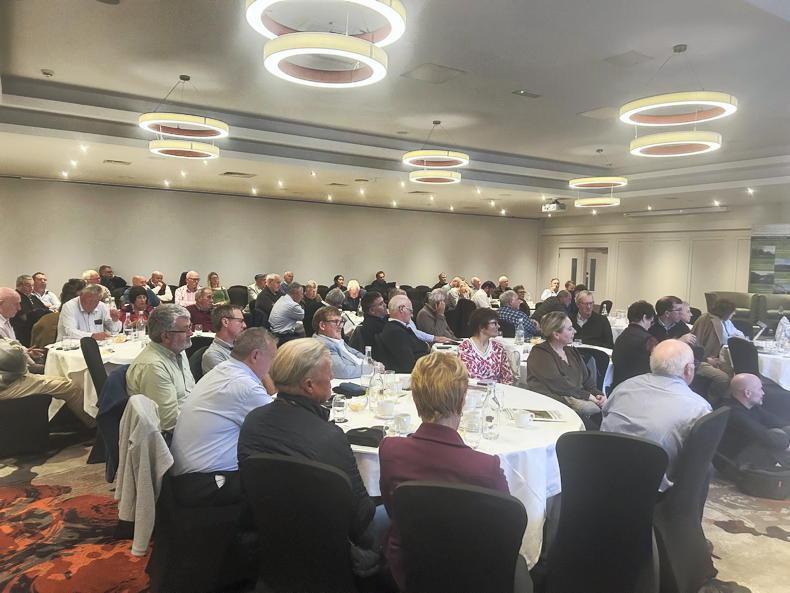
The INHFA remains vehemently opposed to the reintroduction of coupled payments in the next Common Agriculture Programme (CAP).
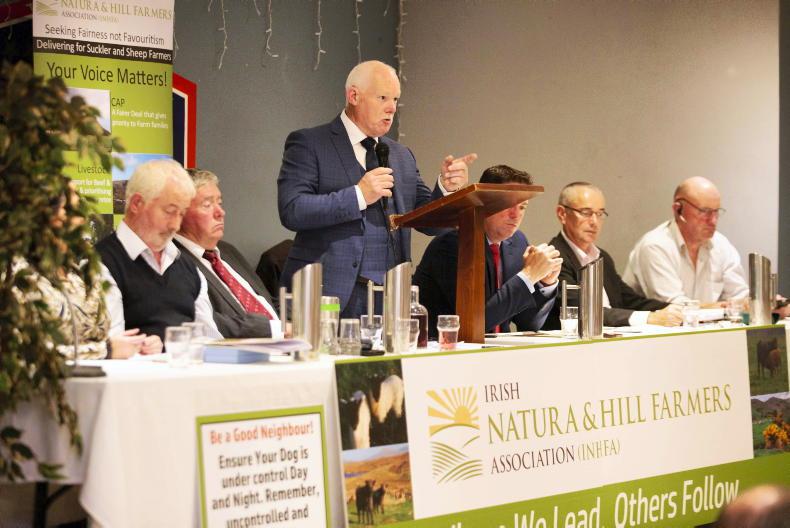
Speaking at the association’s annual general meeting in Sligo, INHFA president Pheilim Molloy said returning to coupled payments risked creating “market distortion” and was “contrary to the objective of simplification”.
“In relation to coupled payments, we are opposed to these as they will increase the administrative burden and complexity for farmers, and they will almost definitely see the introduction of retention periods and increase compliance requirements,” Molloy argued.
He also pointed out that if coupled payments were reintroduced then supports such as the Sheep Improvement Scheme and Sheep Welfare Scheme, as well as suckler supports such as Beef Welfare Scheme and SCEP, will almost definitely come to an end.
CAP budget
Molloy called for a budget of €400bn for the next CAP programme, continued convergence in direct payments and a “clear definition of a farmer across the entire European Union”.
“In the current CAP programme, we saw payments move through convergence to 85% of the national average, and in the upcoming CAP programme it is vital that the convergence journey is completed,” Molloy said.
On the issue of generational renewal, Molloy repeated the INHFA position that a retirement scheme for older farmers was needed to balance the existing supports for young farmers.
“Young farmer supports are only one aspect in addressing this issue,” he said.
“This is why we have also been campaigning for a Farm Retirement Scheme to ensure those interested in passing on their land have options and are not left facing a cliff-edge with regard to their income,” Molloy explained.
On the issue of pensioners potentially being denied direct payments in the next CAP programme, Molloy said that the INHFA was “totally opposed to the proposal”.
Meanwhile, the INHFA president repeated the association’s demand for the provision of an upland farming research facility.
“This has been a priority for the INHFA for a number of years and is something we have continually lobbied on,” Molloy said.
“This lobbying has intensified over the last year and will continue until this is delivered on, as we see this being critical to the future of farming in upland areas,” he told the AGM.
Farmers will resist the imposition of stringent restrictions on their farming practices associated with the Nature Restoration Law (NRL), the INHFA’s annual general meeting was told.
Association president Pheilim Molloy warned that farmers would not accept the effective designation of their land in order for the State to meet its NRL commitments and he called on the Government to stall the process.
“To date, no viable funding streams have been identified [for the NRL] and we are now looking at a very similar situation to the land designations which were imposed without a proper commitment on funding,” Molloy told the AGM in the Clayton Hotel, Sligo.
Molloy told delegates that Ireland’s proposed Nature Restoration Plan, which has submitted to Brussels, is likely to be ratified and “come into force in 2027”.
However, the INHFA president insisted that the organisation will fight any attempt to impose a Nature Restoration Plan on farmers in the absence of consultation and agreed compensation
“Without funding, this plan must not go ahead and we are calling on the Government to pause the implementation of this plan until these issues are addressed,” Molloy said.
“These areas are mainly Annex1 habitats, and are currently subject to the land designations under the Bird’s and Habitats Directives,” he maintained.
“There is a disproportionate environmental burden being placed on farmers who farm these lands.”
“Farmers need to stop hiding under the table on succession,” said Mícheál McDonnell of the INHFA.
The INHFA representative was speaking following a panel discussion on the issue of generational renewal at the farm body’s annual general meeting in Sligo last week.
McDonnell said the range of opinions, which the two-hour discussion prompted from both the panel and the floor, illustrated the depth of feeling that exists on the matter.
McDonnell doubled down on the INHFA line that a farm retirement scheme is needed in the new CAP to facilitate the transition from one generation to the next.
However, former INHFA leader Colm O’Donnell commented from the floor that there was no provision for such a measure in the proposed CAP package.
Another farmer said that he didn’t know if he was handing over an “asset or a burden” in giving the farm to the next generation.
However, another contributor from the floor said there was an “endless number of young people” looking to get into farming but they couldn’t get access to land.
IFAC’s Trevor Boland said farm partnerships, with either a family member or a neighbour, offered a potential avenue into farming and out of farming for those at the opposite ends of the age spectrum.
Asked for a wrap up comment, Boland advised farmers to: “Make sure your will is up to date, go and seek legal and tax advice, and design a plan that suits you and your family.”