


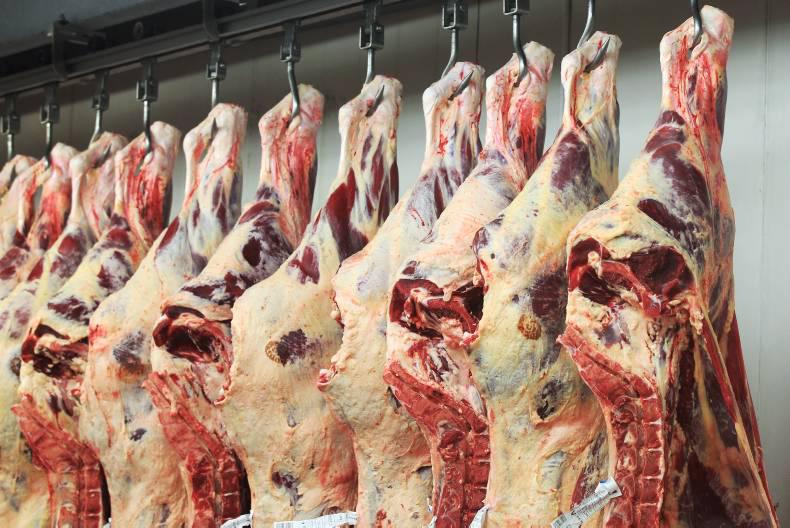
“If a carcase is not presented in accordance with EU regulation, eg over-trimmed or torn, is the factory required to pay the farmer on the top grade for that animal? What is the legal obligation on the Department of Agriculture in relation to inspection processes around carcase trim?”
There is a belief held by some stakeholders that carcases are being overtrimmed in meat factories. The Department of Agriculture is examining the possibility of giving limited authorisation to Veterinary Public Health Inspection Service (VPHIS) staff to assist the regulation of trimming of carcases by factories.
Currently regionally based DAFM beef carcase classification (BCC) staff carry out on-the-spot inspections in regard to classification, weights and trim but are not on site every day. It is proposed that VPHIS staff, permanently based in slaughter plants, will report suspected non-compliance with the carcase trim specification to regional staff of the BCC unit for further investigation.
European legislation
There is a standard EU dressing specification for beef carcases applied in the Republic of Ireland known as the “EU reference presentation”. This, along with grading on the S, E, U, R, O and P scale allows the European Commission to monitor prices paid for cattle across the EU. Regulation (EC) No 1249/2008 Article 13(3) states that for the purpose of establishing market prices, the carcase shall be presented without the removal of external fat, the neck being cut in accordance with the veterinary requirements without kidneys, kidney fat, pelvic fat, thin skirt, thick skirt, the tail, the spinal cord, cod fat, fat on the inside of topside, jugular vein and adjacent fat.
Article 13(5) provides that in the case where the presentation of the carcase at the moment of weighing and classifying on the hook differs from the presentation provided for in paragraph 3, the weight of the carcase shall be adjusted by application of corrective factors specified in Annex III of the EC regulation in order to progress from that presentation to the reference presentation, eg it provides for an increase of 0-4 where there has been a removal of external fat. Further, it specifies that in the removal of brisket fat to leave a covering of fat, the muscle tissue must not be exposed.
Inspections
Article 11 of the EC regulation provides for on-the-spot checks which can be carried out by the competent authority, eg the Department of Agriculture. Checks must be carried out at least twice every three months in all approved establishments which on average slaughter more than 75 adult cattle weekly. Each check must relate to at least 40 carcases selected at random.
Irish Legislation
The European Communities (Beef Carcase Classification) Regulations 2010 is the Irish legislation introduced for the purpose of giving effect to the EC regulation. However, the EC regulation is binding in its entirety and is directly applicable in each member state, so farmers can rely on its provisions.
Carcase trim
Section 6 of the Regulation provides that “a person who presents or causes or permits another person to present a carcase other than in accordance with Article 13(3) of the [Commission] regulation commits an offence”. The section goes on to provide that the person in charge of the establishment, where the carcase was slaughtered, is obliged to rectify the presentation and, if the presentation is not rectified, he or she shall reject the carcase which shall be dealt with by the operator of the establishment in accordance with the directions of a supervisory officer. The record must specify the manner in which the carcase initially failed to satisfy Article 13(3) and the final classification relating to the carcase. A person who does not keep such a record as obliged is guilty of an offence.
Inspection
The Irish regulation provides that a supervisory officer may at all reasonable times carry out inspections.
In conclusion, there is provision under the EC regulations for an adjustment to be made where there may have been an over-trim.
Further, there must be records kept of such adjustments. However, compliance with the law is dependent on sufficient checks and the permanent presence of scrutineers would enhance confidence in the inspection process as well as disclosure of the results of the reports which the Department of Agriculture are obliged to keep under Article 12 of the EC regulations as detailed above.


SHARING OPTIONS