The closing date for submitting applications for a nitrates derogation is 31 March. Approximately 7,000 producers submitted applications in 2016 to allow them to farm above the limit of 170kg/ha organic nitrogen and operate to a maximum level of 250kg organic nitrogen/ha. This number has been growing in recent years, with expanding dairy farmers becoming more reliant on the derogation.
While figures are not available for 2016, there were close to 2,000 farmers who exceeded the organic nitrogen limit in 2015, showing that there are other farmers who should be considering applying for a derogation or taking alternative routes (renting land, reducing stock numbers, exporting slurry) to stay within the 170kg/ha organic nitrogen limit.
Farmers close to the limit received text messages, where their number is recorded on the Department database, towards the end of last year and the Department is advising these farmers to consider applying for a derogation or review their planned organic nitrogen level for 2017.
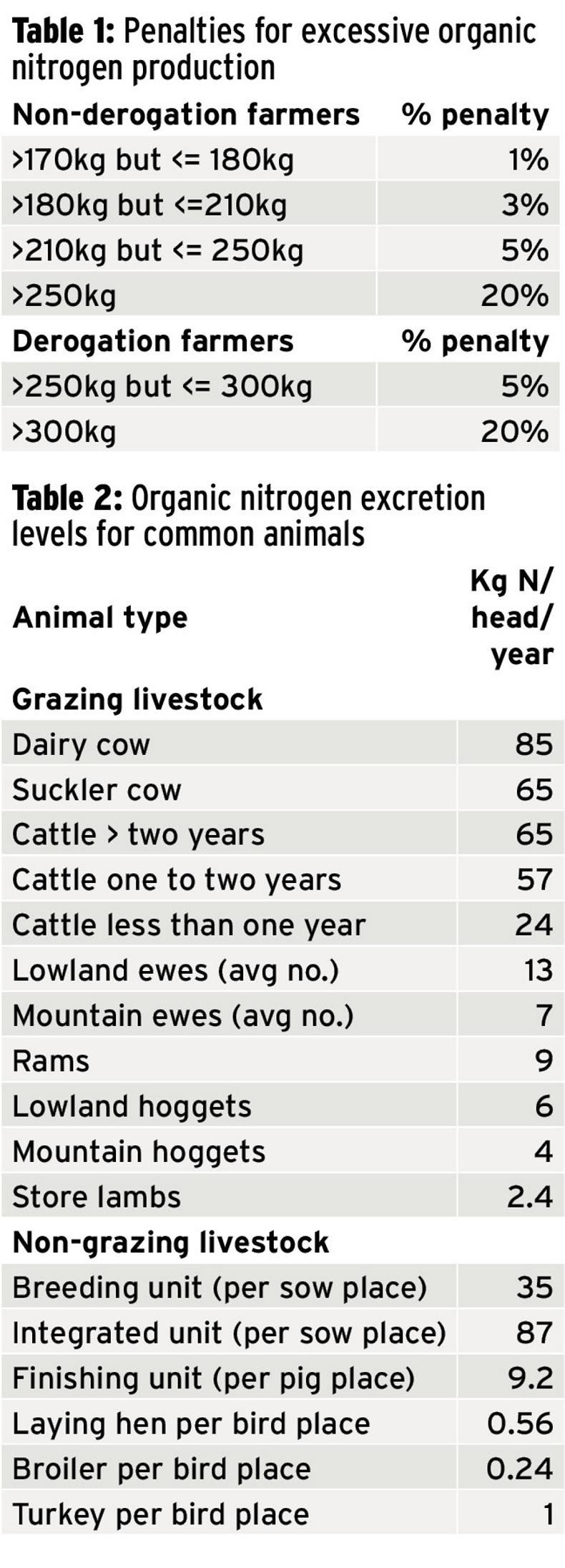
Farmers with a derogation are also recommended to review their organic nitrogen levels, with breaches also occurring each year over the upper limit of 250kg/ha organic nitrogen. Typical penalties for excessive organic nitrogen production are detailed in Table 1 for derogation and non-derogation farmers.
Those concerned with their level of organic nitrogen output can access their output for 2016 and at regular intervals throughout the year on the Department’s agfood.ie facility. Farmers should note, however, that the nitrogen and phosphorus statements are based on bovine numbers recorded on the Department’s Animal Identification and Movements (AIM) database and as such do not take into account other animals such as sheep, pigs, poultry, horses, etc.
Farmers need to account for these themselves and Table 2 details organic nitrogen levels for the most common grazing and non-grazing livestock.
Applying for a derogation
The first aspect to note is that derogation applications can only be submitted online. Another vital component to note is that a derogation will only be granted where the holding is at least 80% grass and grazing livestock are present.
A fertiliser plan is required to be in place by 1 March and must be submitted along with your application unless in the case of current derogation holders a fertiliser plan has been submitted in either 2014, 2015 or 2016, or a valid REPS 4 adjusted plan is in place that has been prepared in 2014 or later. Where a new or amended fertiliser plan is submitted in 2017, the terms and conditions state that only a plan produced by the Teagasc online Nutrient Management Plan (eNMP) is the acceptable format.
Fertiliser plans must be based on soil samples dated after 15 September 2013. For applicants who have never previously applied for a derogation, or last applied in 2012 or earlier and do not possess up-to-date soil analysis, the terms and conditions state that Index 3 must be assumed for P and K for 2017, with fertiliser plans amended for the 2018 derogation year (by 31 March 2018) to include up-to-date soil analysis.
Soil analysis must be updated at least every four years, with one sample covering a maximum of 5ha of land.
Where samples are available, a farm map must also be submitted that lists the location of individual fields and corresponding soil samples. Fertiliser accounts must also be maintained on a yearly basis and in contrast to the fertiliser plan, these must be submitted annually and no later than 31 March in the following year, ie fertiliser accounts for 2017 must be submitted by 31 March 2018.
A template for fertiliser accounts required can be found at www.agriculture.gov.ie/ruralenvironment/environmentalobligations/nitrates/nitratesderogation. A range of other information is also available, including the nitrates explanatory handbook for farmers, approved soil testing laboratories, cross-compliance inspection forms, derogation forms and contact details for the nitrates section in Johnstown.
Fertiliser plans – key requirements
Fertiliser plans must include the following elements as laid out under the terms and conditions. The terms and conditions also state that where any changes to agricultural activity take place, the plan must be revised no later than seven days following the changes to ensure consistency between the plan and the actual agricultural practice.
The crop rotation plan, which must specify the area (ha) of parcels with grass and parcels with other crops including a sketch map indicating the location of individual parcels.The number of livestock, a description of the housing and storage system, including the volume of manure storage available and a farmyard sketch.A calculation of manure nitrogen and phosphorus produced on the holding.The amount, type and characteristics of manure delivered outside the farm or to the farm.The foreseeable nitrogen and phosphorus crop requirements for each parcel.The results of soil analysis related to nitrogen and phosphorus soil status if available.The nature of the fertilisers to be used.A calculation of nitrogen and phosphorus from manure over each field.A calculation of nitrogen and phosphorus application from chemical and other fertilisers over each field.Assessing alternative options
In some cases, it may be deemed more appropriate by the farmer to assess alternative options. This could particularly be the case where the farm is close to the limit or only slightly exceeding it. Options available include renting additional lands, reducing stock numbers or a popular option is exporting organic nitrogen where there are farmers that are suitable to import.
The closing date for submitting applications for a nitrates derogation is 31 March. Approximately 7,000 producers submitted applications in 2016 to allow them to farm above the limit of 170kg/ha organic nitrogen and operate to a maximum level of 250kg organic nitrogen/ha. This number has been growing in recent years, with expanding dairy farmers becoming more reliant on the derogation.
While figures are not available for 2016, there were close to 2,000 farmers who exceeded the organic nitrogen limit in 2015, showing that there are other farmers who should be considering applying for a derogation or taking alternative routes (renting land, reducing stock numbers, exporting slurry) to stay within the 170kg/ha organic nitrogen limit.
Farmers close to the limit received text messages, where their number is recorded on the Department database, towards the end of last year and the Department is advising these farmers to consider applying for a derogation or review their planned organic nitrogen level for 2017.
Farmers with a derogation are also recommended to review their organic nitrogen levels, with breaches also occurring each year over the upper limit of 250kg/ha organic nitrogen. Typical penalties for excessive organic nitrogen production are detailed in Table 1 for derogation and non-derogation farmers.
Those concerned with their level of organic nitrogen output can access their output for 2016 and at regular intervals throughout the year on the Department’s agfood.ie facility. Farmers should note, however, that the nitrogen and phosphorus statements are based on bovine numbers recorded on the Department’s Animal Identification and Movements (AIM) database and as such do not take into account other animals such as sheep, pigs, poultry, horses, etc.
Farmers need to account for these themselves and Table 2 details organic nitrogen levels for the most common grazing and non-grazing livestock.
Applying for a derogation
The first aspect to note is that derogation applications can only be submitted online. Another vital component to note is that a derogation will only be granted where the holding is at least 80% grass and grazing livestock are present.
A fertiliser plan is required to be in place by 1 March and must be submitted along with your application unless in the case of current derogation holders a fertiliser plan has been submitted in either 2014, 2015 or 2016, or a valid REPS 4 adjusted plan is in place that has been prepared in 2014 or later. Where a new or amended fertiliser plan is submitted in 2017, the terms and conditions state that only a plan produced by the Teagasc online Nutrient Management Plan (eNMP) is the acceptable format.
Fertiliser plans must be based on soil samples dated after 15 September 2013. For applicants who have never previously applied for a derogation, or last applied in 2012 or earlier and do not possess up-to-date soil analysis, the terms and conditions state that Index 3 must be assumed for P and K for 2017, with fertiliser plans amended for the 2018 derogation year (by 31 March 2018) to include up-to-date soil analysis.
Soil analysis must be updated at least every four years, with one sample covering a maximum of 5ha of land.
Where samples are available, a farm map must also be submitted that lists the location of individual fields and corresponding soil samples. Fertiliser accounts must also be maintained on a yearly basis and in contrast to the fertiliser plan, these must be submitted annually and no later than 31 March in the following year, ie fertiliser accounts for 2017 must be submitted by 31 March 2018.
A template for fertiliser accounts required can be found at www.agriculture.gov.ie/ruralenvironment/environmentalobligations/nitrates/nitratesderogation. A range of other information is also available, including the nitrates explanatory handbook for farmers, approved soil testing laboratories, cross-compliance inspection forms, derogation forms and contact details for the nitrates section in Johnstown.
Fertiliser plans – key requirements
Fertiliser plans must include the following elements as laid out under the terms and conditions. The terms and conditions also state that where any changes to agricultural activity take place, the plan must be revised no later than seven days following the changes to ensure consistency between the plan and the actual agricultural practice.
The crop rotation plan, which must specify the area (ha) of parcels with grass and parcels with other crops including a sketch map indicating the location of individual parcels.The number of livestock, a description of the housing and storage system, including the volume of manure storage available and a farmyard sketch.A calculation of manure nitrogen and phosphorus produced on the holding.The amount, type and characteristics of manure delivered outside the farm or to the farm.The foreseeable nitrogen and phosphorus crop requirements for each parcel.The results of soil analysis related to nitrogen and phosphorus soil status if available.The nature of the fertilisers to be used.A calculation of nitrogen and phosphorus from manure over each field.A calculation of nitrogen and phosphorus application from chemical and other fertilisers over each field.Assessing alternative options
In some cases, it may be deemed more appropriate by the farmer to assess alternative options. This could particularly be the case where the farm is close to the limit or only slightly exceeding it. Options available include renting additional lands, reducing stock numbers or a popular option is exporting organic nitrogen where there are farmers that are suitable to import.



SHARING OPTIONS