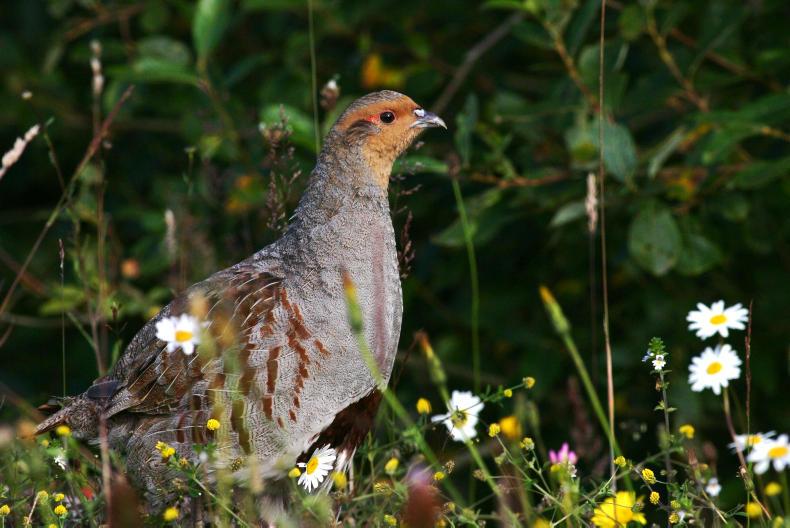
Male grey partridge bird which is a red-listed bird of conservation concern in Ireland. \ Irish Grey Partridge Conservation Trust
Speakers at the recent grey partridge meeting organised by Offaly IFA. From left: Kevin Keegan, FRS; John Keena, chair of Offaly IFA; Gerry Gunning, IFA rural development executive; Catherine Keena, Teagasc countryside management specialist; Pat Walsh, Offaly rural chair; Michael Martin, NPWS; Mark Gavin, Teagasc; and Kieran Buckley, NPWS.
The grey partridge is a red-listed bird of conservation concern in Ireland. The species has suffered a severe decline in numbers in recent years. Since the establishment of GLAS, farmers in areas where the grey partridge continues to have a sustainable population are being incentivised to protect the species with tailored measures to protect their habitats. The main objective of the grey partridge action is to promote and maintain suitable breeding and foraging habitats for the grey partridge.
There will be over 200 farmers creating over 140,000m of grey partridge margins in GLAS this year. With some in north Dublin and others in a newly approved area in south Inishowen, Co Donegal, the majority are in Boora, Co Offaly.
What is required?
ADVERTISEMENT
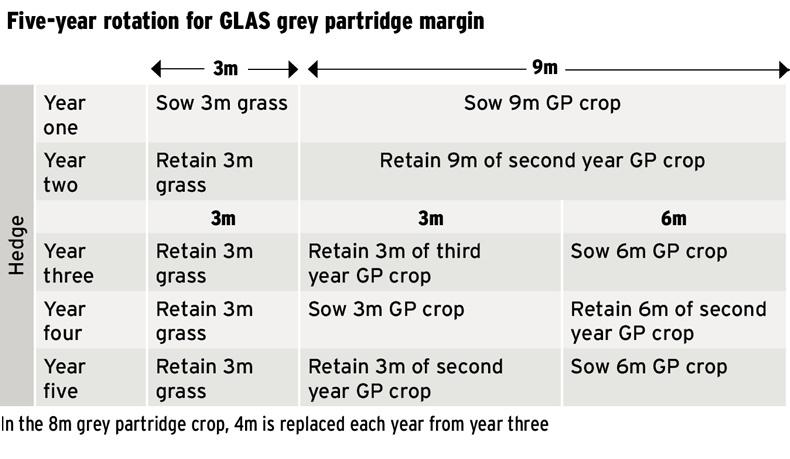
The margin is 12m in width with two options depending on machinery. Farmers using a 3m drill sow 3m of grass margin and 9m of grey partridge margin, while those with a 4m drill sow 4m of grass and 8m of grey partridge margin. The grass margin is established in year one and comprises 70% Cocksfoot and 30% Timothy sown at a rate of 15kg/ha. This is retained for the five years, topping if necessary in years one, two and four between 31 August and 15 January. The grey partridge mix of triticale, kale, lucerne, perennial chicory and fodder radish is established in the first year and replaced on a rotation as above. Half of the 200 farmers are in GLAS I and II and are in their second year, so there is no new sowing this year unless last year’s margins failed. GLAS III farmers are planting margins for the first time in 2017.
The NPWS Grey Partridge Conservation Project increased grey partridge numbers from 22 birds in 2002 to 700 birds last year. Kieran Buckley, an NPWS conservation ranger, says: ‘‘The grey partridge measure in GLAS will not only benefit the grey partridge. It will also benefit a host of other farmland birds of conservation concern and deliver a significant boost for the local economies where the measure will be rolled out.”
Locate grey partridge margin as shown on your GLAS map.
Margins must extend along the full side of each field boundary identified on the GLAS map.
Important change in the rules for all grey partridge farmers in GLAS I, II and III: where the margin is located in an arable field, there is no need to fence unless livestock are present in the field or if the field is converted to grass during the GLAS contract.
Register for free to read this story and our free stories.
This content is available to digital subscribers and loyalty code users only. Sign in to your account, use the code or subscribe to get unlimited access.
The reader loyalty code gives you full access to the site from when you enter it until the following Wednesday at 9pm. Find your unique code on the back page of Irish Country Living every week.
CODE ACCEPTED
You have full access to the site until next Wednesday at 9pm.
CODE NOT VALID
Please try again or contact support.
The grey partridge is a red-listed bird of conservation concern in Ireland. The species has suffered a severe decline in numbers in recent years. Since the establishment of GLAS, farmers in areas where the grey partridge continues to have a sustainable population are being incentivised to protect the species with tailored measures to protect their habitats. The main objective of the grey partridge action is to promote and maintain suitable breeding and foraging habitats for the grey partridge.
There will be over 200 farmers creating over 140,000m of grey partridge margins in GLAS this year. With some in north Dublin and others in a newly approved area in south Inishowen, Co Donegal, the majority are in Boora, Co Offaly.
What is required?
The margin is 12m in width with two options depending on machinery. Farmers using a 3m drill sow 3m of grass margin and 9m of grey partridge margin, while those with a 4m drill sow 4m of grass and 8m of grey partridge margin. The grass margin is established in year one and comprises 70% Cocksfoot and 30% Timothy sown at a rate of 15kg/ha. This is retained for the five years, topping if necessary in years one, two and four between 31 August and 15 January. The grey partridge mix of triticale, kale, lucerne, perennial chicory and fodder radish is established in the first year and replaced on a rotation as above. Half of the 200 farmers are in GLAS I and II and are in their second year, so there is no new sowing this year unless last year’s margins failed. GLAS III farmers are planting margins for the first time in 2017.
The NPWS Grey Partridge Conservation Project increased grey partridge numbers from 22 birds in 2002 to 700 birds last year. Kieran Buckley, an NPWS conservation ranger, says: ‘‘The grey partridge measure in GLAS will not only benefit the grey partridge. It will also benefit a host of other farmland birds of conservation concern and deliver a significant boost for the local economies where the measure will be rolled out.”
Locate grey partridge margin as shown on your GLAS map.
Margins must extend along the full side of each field boundary identified on the GLAS map.
Important change in the rules for all grey partridge farmers in GLAS I, II and III: where the margin is located in an arable field, there is no need to fence unless livestock are present in the field or if the field is converted to grass during the GLAS contract.
If you would like to speak to a member of our team, please call us on 01-4199525.
Link sent to your email address
We have sent an email to your address. Please click on the link in this email to reset your password. If you can't find it in your inbox, please check your spam folder. If you can't find the email, please call us on 01-4199525.
ENTER YOUR LOYALTY CODE:
The reader loyalty code gives you full access to the site from when you enter it until the following Wednesday at 9pm. Find your unique code on the back page of Irish Country Living every week.







SHARING OPTIONS