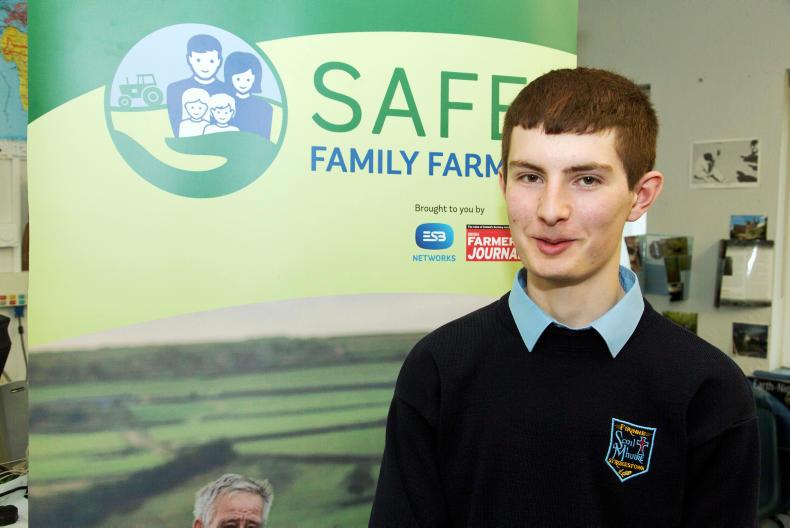
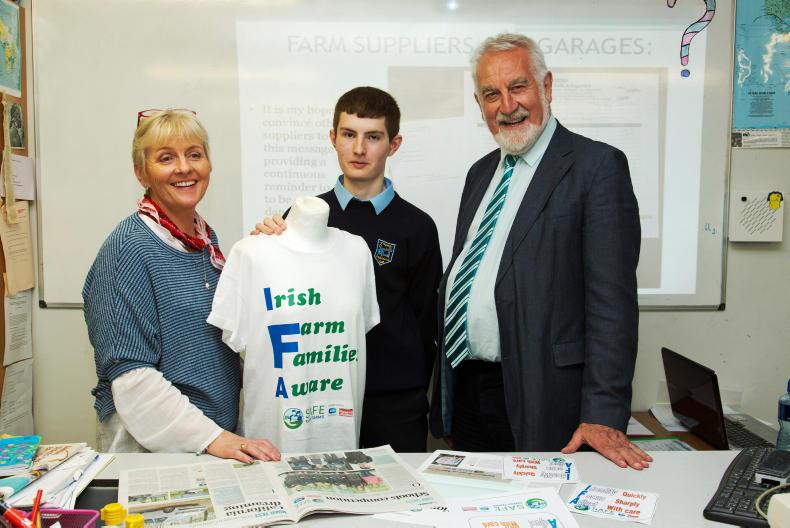
The first of our three finalists in the Safe Family Farm schools competition is fifth-year ag science student Michael Feely, from Scoil Mhuire in Strokestown, Co Roscommon. He outlines his project.
My primary aim is to make farm families aware of the importance of mental health and psychological well-being. I feel that this is critical for safe farming practice. I plan on do this in four simple steps:
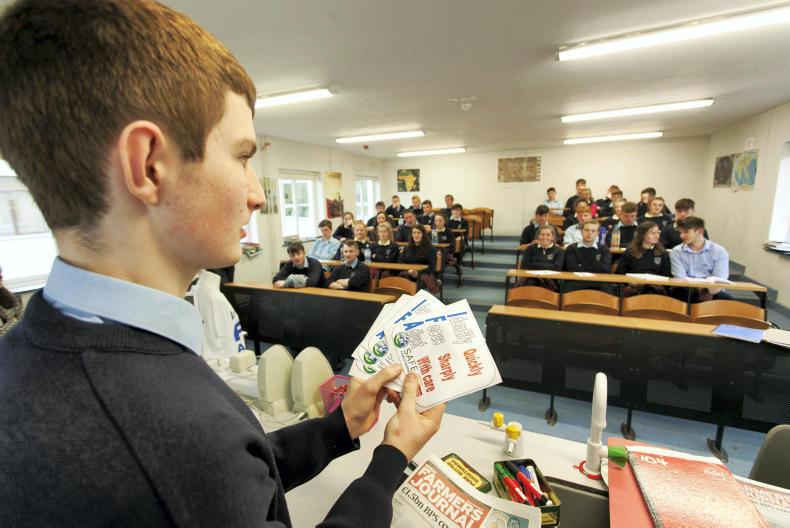
In order to engage the farming community, my aim is to hold workshops, in partnership with farm organisations, to help identify the causes and symptoms of stress and poor mental health and, as a result, demonstrate coping mechanisms to deal with these symptoms.
I propose creating a farm-risk simulator zone to encourage farmers to recognise hazards on their farms. This zone would test the candidate’s ability to identify a safety hazard and their ability to safely deal with the particular risk, which presents itself in the course of a normal farming day.
The information for this simulator could be supplied by a smartphone app which encourages farmers to share the risks they identify and help educate other members of their farming community.
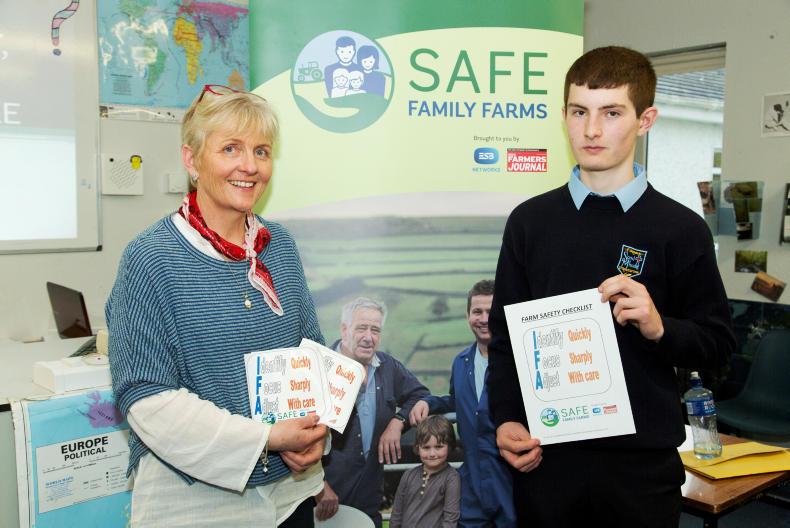
This app would base its data on the checklist which I have created, “Identify Quickly, Focus Sharply, Adjust with Care”. It is my hope that the use of such a farm risk simulator, will at some point be included in the agricultural science curriculum for Leaving Certificate students.
ADVERTISEMENT
I believe farm merchant suppliers can help in this aspect through the use of my checklist being printed on to their invoices, dockets and receipts. Two local farm supplies merchants have already come on board. It is my hope to convince other farm suppliers to include this message providing a continuous reminder to farmers to be aware of the dangers.
The farming community is a mixture of generations. Safety has to appeal to each generation and each generation’s perception of life is different. To help educate younger generations, I have produced stickers which can be applied to machinery.
Case study
Mechanisation is an essential part of farming life, which Liz McCabe – a family friend – is very much aware of.
In July 1965, she was two years old, the youngest in a family of seven. Her father Michael Fleming was working on the farm. While he was operating a tractor on sloped land near a river, the tractor overturned. As the tractor had no safety frame, her dad was trapped underneath and died, aged forty four. She believes that the accident could have been prevented had the tractor been fitted with a protective cab. She also feels that dangerous areas of land should be fenced off, to prevent machinery being operated on unsuitable ground.
Upon researching legislation on Rollover Protection Structures (ROPS), I found that all tractors used in a public place since 1 September 1977 are required to have these structures of an appropriate standard in place.
Consequences of the accident were far-reaching, and resulted in the farm having to be sold. She feels that safety standards have improved through education. I also share this belief, but feel that farm safety can be furthered through interaction between farmers, farming organisations and farm suppliers. It is about working together as a group and educating each other.
This content is available to digital subscribers and loyalty code users only. Sign in to your account, use the code or subscribe to get unlimited access.
The reader loyalty code gives you full access to the site from when you enter it until the following Wednesday at 9pm. Find your unique code on the back page of Irish Country Living every week.
CODE ACCEPTED
You have full access to the site until next Wednesday at 9pm.
CODE NOT VALID
Please try again or contact support.
My primary aim is to make farm families aware of the importance of mental health and psychological well-being. I feel that this is critical for safe farming practice. I plan on do this in four simple steps:
In order to engage the farming community, my aim is to hold workshops, in partnership with farm organisations, to help identify the causes and symptoms of stress and poor mental health and, as a result, demonstrate coping mechanisms to deal with these symptoms.
I propose creating a farm-risk simulator zone to encourage farmers to recognise hazards on their farms. This zone would test the candidate’s ability to identify a safety hazard and their ability to safely deal with the particular risk, which presents itself in the course of a normal farming day.
The information for this simulator could be supplied by a smartphone app which encourages farmers to share the risks they identify and help educate other members of their farming community.
This app would base its data on the checklist which I have created, “Identify Quickly, Focus Sharply, Adjust with Care”. It is my hope that the use of such a farm risk simulator, will at some point be included in the agricultural science curriculum for Leaving Certificate students.
I believe farm merchant suppliers can help in this aspect through the use of my checklist being printed on to their invoices, dockets and receipts. Two local farm supplies merchants have already come on board. It is my hope to convince other farm suppliers to include this message providing a continuous reminder to farmers to be aware of the dangers.
The farming community is a mixture of generations. Safety has to appeal to each generation and each generation’s perception of life is different. To help educate younger generations, I have produced stickers which can be applied to machinery.
Case study
Mechanisation is an essential part of farming life, which Liz McCabe – a family friend – is very much aware of.
In July 1965, she was two years old, the youngest in a family of seven. Her father Michael Fleming was working on the farm. While he was operating a tractor on sloped land near a river, the tractor overturned. As the tractor had no safety frame, her dad was trapped underneath and died, aged forty four. She believes that the accident could have been prevented had the tractor been fitted with a protective cab. She also feels that dangerous areas of land should be fenced off, to prevent machinery being operated on unsuitable ground.
Upon researching legislation on Rollover Protection Structures (ROPS), I found that all tractors used in a public place since 1 September 1977 are required to have these structures of an appropriate standard in place.
Consequences of the accident were far-reaching, and resulted in the farm having to be sold. She feels that safety standards have improved through education. I also share this belief, but feel that farm safety can be furthered through interaction between farmers, farming organisations and farm suppliers. It is about working together as a group and educating each other.
If you would like to speak to a member of our team, please call us on 01-4199525.
Link sent to your email address
We have sent an email to your address. Please click on the link in this email to reset your password. If you can't find it in your inbox, please check your spam folder. If you can't find the email, please call us on 01-4199525.
ENTER YOUR LOYALTY CODE:
The reader loyalty code gives you full access to the site from when you enter it until the following Wednesday at 9pm. Find your unique code on the back page of Irish Country Living every week.





 Upon researching legislation on Rollover Protection Structures (ROPS), I found that all tractors used in a public place since 1 September 1977 are required to have these structures of an appropriate standard in place.



SHARING OPTIONS