



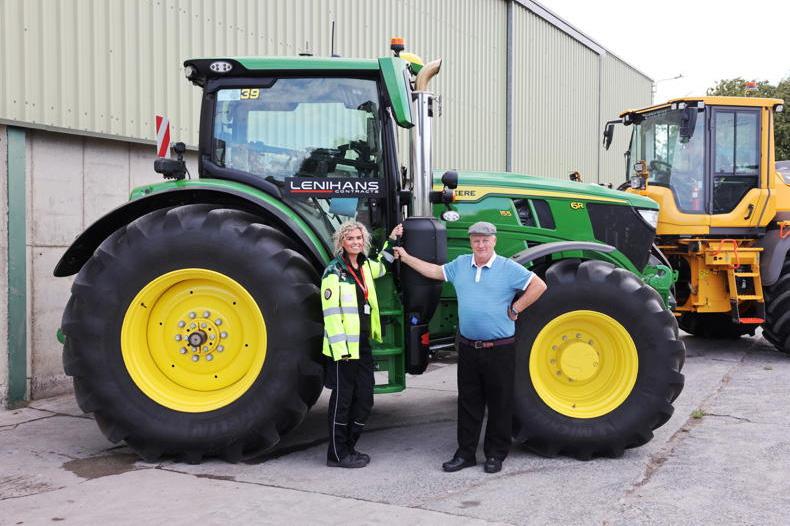
Rural families know better than anyone the vulnerability of living far from medical help when a crisis strikes. For farm families, that risk is heightened considerably as the dangers of machinery and livestock increase the chance of accidents.
Community First Responders (CFRs) is the national first responders network, and has almost 300 volunteer-led groups providing critical emergency care in rural communities across the country.
Supported by the National Ambulance Service, CFRs are trained in basic life support skills, including how to use an Automated External Defibrillator (AED), in the event of a potentially life-threatening emergency in their area.
Volunteers respond to crisis situations, providing early intervention in cases of cardiac arrest, stroke or choking, until the ambulance arrives.
Rural communities know first-hand that ambulance wait times are significantly greater for those living far from main hospitals, but the growth of CFR groups throughout the country is helping to save lives.
The latest figures from the National Ambulance Service (NAS) show a further decline in response times, with targets for both cardiac or respiratory arrest (purple calls) and other life-threatening emergencies (red calls) not being met. Figures released by the Minister for Health earlier this year show 70% of purple calls were responded to within 19 minutes, missing the target of 75%.Red calls response times reach 40% of a 45% target.
However, one of the newer CFR groups established in the country, Mitchelstown CFR is making a huge difference in the north Cork community it serves, particularly for farming families.
Terrible tragedy
Liam O’Donnell didn’t realise the vital work being done in his community until tragedy struck. His brother Gerry lost his life last year in a farm accident. While the family waited for the emergency services to arrive, members of Mitchelstown CFR were on the scene in minutes.
“Gerry’s death was a terrible tragedy, and there was nothing that could be done in the circumstances to save him, but the women who attended the scene, were incredible,” he explains.
“It was only in the weeks and months after our own tragedy that I discovered these volunteers were all local and doing Trojan work around the area. They are the hidden jewels in the countryside.
“I couldn’t understand how they aren’t getting funding from the HSE, everything they do is supported through fundraising. Well, I know a thing or two about raising money as I’d be well known in the farming community, so I’ve pledged to do all I can to get them a few quid.”
Pamela Hanna set up the Mitchelstown CFR in 2024, and has 10 volunteers manning a catchment area of a 10km radius of the north Cork town.
“I had gone along to a first aid refresher course run by Fermoy CFR and had wanted to join their group, but because I’m not within the 10km radius, I couldn’t,” explains Pamela.
“They suggested I set up a group here in Mitchelstown, and while I was reluctant at first, I put a post up on Facebook and it just exploded. I thought I’d opened up a can of worms but when we held a public meeting there was huge demand for it, so we set about signing up volunteers and getting our training up and running.”
This training includes fortnightly sessions with the National Ambulance Service, and since their first alert was received in November 2024, the group has responded to over 200 callouts.
“We’re in a very remote area here as we’re north Cork, so we are some distance from the city. You would also be taking in parts of south Tipperary and west Limerick, both of which are not close to an ambulance base, so the ability of local volunteers to respond to calls is proven to save lives.
“We don’t always get the outcome we want, but we have to leave the emotion of situations to one side and focus on the job we’re there to do. [In those situations], we then have our debrief with a cup of tea and a box of tissues where we cry our eyes out as these are often people we know, and it is very very hard at times.
“We have attended all sorts of incidents, from workplace accidents to emergencies in homes and farm incidents, where often a person can be lying in the middle of a field. We’re there to respond to whatever faces us, and it’s a case of muscle memory at this stage. We have a job to do and we do it.”
While the Mitchelstown group started out with 16 members, that number has fallen to 10 as Pamela says it is a role not everyone is able for.
“People really do want to help and give something to their communities. They feel they’re well able to do this job, but it’s a different story when you attend a call-out. There’s also the fact that being a volunteer doesn’t just impact on that person, it affects the whole family if you’re getting a call at 3am to attend an incident. And that is difficult.”
We don’t always get the outcome we want, but we have to leave the emotion of situations to one side and focus on the job we’re there to do. [In those situations], we then have our debrief with a cup of tea and a box of tissues where we cry our eyes out as these are often people we know, and it is very very hard at times
To honour Gerry's memory, Liam is organising a memorial fundraiser in Glenroe, Co Limerick, on Sunday August 30. Registration for the tractor run begins at 10.30am, with participants setting off at 1.30pm from the village where Gerry was a respected mechanic and machinery expert.
“Morning Star Vintage Club and Glenrue GAA club have come together to support my family in organising this tractor run and auction where we will be raising funds for Mitchelstown CFR on 30 August,” he adds.
“These volunteers do this incredible work with no Government support so we want to help make their jobs that little bit easier, to have the funds to pay for equipment and whatever else they need.”
Volunteers
Pamela says the group are fortunate to receive sponsorship from Kerrygold Park and says the community support has been vital in keeping the group going.
“We’ve recently been upgraded to Emergency First Responder status, so that has meant we’ve had to upgrade our equipment, from the different life-stage mannequins to the training airways equipment.
“Every time we use a defibrillator the pads have to be replaced, at a cost of €80, and then there is the cost of our uniforms, bags etc.
“We estimate the annual running costs to be in the region of €20,000 so every donation from the community and every fundraiser like the one Liam is organising means we can continue to help save lives in our local community.”
Liam is hoping for a strong turnout to the fundraiser in Glenroe and says the tragedy of farm accidents and fatalities is something no one wants to encounter.
“Farm accidents devastate communities, it’s not just the person who is killed or injured. When we lost Gerry, who was a bachelor, the effect on his family and close friends was tremendous, so we can’t praise the work Mitchelstown CFR does highly enough. There should be more of these hidden angels all over the country in my mind.”
Community First Reponders aim to be on the scene of a critical incident within 10 minutes of receiving the emergency SMS from Ambulance Control.
Once they arrive with the patient their work includes clearing and controlling the airway of an unconscious patient, providing resuscitation and defibrillation and putting the patient at ease, where possible. They also play a vital role in reassuring worried relatives and use their local knowledge to ensure that the ambulance can find the location quickly.
For more information and to set up a Community First Responder scheme in your area, see cfr.ie; and embracefarm.com


SHARING OPTIONS