It has been a very dry summer for us in Australia but we have had a fantastic autumn break at Easter when we received just over 20mm of rain and a further 30mm about 10 days after that. But like all good things, there is often a downside. The same rain played havoc with our summer crop harvest.
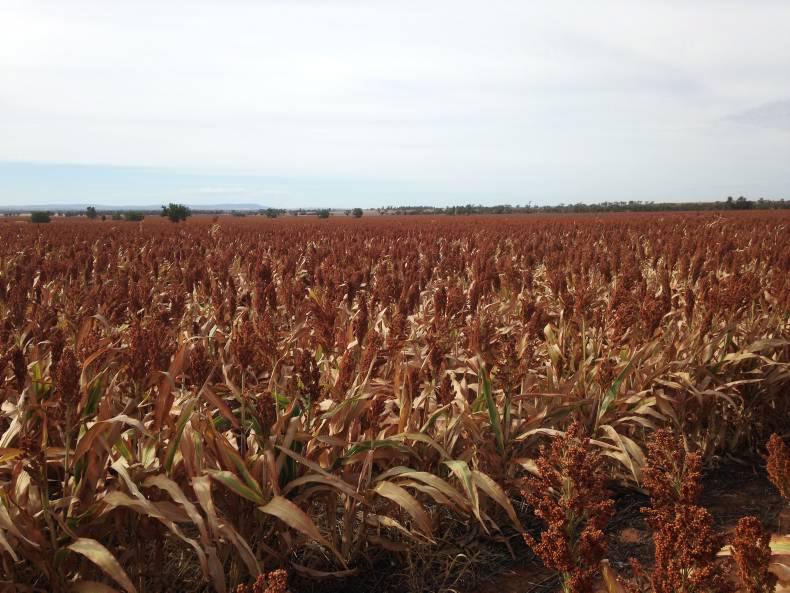
Our sorghum averaged about 4t/ha, which was our best ever result and we had over 400ha planted. Our only problem was that with the rain, humidity and cooler weather we couldn’t get the moisture down low enough at cutting so I have about 1,500t of sorghum at 15% moisture which I need to bring down to at least 13.5% moisture content. We do have an old eight-tonne diesel batch drier which I will have to use to get this moisture drop, so I have a busy three months ahead of me.
The price of sorghum is actually better than wheat at the moment (about $290/t (€199/t) ex-farm) because the Chinese are importing it to make Baijiu, which is a fermented spirit they particularly enjoy after their banquets. My sorghum will be the second-best gross margin across the farm, which is encouraging considering I only started growing it in 2012.
Mung beans
We received good rain in December and early January (about 150mm over six weeks) so, following our success with the crop last year, I decided to plant 500ha of double-crop mung beans. These were planted just after Christmas through to the middle of January into wheat stubble that we had harvested in November.
However, they received no rain after planting and only averaged about 150-220kg/ha as a result. But the price of $1,400/t (€960/t) helped to alleviate some of the pain.
We have since planted one of these paddocks back to barley (ie a fallow of only one month) and the remainder will be fallowed during the winter and spring before we hopefully plant sorghum into it in November or December, depending on rainfall.
Winter crops
With regard to our winter crops, I have pulled back my canola hectares significantly due to the low prices at planting time and costs associated with growing the crop. Last year, I planted about 1,000ha and this year I am back to about 300ha. I have planted more faba beans (approximately 250ha) and lupins (approximately 330ha) and have 20ha of lentils in as a trial.
The prices of these crops were about the same, or up to $100/t (€68/t) higher than canola last harvest and they have significantly cheaper growing costs so we are trying to make these crops work. Lentils are worth about $1,000/t (€686/t) at the moment and trials are indicating that they will yield about the same as canola, so they are a no brainer to grow if we can get the agronomy right.
In my area the canola hectares would be back about 10% with more people putting in barley (on the back of malt demand and record cattle-on-feed numbers in Australia) and pulses (faba beans, lupins, lentils, field peas or chickpeas). Chickpeas are very hot at the moment. The price at harvest was only about $400/t (€274/t) but they have doubled now to about $800/t (€549/t) as they scramble to secure more supply on the back of a failed crop in India.
Weather issues
On the rainfall front, we had good rain in April and early May but it has started to dry out now. As I write this, we have had three massive frosts on Tuesday, Wednesday and Thursday (2 June to 6 June) which have registered about -3 degrees Centigrade on our weather station. But temperatures were probably down to -5 to -6 degrees at ground level. Since then much of our grain belt received more rain (except here) and the temperature last weekend dropped to two degrees under.
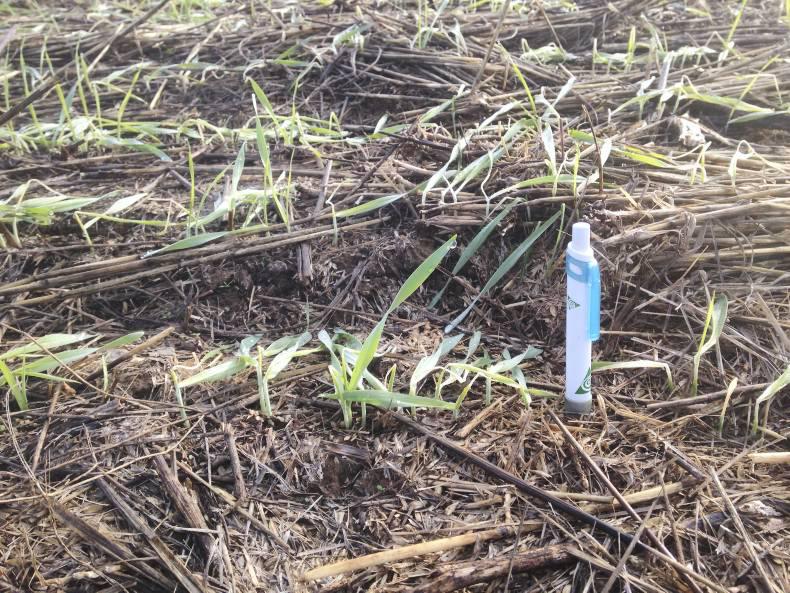
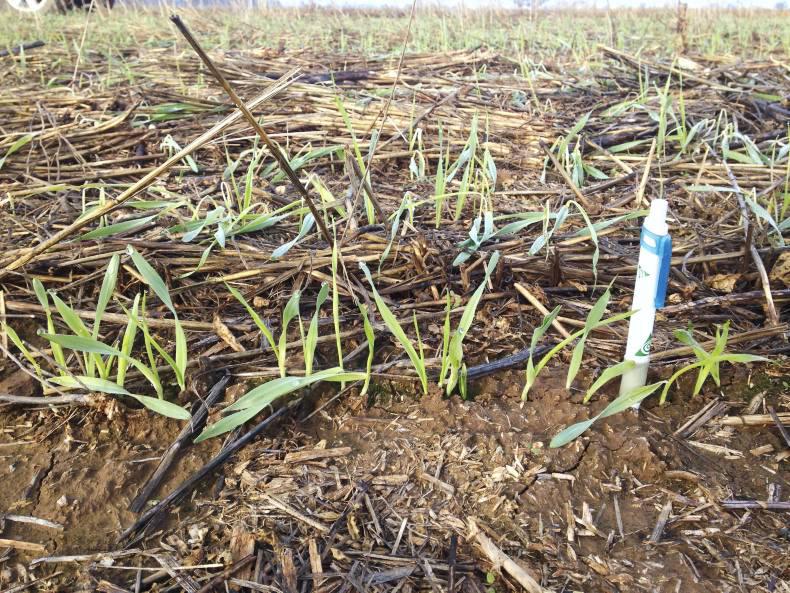
The early June frost burned off some of the barley plants that had emerged at the time where the stubble lay across the emerging rows (see photos). We were uncertain about this for a while but it has since recovered and bounced back.
The same frost has also made my lupins feel a bit crook (shook) as they were planted into heavy wheat stubbles. However, I am hopeful that some rain and a few good days will help them grow out of it.
Frost is becoming the number one issue in my farming system and we are looking at ways to reduce stubble groundcover without burning. This is partly why we are looking at planting more pulse crops. We are hoping to move to a rotation of pulse crop, followed by canola, to reduce ground cover naturally by growing lower carbon crops. These would be followed by a cereal crop (either wheat, barley or triticale) and then probably back to a summer crop.
This rotation should also help reduce my nitrogen cost by growing a legume crop that fixes its own nitrogen. It will also give me two years to use cheaper chemistry to control grass weeds in my pulse and canola crops. Hopefully this will then mean that I can get away without having to use expensive chemicals to control ryegrass or wild oats in my cereal crops.
This rotation will also give me a two-year disease break from potential cereal diseases. Hopefully it will work out and I will get back to you after winter crop harvest with an update on its success or lack thereof.
New planter
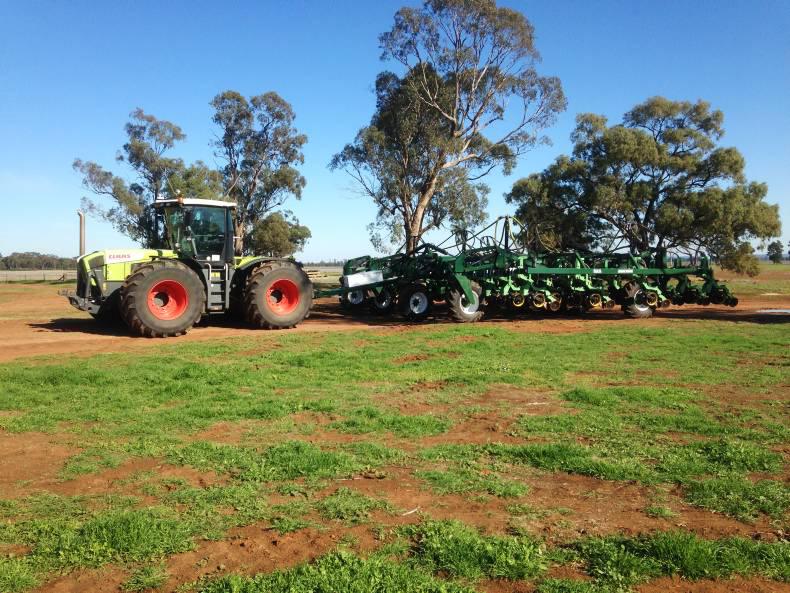
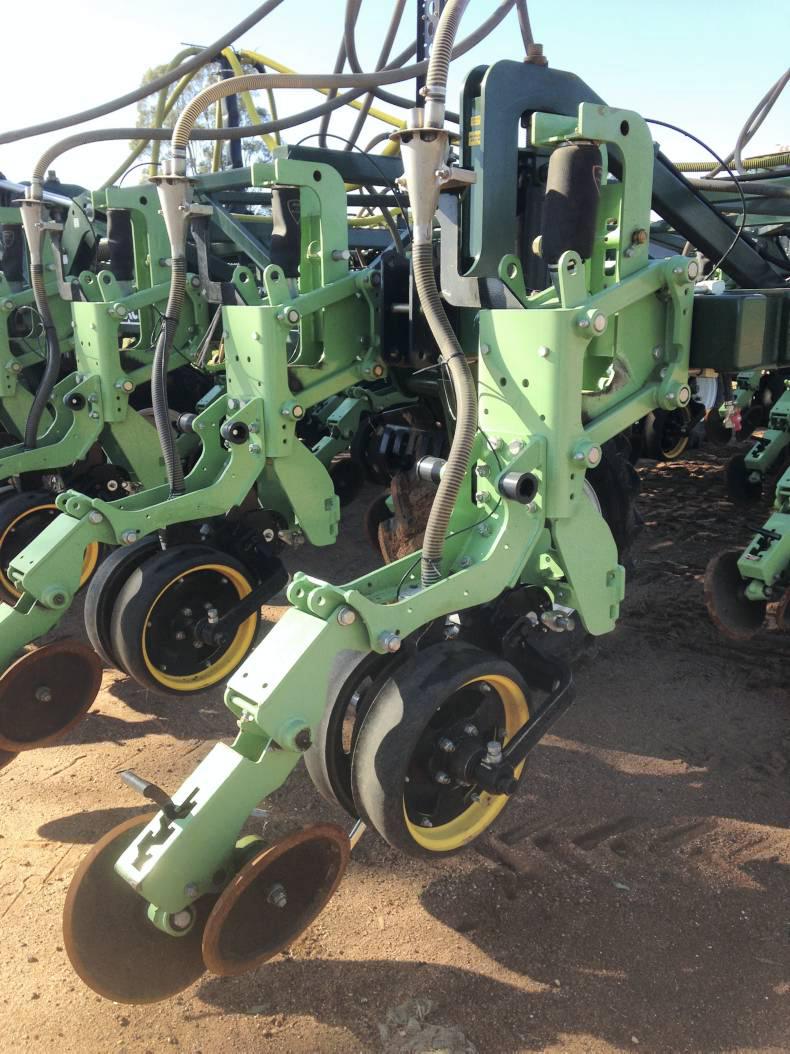
To help facilitate this, we have purchased a new planter (see photo). It is made by a company called Excel, which is based in Toowoomba in Queensland. It is a double-disc machine on 25cm row spacing with planting units mounted on four gangs. It is a big piece of kit, weighs about 19t and it takes a little bit of pulling!
The reason we chose this planter is that we can configure the rows on the machine so we can lift up the front three gangs and plant sorghum on 1m row spacing by just using the rear gang. Alternatively we can lift up the middle two gangs to potentially plant canola and pulse crops on 50cm spacings, with the cereals on 25cm row spacings to help with weed competition.
We are hoping to move to purchase vacuum boxes to precision-plant our sorghum and pulse crops for this coming summer and winter. We have also purchased row cleaners (Yetter stubble whippers), which will be mounted in front of the front and back gang, to clear stubble from the crop row of the sorghum or pulse.
Because these crops will be planted into cereal stubble, we believe that not having stubble cover close to the seeds could be important. The hope is that this will alleviate some of our frost issues by letting the crop grow in bare soil which can absorb heat from the sun during the day and radiate this back over the night to help reduce frost damage.
We are moving to a situation now where we really don’t want residue in our winter crop system but we do want it for our summer crops to help reduce evapotranspiration during our hot summers. All very challenging!!
El Niño
Another weather issue confronting Australia this growing season is the confirmation that we are about to enter an El Niño weather event. This is commonly linked to droughts in this part of the world and Australia is probably due one as we have not had a really serious drought since about 2007.
To compound this potential drought, the forecasters are also talking about the Indian Ocean Dipole (which measures the sea surface temperatures off the northwest coast of Australia) switching to a positive event, which is bad for moisture feed from northwestern Australia across the centre of the country to the SE corner. This is where most of the cropping belt on the east coast of Australia is located.
This can also possibly reduce moisture for the palm oil growing areas of Malaysia, Indonesia and Philippines which could be bullish for oil prices. However, an El Niño normally means wetter weather for the USA and South America, which can be good for yield there but generates a bearish sentiment for soybean prices. Time will tell.
Market prospects
We currently have about 60-70cm of moisture in the soil profile which may not be enough. This could mean trouble in the months ahead as we would ideally like to have 1m of moisture in the profile at planting. This fear was also reflected in grain prices in early June, with wheat rallying about $25/t (€17/t), reflecting a basis of $65 (€45) over the CBOT December wheat contract. Canola has also rallied by about $40/t (€27/t) on the back of reduced hectares planted in Australia coupled with fears of drought and the frost damage in Canada.
Unfortunately the sentiment on wheat has since reversed. I sold some wheat forward back then at $270/t (€185/t) for 10.5% protein delivered, which is a good start, but I would like to see more rain and less frost before selling any more. I am also thinking about selling some canola on the back of this rally, despite the drought risk, given the tsunami of soyabeans likely to come from the USA and South America over the next nine months.
Luckily our dollar has depreciated relative to the US$, from close to parity late last year to about 77c now. This helps our competitiveness.
A busy time
Anyway, that is about it from here in Australia for the moment. It has been a very busy time since we started on our summer crop journey – we now harvest and plant crops at the same time, twice a year, so logistics and time can be challenging.
Increased rotation is necessary for a range of reasons.Frost is an increasing issue for winter crops where trash is left on the surface.There is a fear of the risk of drought due to El Niño.A recent frost caused damage to emerging barley.
It has been a very dry summer for us in Australia but we have had a fantastic autumn break at Easter when we received just over 20mm of rain and a further 30mm about 10 days after that. But like all good things, there is often a downside. The same rain played havoc with our summer crop harvest.
Our sorghum averaged about 4t/ha, which was our best ever result and we had over 400ha planted. Our only problem was that with the rain, humidity and cooler weather we couldn’t get the moisture down low enough at cutting so I have about 1,500t of sorghum at 15% moisture which I need to bring down to at least 13.5% moisture content. We do have an old eight-tonne diesel batch drier which I will have to use to get this moisture drop, so I have a busy three months ahead of me.
The price of sorghum is actually better than wheat at the moment (about $290/t (€199/t) ex-farm) because the Chinese are importing it to make Baijiu, which is a fermented spirit they particularly enjoy after their banquets. My sorghum will be the second-best gross margin across the farm, which is encouraging considering I only started growing it in 2012.
Mung beans
We received good rain in December and early January (about 150mm over six weeks) so, following our success with the crop last year, I decided to plant 500ha of double-crop mung beans. These were planted just after Christmas through to the middle of January into wheat stubble that we had harvested in November.
However, they received no rain after planting and only averaged about 150-220kg/ha as a result. But the price of $1,400/t (€960/t) helped to alleviate some of the pain.
We have since planted one of these paddocks back to barley (ie a fallow of only one month) and the remainder will be fallowed during the winter and spring before we hopefully plant sorghum into it in November or December, depending on rainfall.
Winter crops
With regard to our winter crops, I have pulled back my canola hectares significantly due to the low prices at planting time and costs associated with growing the crop. Last year, I planted about 1,000ha and this year I am back to about 300ha. I have planted more faba beans (approximately 250ha) and lupins (approximately 330ha) and have 20ha of lentils in as a trial.
The prices of these crops were about the same, or up to $100/t (€68/t) higher than canola last harvest and they have significantly cheaper growing costs so we are trying to make these crops work. Lentils are worth about $1,000/t (€686/t) at the moment and trials are indicating that they will yield about the same as canola, so they are a no brainer to grow if we can get the agronomy right.
In my area the canola hectares would be back about 10% with more people putting in barley (on the back of malt demand and record cattle-on-feed numbers in Australia) and pulses (faba beans, lupins, lentils, field peas or chickpeas). Chickpeas are very hot at the moment. The price at harvest was only about $400/t (€274/t) but they have doubled now to about $800/t (€549/t) as they scramble to secure more supply on the back of a failed crop in India.
Weather issues
On the rainfall front, we had good rain in April and early May but it has started to dry out now. As I write this, we have had three massive frosts on Tuesday, Wednesday and Thursday (2 June to 6 June) which have registered about -3 degrees Centigrade on our weather station. But temperatures were probably down to -5 to -6 degrees at ground level. Since then much of our grain belt received more rain (except here) and the temperature last weekend dropped to two degrees under.
The early June frost burned off some of the barley plants that had emerged at the time where the stubble lay across the emerging rows (see photos). We were uncertain about this for a while but it has since recovered and bounced back.
The same frost has also made my lupins feel a bit crook (shook) as they were planted into heavy wheat stubbles. However, I am hopeful that some rain and a few good days will help them grow out of it.
Frost is becoming the number one issue in my farming system and we are looking at ways to reduce stubble groundcover without burning. This is partly why we are looking at planting more pulse crops. We are hoping to move to a rotation of pulse crop, followed by canola, to reduce ground cover naturally by growing lower carbon crops. These would be followed by a cereal crop (either wheat, barley or triticale) and then probably back to a summer crop.
This rotation should also help reduce my nitrogen cost by growing a legume crop that fixes its own nitrogen. It will also give me two years to use cheaper chemistry to control grass weeds in my pulse and canola crops. Hopefully this will then mean that I can get away without having to use expensive chemicals to control ryegrass or wild oats in my cereal crops.
This rotation will also give me a two-year disease break from potential cereal diseases. Hopefully it will work out and I will get back to you after winter crop harvest with an update on its success or lack thereof.
New planter
To help facilitate this, we have purchased a new planter (see photo). It is made by a company called Excel, which is based in Toowoomba in Queensland. It is a double-disc machine on 25cm row spacing with planting units mounted on four gangs. It is a big piece of kit, weighs about 19t and it takes a little bit of pulling!
The reason we chose this planter is that we can configure the rows on the machine so we can lift up the front three gangs and plant sorghum on 1m row spacing by just using the rear gang. Alternatively we can lift up the middle two gangs to potentially plant canola and pulse crops on 50cm spacings, with the cereals on 25cm row spacings to help with weed competition.
We are hoping to move to purchase vacuum boxes to precision-plant our sorghum and pulse crops for this coming summer and winter. We have also purchased row cleaners (Yetter stubble whippers), which will be mounted in front of the front and back gang, to clear stubble from the crop row of the sorghum or pulse.
Because these crops will be planted into cereal stubble, we believe that not having stubble cover close to the seeds could be important. The hope is that this will alleviate some of our frost issues by letting the crop grow in bare soil which can absorb heat from the sun during the day and radiate this back over the night to help reduce frost damage.
We are moving to a situation now where we really don’t want residue in our winter crop system but we do want it for our summer crops to help reduce evapotranspiration during our hot summers. All very challenging!!
El Niño
Another weather issue confronting Australia this growing season is the confirmation that we are about to enter an El Niño weather event. This is commonly linked to droughts in this part of the world and Australia is probably due one as we have not had a really serious drought since about 2007.
To compound this potential drought, the forecasters are also talking about the Indian Ocean Dipole (which measures the sea surface temperatures off the northwest coast of Australia) switching to a positive event, which is bad for moisture feed from northwestern Australia across the centre of the country to the SE corner. This is where most of the cropping belt on the east coast of Australia is located.
This can also possibly reduce moisture for the palm oil growing areas of Malaysia, Indonesia and Philippines which could be bullish for oil prices. However, an El Niño normally means wetter weather for the USA and South America, which can be good for yield there but generates a bearish sentiment for soybean prices. Time will tell.
Market prospects
We currently have about 60-70cm of moisture in the soil profile which may not be enough. This could mean trouble in the months ahead as we would ideally like to have 1m of moisture in the profile at planting. This fear was also reflected in grain prices in early June, with wheat rallying about $25/t (€17/t), reflecting a basis of $65 (€45) over the CBOT December wheat contract. Canola has also rallied by about $40/t (€27/t) on the back of reduced hectares planted in Australia coupled with fears of drought and the frost damage in Canada.
Unfortunately the sentiment on wheat has since reversed. I sold some wheat forward back then at $270/t (€185/t) for 10.5% protein delivered, which is a good start, but I would like to see more rain and less frost before selling any more. I am also thinking about selling some canola on the back of this rally, despite the drought risk, given the tsunami of soyabeans likely to come from the USA and South America over the next nine months.
Luckily our dollar has depreciated relative to the US$, from close to parity late last year to about 77c now. This helps our competitiveness.
A busy time
Anyway, that is about it from here in Australia for the moment. It has been a very busy time since we started on our summer crop journey – we now harvest and plant crops at the same time, twice a year, so logistics and time can be challenging.
Increased rotation is necessary for a range of reasons.Frost is an increasing issue for winter crops where trash is left on the surface.There is a fear of the risk of drought due to El Niño.A recent frost caused damage to emerging barley. 




SHARING OPTIONS