


The conference, organised by Dr Michael Gaffney, brought in experts across a range of subject areas from radiation interception to biological control and energy efficiency.
Light is critical for plant growth. Tim Haworth from Cambridge HOK said that light can be an important input in a protected crop scenario. Light drives growth. Light photons are absorbed by pigments in the plant tissue and this energy is then captured to produce glucose by recombining carbon dioxide and water, resulting in the release of oxygen. This is photosynthesis.
Plants 'see' a much broader light spectrum than humans. We tend to be most sensitive to green light, and shades either side, while plants have greater overall light-band sensitivity for photosynthesis, with a preference for red and blue light.
Light is one of the most important factors driving photosynthesis. It governs the potential for the rate of transfer of photons to fuel photosynthesis. And different parts of the light spectrum can have different growth effects, with far-red radiation having the potential to produce either beneficial or negative effects.
In general, the brighter the day, the darker the leaf, and we all see this in periods of warm sunny weather. Denser chlorophyll can capture more photons in high light intensity, which relates to the rate of photosynthesis.
Light drives other plant processes too. It affects plant rooting, elongation, the shape and orientation of the leaves, colour of the leaves and flowers, tillering, stomatal opening and the flowering process itself.
A range of light receptors in the plant drive these processes and they impact differently on the growth of the plant over its lifetime. The length of day versus night is an important trigger for many plant processes.
So light, its quality and intensity, controls many different processes in the plant.
LED light and UV
This knowledge is very important for the protected crops sector. The ability to add light adds growing power. It can result in higher production or higher quality characteristics, or both.
In a controlled environment, light can be used to alter growth characteristics. The ability to add light gives more control to the grower. This is not new and we have seen brightly lit glasshouses for decades.
What is new on the technology front is the capacity to supply light from LED sources, according to Tim Haworth. He said that LED technology can provide a broader range of light, is cheaper to run and can be placed much closer to the growing plants because these lights generate much less heat. LED lighting adds additional growing power using less energy for increased productivity.
LED lighting enables plants to be layered in houses to increase output capacity. This may mean that future production in protected houses will be measured per cubic metre rather than per square metre.
Tim said that LED light will enable growers to use a 'light recipe' for the life of the crop to optimise its value. This will vary by crop and, possibly, by location.
Staying with light, Dr Marcel Jansen of UCC spoke about the UV-B (ultraviolet B) end of the light spectrum and its potential to alter plant growth characteristics. This is the light range that causes sunburn in humans, can stress plants and is part of the ozone problem.
Marcel said that UV-B is a regulator of many desirable traits in plants. It can influence colour, flavour and nutritional quality.
UV-B can also induce the production of bioactives within the plant to alter its characteristics.
Early investigations suggest that the addition of UV-B can result in shorter, sturdier plants with decreased leaf area but increased leaf thickness - a more robust plant. In particular, it shortens the petiole length and can decrease transpiration. It appears to decrease elongation, which can have many useful benefits.
He said that the addition of UV-B light has been shown to alter the sensory value of lettuce, produce improved pigmentation in apples, increase antioxidant production within plants, prolong the flavour of cut herbs and increase vitamin D levels in mushrooms.
Most protected housing materials tend to prevent entry of UV light.
However, new materials are available which allow more of the UV light through and these are referred to as UV transparent plasticis.
Alternatively, UV light can be added in the house, but this is an additional cost and LED sources are not yet perfected for this job.
Biological control
Two presentations dealt with biological pest control in protected environments. There appear to have been considerable advances in this area and it is deemed essential, given the number of chemicals that may be lost in the future. If this happens, control of many problems may rely on the capability of this evolving technology.
In the protected crops environment this is now real technology with different products available for specific problems. David Davidson from Koppert Biological Systems talked about natural aphid predators and how some of these are used as the basis for biological control.
Many farmers have seen bloated aphid carcases on plants. These aphids were killed by the larva of a parasitic wasp, which grows inside the aphid and kills it. Most will be aware that the ladybird and its larva are also aphid predators, as are the larvae of the lacewing and the hoverfly.
Some commercial biogical control agents contain a combination of aphid parasites to broaden the spectrum. The predatory midge, Aphidoletes aphidimyza, is also effective against most aphid species.
Biologicals have the advantage that they can continue to multiply as long as there is adequate food present. But the balance is delicate and good management is very important.
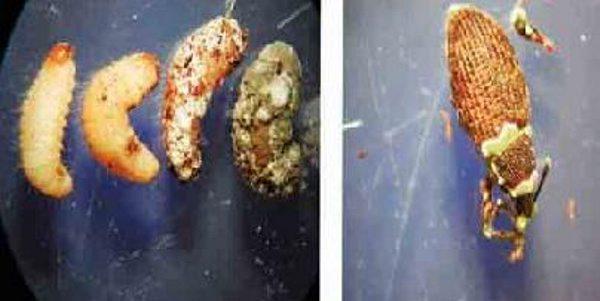
Michael Gaffney talked about biological control of black vine weevil - a pest which he described as 'walking ovaries'. Their feeding grubs can decimate the stems of plants and it has a massive potential to multiply.
Michael showed that the fungus Metarhizium anisopliae can attack and kill the larvae and can also kill adults. Comparing this with other biological agents in a nursery scale field trial, he found that it was somewhat inferior to another product but that the mixture of the two agents was at least as good or better than the best.
Another experiment compared it to a nematode control agent with similar results. In this case a half rate combination was better than the best at full rate.
This led him to consider if stressing agents on the insects would help the efficacy of biological control agents. He used ground neem kernels as a stressing agent and found that it improved the efficacy of the fungus, making application timing less important and helping provide long term control efficacy.


SHARING OPTIONS