


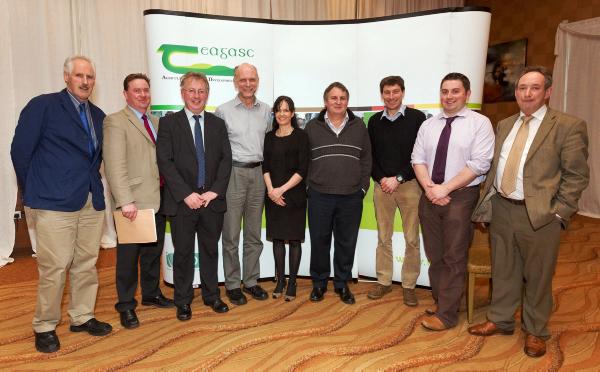
Last week, Teagasc held an afternoon conference for vegetable growers. Markets, prices and production tools were among the main topics discussed. Agronomist John Hogan told the meeting that there is an obvious and direct anomaly between the plausible objectives of Integrated Pest Management (IPM) and the low to zero tolerance levels for damage being operated by many supermarkets.
The IPM market challenge
The area devoted to vegetable crops is decreasing, as is the number of growers. Supermarket power is a double-edged sword in that it provides the market, but also the supply specifications around it. They want the supply industry to aspire to decreased pesticide use while having a zero tolerance for many of the potential ailments that will arise as growers move to meet IPM requirements.
Agronomist John Hogan told the meeting that the short-term approach to supermarket tendering leaves no room for the use of IPM in vegetable production. He said that the zero or very low tolerance levels for ailments leave growers with no option but to ensure the quality of their crops through pesticide use. If they are less than successful doing this, they may have no market.
IPM just cannot deliver the very tight specs being demanded and implemented by the supermarkets, John said. While growers will still use many different aspects of IPM during the production process, many feel that this is really about pesticides and chemical use.
And while there are a number of alternatives to pesticides available, John stated that these will frequently result is some level of damage to the product. So if the supermarket and the consumer want reduced pesticide use, they will have to modify their purchase specs accordingly.
Ensuring properly balanced soil pH and fertility is very much part of an IPM system, John said. Indeed, he indicated the potential benefits of applying the P and K in the autumn before the crop is sown to enable them to work into the soil and be more available for a spring-sown crop. The use of crop covers is also very beneficial for IPM as they can help prevent infestation by pests like carrot root fly, cabbage root fly, aphids, caterpillars, pigeons, etc. And the physical barrier helps reduce the subsequent requirement for insecticides.
IPM is now a requirement of law for all farmers since 1 January last. Gordon Rennick from the Department explained that IPM must now be practiced by all farmers, but this is nothing new to them, he stated. Farmers always make management decisions that aim to decrease their dependence on pesticides and also their cost of production.
Gordon reminded all present that we have an obligation to provide safeguards for areas like water abstraction points, to protect our ground water supplies and to operate buffer zones for pesticide use close to water courses.
Against this background, everyone needs to use non-chemical initiatives to help decrease the dependence on pesticides. But he also emphasised that there are many different tools in the IPM toolbox and these include chemicals. There are also cultural and biological control methods such as rotation, variety selection, etc. But he acknowledged that the successful use of biologicals will be difficult for field use.
Gordon reminded growers that they will have to fill in an IPM sheet associated with pesticide use this year. This is basically about giving a reason as to why a plant protection product is being used and also to state other actions used to help decrease the need for individual products. Examples might include the use of fleece to help keep out pests, the use of thresholds to guide treatment, the use of rotation to prevent certain diseases and the use of prediction mechanisms to identify a potential threat.
Also speaking at the conference was Teagasc researcher Michael Gaffney, who told delegates to tackle the big pests first with IPM. Once growers get to grips with optimising alternative control measures for the big pests, a similar approach for the smaller ones will appear more natural and easier to implement.
While the use of pesticides will not be eliminated, Michael said that development will continue with other approaches. He said that Teagasc was currently working with biocontrol agents and was examining if the lowering of storage temperatures before use would help them acclimatise to the likely conditions that might apply in the field at the time of application.
Dealing with slugs in the absence of Draza or methiocarb will become a reality sometime in the future. At the conference, Gordon Port from Newcastle University explained that the unpredictable behaviour of slugs adds to the challenge of control, regardless of what active is used. He said that they do not have a predictable seasonal life cycle, they can breed at any time of year, variable proportions of the population can feed at any time and they can migrate into the soil if conditions dry out.
Slugs are most active in moist conditions when temperatures are normal, Gordon stated. He recommended using traps to get a handle on numbers and activity. He favours the inverted flower-pot base with chicken feed as bait and suggested a threshold for action of four or more in cereals, one or more in oilseed rape, one in sprouts and anything above zero in lettuce. The likelihood of damage is increased on heavy soil, in dense canopies, in coarse seedbeds, with shallow sowing and where the history of a field shows a pattern of damage.
There are three main options to consider when controlling slugs. The first is cultivation, which can physically kill a proportion of the slugs, leaving others exposed to natural predation, while some will be buried by the cultivation and juvenile slugs or eggs can be subject to desiccation when the surface of the soil is allowed to dry out.
There are some natural predators for slugs, but not many. Nematodes can be used to carry bacteria into the slugs, but this is a very expensive process. Ground beetles also kill slugs, but the degree of benefit is unknown.
The final control procedure is the use of molluscicides. The current actives are all good molluscicides, but their effects are not always clear. Draza will be gone soon as slug pellets based on methiocarb must be removed from the market by 19 September, which means they can no longer be sold after this date. There will be a further 12 months to use up all existing stocks and this means that the last legal use date will be 19 September 2015.
Other snippets
The efficacy of biological control agents may be improved by the fact that the large multinational companies are now in that business. Peter Parr, who spoke at the meeting, asked if this might herald an era of improved formulation technology, which could improve the efficacy of the current biological control agents.
Andy Richardson reminded us that Dursban remains under threat from registration due to the challenges it has with water. Andy also told us that Wing P is now registered for use in Ireland as a residual herbicide on broccoli, cauliflower and sprouts. It should only be used pre-planting.
Andy also said that Totril will be gone from the market by August 2017 and that the arrival of Butryflo (bromoxynil) will cover a similar range of weeds.


SHARING OPTIONS