



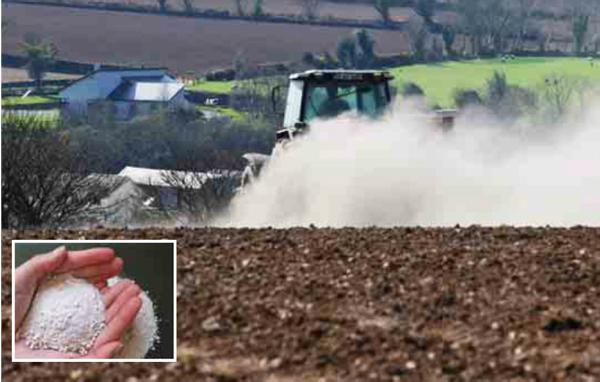

This is because of its combined characteristics and especially the fact that it is a renowned flocculent material, or soil conditioner.
Flocculation is a process which helps soil particles to bind together to help keep soils open. This is done chemically rather than physically but the chemical reactions can have a physical effect.
Rather than particles existing as individuals, they can be re-organised in a way that makes individual soil particles much bigger (Figure 1) and this can change the soil’s physical characteristics.
Flocculated soils are more open. They allow for better water percolation down through the soil and, at the same time, facilitate root growth and air transfer. They are less tight and may be somewhat easier to work. Basically, the use of gypsum can help soil structure and this is something that is on most farmers’ minds following recent bad years.
This is important at this time because many farmers are considering actions to help improve areas in fields with known problems. Unlike many other products we apply to our soils, gypsum will move much deeper to have a direct consequence down into the soil profile.
More and more fields are showing areas where water percolation difficulties are increasing. Dips in fields that never had a problem historically may have held water many times in recent years, leaving a footprint that seems to be getting bigger and bigger. These problems are more likely to be associated with water percolation difficulties rather than compaction but subsoiling is the automatic farmer reaction.
Leaving aside the debate about the likely merits of subsoiling following a dry summer, the problem is that subsoiling will only open up the ground to its working depth. If the problem is deeper, then the problem remains.
||PIC2||
And if the migration of fine and small soil particles down the profile is causing the lack of percolation, then loosening the soil merely makes it easier for these fine soil particles to get to deeper depths and make a new problem that becomes worse in time and which is extremely difficult to remedy.
The question is: could an application of gypsum alone help to open up this soil area and provide a more sustainable remedy?
Where does it
come from?
This question is being asked now mainly because sources of gypsum are re-appearing on the market. Gypsum is a calcium plus sulphur (S) product (23% and 19%, respectively), technically called calcium sulphate dihydrate, with the chemical formula CaSO4 2H2O.
The traditional source of gypsum was that it was mined from the ground. But in recent decades the scrubbing of industrial facilities to prevent the release of sulphur products that result in pollution has resulted in a new source of synthetic gypsum through the process of ‘flue-gas de-sulphurisation’.
As well as being a soil conditioner and fertility agent, gypsum is mainly used in the plasterboard industry. And it is the recycling of plasterboard that is providing a source of gypsum that will be available for field application. This recycled material claims to contain higher concentrations of calcium, sulphur and trace elements than the gypsum rock because of the refining process used in plasterboard manufacture.
Very soluble
Technically, gypsum is a soil conditioner, a source of calcium and an important source of sulphur for worn tillage soils. It also has other claimed characteristics in that, as a source of calcium, it is about 200 times more soluble than agricultural lime, or calcium carbonate.
This enables it to move readily down through the soil profile where it can help soil structure problems deep in the soil and provide nutrients to deep plant roots.
However, gypsum is not a liming agent. It does not neutralise hydrogen ions or change soil pH as efficiently as calcium carbonate. But in the event of sub-5pH levels, gypsum has a particular ability to reduce the aluminium toxicity that is often associated with very acidic soils.
Source of sulphur
Sulphur is an essential element for plant growth. It is essential for making proteins, as amino acids like methionine and cysteine contain sulphur atoms. Sulphur is also very important in the nitrogen fixing enzyme, nitrogenase, found in legumes, as this also has a very high requirement for sulphur.
Sulphur was traditionally supplied to soil from the breakdown of organic matter and from atmospheric depositions. Traditionally, there were significant sulphur impurity levels in artificial fertilizers but these have been mainly eliminated due to improved industrial processes.
Atmospheric depositions have also been substantially decreased so that there is much less sulphur being added to support plant growth. And add to this the fact that soils have been tilled for longer and are now more worn, plus the fact that crop yields have increased considerably.
These things combine to increase the risk of deficiency. We attempt to counteract that in tillage by using fertilizers containing sulphur. If sulphur was not needed in the fertilizers, especially nitrogen, it would provide more choice flexibility to growers.
Putting it on in advance of requirement is generally not advised but the use of gypsum might provide a real alternative.
Most growers will know that sulphur is important to enable the efficient use of nitrogen. For this reason, S deficiency looks like nitrogen deficiency because the interaction between both elements is highly significant.
Calcium for plant
and soil health
Gypsum also provides calcium. While soils with adequate pH might be expected to have adequate calcium, this might not necessarily be the case.
Some crops have a greater calcium requirement than others, with potatoes being among the most responsive annual crop. In this crop, added calcium is associated with stronger cell walls that make the tubers more robust to improve storability.
Calcium tends to be required in big amounts in actively growing organs. In most crops, root tips and root hairs need a lot of calcium and lack of the nutrient may influence the extent of root growth and activity. And because gypsum can move deeper into the profile than most other forms of calcium, this may help result in deeper rooting.
While gypsum provides calcium, it is not really a liming agent but it can impact deeper into the soil than lime.
But perhaps the biggest effect of calcium is its claimed ‘flocculating’ ability in the soil to improve soil structure. Flocculation is the aggregation or clumping together of soil particles and this is largely influenced by which positively charged ions are present at the exchange sites in soil.
Where there is a large concentration of ions with more than one positive charge, such as calcium (Ca2+) and magnesium (Mg2+), these help to hold soil particles together in stable aggregates. But where high levels of single-charge ions are present, especially sodium (Na+), they will cause soil particles to disperse.
Calcium is one of the best flocculating nutrients and well flocculated soils tend to be more resistant to capping, cracking and erosion while being more favourable for root growth, water percolation and soil aeration.
Lack of aggregation, or flocculation, in turn, causes poor root growth and poor soil structure that is more prone to waterlogging, erosion, reduced percolation, surface-capping and compaction.
If gypsum can achieve these effects in the soil, the result would be a wider weather window for establishing, maintaining and harvesting and the ability to cope better with heavy machinery. It should also help prevent the soils from tightening, with all the associated consequences.
Velcourt trials
A replicated field trial on winter wheat was conducted by Velcourt in Britain in 2007 which found recycled gypsum to show benefit at field level. This was applied to a heavy soil with percolation difficulties in the field.
They applied three and six tonnes per hectare of both agricultural grade and recycled gypsum and the broad range of results indicated that the recycled product was superior for all of the characteristics examined and that the three-tonne rate was as good as or better than the six-tonne rate.
The trial also looked at four nitrogen rate treatments on each gypsum treatment, plus an area not treated with gypsum.
The product was deemed to be easily spreadable with a lime spreader and there were no worrying issues recorded with the high rate.
Where the recycled product was applied, the winter wheat crop grew more leaf to intercept more light and produced higher grain yield. This treatment also produced higher specific weight grain which had a higher thousand grain weight.
There were no recorded benefits in physical soil characteristics found in that year. But it was noted that yield level was higher than might have been expected given that the land had to endure both waterlogging and drought in the same season.
A somewhat similar trial on potatoes was carried out on a sandy loam soil that had been intensively worked with potatoes, cereals and other vegetables and was deemed to be poorly structured.
The results showed no total yield or marketable yield benefits from the use of either gypsum source. There was no benefit in terms of reduced soil on the tubers either but then there was virtually no soil on the untreated plots either given the sandy soil.
The gypsum treatments showed no benefit in terms of reduction in common scab but the treated plots showed significantly reduced growth cracks in the tubers.
Rate and availability
As of now, we have little to recommend the widespread use of gypsum on Irish farms but this historic record of its performance is worthy of consideration.
It must be especially interesting as a spot treatment on the saucers where water has been lying in recent years. But it could also be interesting at an autumn applied source of sulphur with added side benefits.
Used for soil conditioning, the application rate suggested is two to three tonnes per ha. At roughly €70/t delivered, this is a big cost and so more likely to be considered for treating spots with infiltration or growing difficulties. The gypsum rate to apply sulphur is put at 170kg to 200kg/ha so this could be a real sulphur option for both grassland and tillage farmers.
Interestingly, a granular product is to be made available next spring.
The recycled product is available from James Dorman at 0044 7766 595095. There will only be limited quantities available this autumn but supply will increase in time.


SHARING OPTIONS