


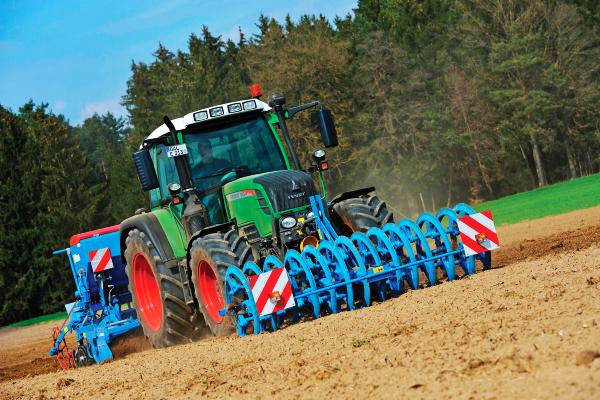
Changes in agricultural production techniques have meant a continuous increase of machinery power, vehicle weight, and equipment size to improve labour efficiency. Tractors, combines, forage harvesters, grain and forage trailers have become progressively bigger.
This increase in equipment size may cause significant soil compaction that can negatively affect soil productivity, as well as environmental quality.
Soil is composed of three components: air, water, and solid particles. Soil compaction occurs when pressure is exerted on the soil surface, reducing the space available for air and water as the solid particles are pressed closer together.
Overuse of machinery, intensive cropping, short crop rotations, intensive grazing, and inappropriate soil management all lead to compaction.
Soil compaction increases soil strength (bulk density) and decreases soil physical fertility by reducing the facility to store and supply air, water, and nutrients.
Soil compaction also restricts the development of crop roots. Compaction decreases soil aeration which causes increased denitrification within the soil.
Compaction-induced nitrogen and potassium deficiencies can also occur. These can lead to additional fertilizer needed and increased production costs.
Soil compaction is linked to changes in soil properties which control the emission of greenhouse gases, the runoff of water and pollutants into surface waters, and the movement of nitrate and pesticides into ground waters.
Compaction of tillage soils can occur in different ways. The potential for compaction is increased early in the season due to tillage operations.
Wheel traffic is the major cause of soil compaction and arises from the use of larger, heavier farm machinery.
Even one-pass sowing units can cause compaction if used when soil is not fully fit for traffic.
Continuous tillage operations at the same depth can cause compaction by creating soil pans which are usually 25mm to 50mm (1-2 inches) thick.
Crop rotation can also contribute to compaction by limiting the rooting systems which develop in the soil, particularly if there are no deeper-penetrating rooting systems included in the rotation which could break up pans.
The natural phenomenon of raindrops falling onto an exposed soil surface can affect soil physical fertility by forming a soil crust, preventing seedling emergence.
One of the main objectives of soil cultivation is to loosen the soil, allowing good aeration and water movement for optimum plant growth.
Soils loosened by tillage have no inherent strength and are not able to withstand the compressive forces exerted by vehicle traffic.
The stress caused to soil by vehicles during field operations can be alleviated by either reducing the load on the soil or by increasing the contact area between the load and the soil.
Research conducted by UCD Crop Science investigated variations in the level of compaction observed when the total load trafficked across the soil was reduced and when the contact area at the tyre/soil interface was increased.
Standard sowing operations for spring barley were conducted under different conditions of tyre inflation pressure, front axle load, rear tyre size, and traffic frequency (number of passes).
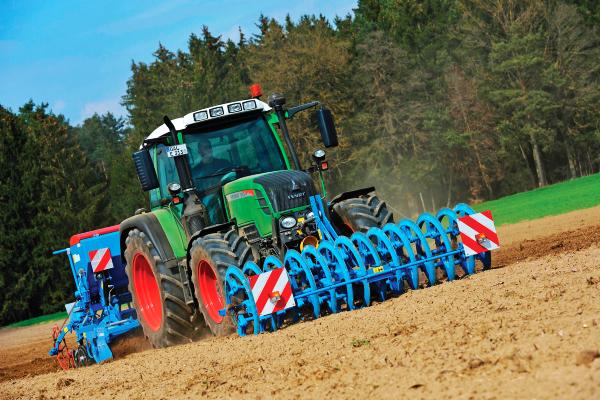
The sowing equipment used was a 3m Accord DA pneumatic seed drill mounted on a 3m Kuhn HR 3002 power harrow. This sowing unit was rear-mounted on a tractor fitted with 540/65 R 28 Massey Ferguson 6280 front axle tyres and a range of rear tyre sizes.
During the growing season, the level of compaction was recorded in trafficked zones, untrafficked zones (centreline of each trial plot), and in an unsown control strip by measuring soil penetration resistance using a penetrologger apparatus.
These readings can be used to determine what amount and what depth of compaction in the soil.
Tyre pressures
Trial 1 investigated the effect of tyre inflation pressures on the soil compaction. Four conditions of tyre inflation were investigated: extra high (2.2 bar), high (1.6 bar), medium (1.1 bar), and low (0.8 bar), each under high front axle load conditions. This means that the tractor carried the maximum front ballast weight supplied by the manufacturer (4,200kg).
The results of this test showed that although compaction was evident when the trial plots were compared to an unsown control strip, there was no additional effect due to tyre inflation pressure.
This indicates that the heavy front axle weight was causing more compaction and outweighing the positive effect of reducing rear tyre pressure.
Front axle loads
Trial 2 investigated changes in the level of soil compaction when the front axle load was changed. This consisted of adjusting the front axle load of the tractor with (high front axle load, 4,200kg) and without (low front axle load, 3,160kg) the front ballast weight. All tests in this experiment were conducted at low tyre inflation pressure (0.8 bar).
The results of this test indicate considerable differences in the level of compaction observed under high front axle load and the unsown control strip.
There was very little difference between the low front axle load plot and the control. These results suggest that the front axle load has a considerable effect on compaction.
Number of passes
Trial 3 investigated the effect of making two passes using either high front axle load at high tyre inflation pressure (1.6 bar) or low front axle load at low tyre inflation pressure (0.8 bar).
During the first pass, the seed drill drive wheel was disengaged to prevent the sowing of seed to simulate when a part of the field may require a second pass of a power harrow.
During the second pass, the seed drill drive wheel was engaged and normal sowing operations were conducted.
This test indicated that a second pass of the power harrow combination with the front weight block attached caused a very significant increase in the level of compaction. Two passes without the front weight block caused some level of compaction, but this was lower than one pass with the weight block attached.
Tyre size and pressure
Trial 4 investigated the effect of both tyre size and tyre inflation pressure on the level of compaction.
Both high (1.6 bar) and low (0.8 bar) inflation pressure were investigated using the four different rear tyres of different sizes, supplied by AgriGear (Bailieborough, Co Cavan) and fitted with the assistance of JR Perry Ltd (Athy, Co Kildare).
In all cases, the front ballast weight was removed and the tests were conducted under low front axle weight conditions. This test showed that the level of soil compaction decreased with increasing soil tyre width under both high and low tyre inflation pressure.
Tyre inflation pressure itself had little influence on compaction with the wider tyres.
Research team findings
The researchers found a negative impact of soil compaction on crop productivity.
They found that tractors with a high front axle load operated at high tyre pressure caused full ear emergence to occur 16 days later than in the low front axle load at low tyre inflation pressures.
They also found a lack of uniformity of ear emergence and reduced grain yield under higher compaction conditions. The results clearly show that the lowest achievable ground contact pressure should be used in all cultivation processes.
This requires minimising axle loads, fitting the widest tyres possible or dual wheels, and using low tyre inflation pressures.
The researchers believe that a front furrow-press is a better form of ballast as its weight does not act on the front axle during the sowing process.
The front furrow-press also offers an opportunity to till/consolidate the zone between the tractor’s tyres which is necessary to produce a uniform seedbed, particularly when working directly on ploughed soil with a till-and-sow combination unit.
Above are the tyre size options used in the UCD compaction study.


SHARING OPTIONS