How are you preparing for winter? Keeping your house warm and your heating systems efficient is generally one way. But this presents a challenge for older and harder-to-heat homes, which can be poorly insulated and expensive to upgrade.
There are plenty of options available to consumers to upgrade their heating system and reduce their fuel bill but the decision is often dependent on the home you own, according to Keith Scully, training manager at Grant Ireland.
Let’s first look at building a new property. In this situation, heat pumps are very popular. “Many new homes have a heat pump as it’s the simplest way to achieve compliance with the building regulations,” says Keith. “A heat pump in a new property works really well, because it’s designed for that property. New builds have purpose-built insulation and very high air tightness measures.”
There is a national push towards heat pumps and the Government has committed to installing 400,000 heat pumps by the end of 2030. That being said, the country is nowhere near meeting that target, with 3,600 heat pumps installed in 2024.
Part of the problem is the upfront cost of installing a heat pump – it is too expensive for the majority of households. The price varies according to the size of the property, but it is in the region of €10,000-€15,000. The SEAI offers grants for heat pump installations of a maximum value up to €6,500 to incentivise more households to make the switch.
The estimated annual running costs also depend on the property, Keith explains. “Every house is different. You may be able to achieve a saving if you spend a little bit more on the insulation and the air tightness. What makes the heat pump efficient is dependent on the home and its ability to hold the heat.”
The expected lifespan of a heat pump is around 10 to 20 years. “If you have efficient radiators or underfloor heating in your house, your heat pump will run at a lower temperature, and it’s probably going to last 15 to 20 years. If the radiators are poorly serviced, you could be looking at 10 to 15 years,” says Keith.
If you live in an older property and are interested in a heat pump, this option may be pursued – but it is slightly more complicated. The home must be energy efficient – which may require an upgrade, guided by a technical assessment by a BER.
“There is a lot that has to happen within the house itself before you even consider fitting the heat pump,” Keith explains. Typical measures needed are attic and wall insulation upgrades, new external doors and windows and no open fireplaces. “That’s all the building work,” Keith adds. “Next the plumber would replace the boiler with the heat pump, replace the hot water cylinder and fit larger radiators, and depending on the existing pipework, that may be undersized. It’s an invasive process and the cost can vary depending on what’s needed to bring the home to the required standard. This can range anywhere between €15,000 and €45,000.”
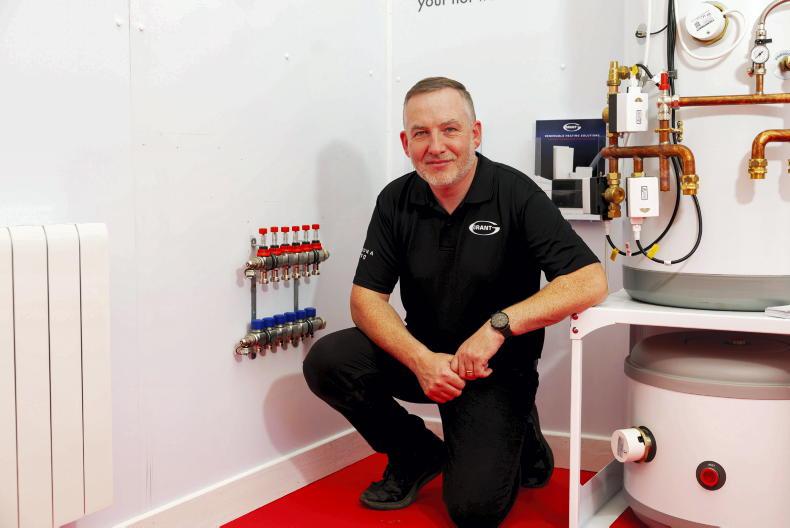
Keith Scully, training manager at Grant.
Condensing boiler
Another option is to replace an older oil-fired boiler with a condensing boiler. “Many older properties in rural Ireland have an oil boiler. Condensing boilers typically are 25% more efficient that their older predecessors,” says Keith.
“If it’s a straightforward boiler change, the cost would be from €2,500 to €4,000, depending on the property and the existing heating system.”
As well as being more energy efficient, some condensing boilers are also HVO (Hydrotreated Vegetable Oil) compatible which means they can be converted to HVO operation with a few alterations.
HVO biofuel is a low-carbon liquid fuel which plays an intermediary role in helping rural properties to transition to more sustainable home heating.
It’s not just condensing boilers that can use this fuel. “If someone has an oil-fired boiler, if they were to use this HVO biofuel, they don’t have to make any changes to their house at all. It’s the same oil boiler, it’s the same oil tank, it’s the same house, the same everything,” explains Keith. “And research has shown that, a 20% HVO blend in oil boilers, could have the equivalent emission reductions effect of retrofitting 160,000 homes with heat pumps if used nationally,” he points out.
How are you preparing for winter? Keeping your house warm and your heating systems efficient is generally one way. But this presents a challenge for older and harder-to-heat homes, which can be poorly insulated and expensive to upgrade.
There are plenty of options available to consumers to upgrade their heating system and reduce their fuel bill but the decision is often dependent on the home you own, according to Keith Scully, training manager at Grant Ireland.
Let’s first look at building a new property. In this situation, heat pumps are very popular. “Many new homes have a heat pump as it’s the simplest way to achieve compliance with the building regulations,” says Keith. “A heat pump in a new property works really well, because it’s designed for that property. New builds have purpose-built insulation and very high air tightness measures.”
There is a national push towards heat pumps and the Government has committed to installing 400,000 heat pumps by the end of 2030. That being said, the country is nowhere near meeting that target, with 3,600 heat pumps installed in 2024.
Part of the problem is the upfront cost of installing a heat pump – it is too expensive for the majority of households. The price varies according to the size of the property, but it is in the region of €10,000-€15,000. The SEAI offers grants for heat pump installations of a maximum value up to €6,500 to incentivise more households to make the switch.
The estimated annual running costs also depend on the property, Keith explains. “Every house is different. You may be able to achieve a saving if you spend a little bit more on the insulation and the air tightness. What makes the heat pump efficient is dependent on the home and its ability to hold the heat.”
The expected lifespan of a heat pump is around 10 to 20 years. “If you have efficient radiators or underfloor heating in your house, your heat pump will run at a lower temperature, and it’s probably going to last 15 to 20 years. If the radiators are poorly serviced, you could be looking at 10 to 15 years,” says Keith.
If you live in an older property and are interested in a heat pump, this option may be pursued – but it is slightly more complicated. The home must be energy efficient – which may require an upgrade, guided by a technical assessment by a BER.
“There is a lot that has to happen within the house itself before you even consider fitting the heat pump,” Keith explains. Typical measures needed are attic and wall insulation upgrades, new external doors and windows and no open fireplaces. “That’s all the building work,” Keith adds. “Next the plumber would replace the boiler with the heat pump, replace the hot water cylinder and fit larger radiators, and depending on the existing pipework, that may be undersized. It’s an invasive process and the cost can vary depending on what’s needed to bring the home to the required standard. This can range anywhere between €15,000 and €45,000.”
Keith Scully, training manager at Grant.
Condensing boiler
Another option is to replace an older oil-fired boiler with a condensing boiler. “Many older properties in rural Ireland have an oil boiler. Condensing boilers typically are 25% more efficient that their older predecessors,” says Keith.
“If it’s a straightforward boiler change, the cost would be from €2,500 to €4,000, depending on the property and the existing heating system.”
As well as being more energy efficient, some condensing boilers are also HVO (Hydrotreated Vegetable Oil) compatible which means they can be converted to HVO operation with a few alterations.
HVO biofuel is a low-carbon liquid fuel which plays an intermediary role in helping rural properties to transition to more sustainable home heating.
It’s not just condensing boilers that can use this fuel. “If someone has an oil-fired boiler, if they were to use this HVO biofuel, they don’t have to make any changes to their house at all. It’s the same oil boiler, it’s the same oil tank, it’s the same house, the same everything,” explains Keith. “And research has shown that, a 20% HVO blend in oil boilers, could have the equivalent emission reductions effect of retrofitting 160,000 homes with heat pumps if used nationally,” he points out.










SHARING OPTIONS