They held dominant positions in the international economic system, had the ability to influence events and project power on a worldwide scale to protect their own interests. Are we now witnessing the emergence of a new type of superpower?
It is well documented that supermarkets, at the end of the supply chain, furthest from the farmer but closest to the consumer, hold a disproportionate amount of power.
Recently, both Tesco and Walmart announced that they are putting more emphasis on sustainability and, in particular, on food.
Walmart CEO William S. Simon recently said that value in food brings footfall and he observed that ‘our customers continue to look for lower prices, particularly in challenging times’. Should farmers get ready for the TV crews to arrive and welcome these new farmer-friendly retailers?
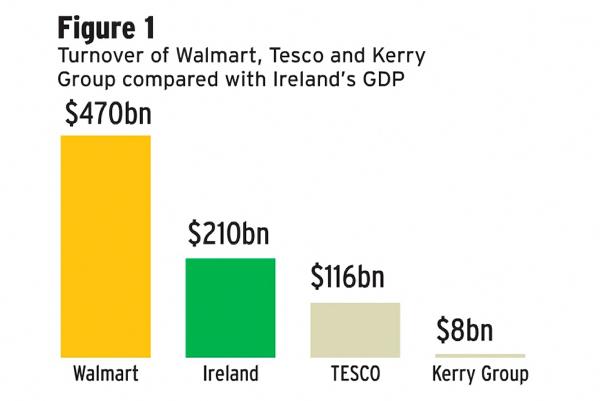
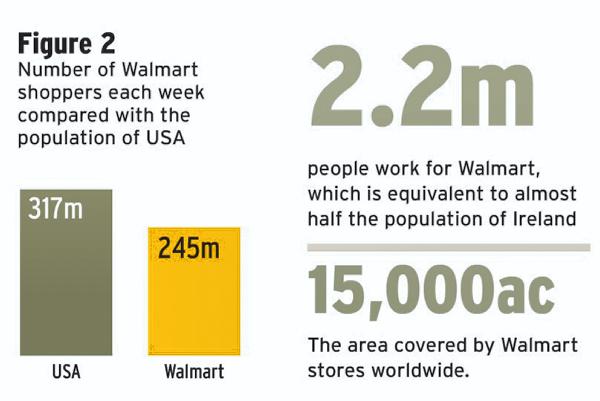
Walmart, the US-based retail giant, is the second largest company in the world, according to the Fortune 500 list. Shell Oil is only marginally bigger. Walmart is larger than many countries with a turnover of $469bn. Every week, 245 million people push trolleys down their aisles. That’s just over one third of the population of Europe every week. And it’s profitable. In 2012, they made $17bn, making it the 16th most profitable business in the world, according to Fortune.
Closer to home, Tesco whose mottos of ‘Food First’ and ‘Tesco Price Promise’ echo the low price model of Walmart has helped them achieve 28% market share.
Tesco’s Irish operation has 142 stores, employs 15,000 and has revenues in excess of £2.3bn with profits of their Irish operation estimated to be close to €160m.
And if you are the largest retailer, you must be a large buyer. Not surprisingly, Tesco is the largest single buyer of Irish food products. Ireland exports more to Tesco than to France, Germany or the US.
Tesco international stores buy almost 10% of the country’s total food and drink exports. According to a report published by Indecon Economic Consultants, Tesco is the biggest exporter of Irish beef, exporting €177m in 2010, which represents 14% of the entire value of beef exports, while dairy product exports totalled €178m confirming the significance of Tesco in the economy as a major exporter.
But their superpower status doesn’t stop there. Tesco has data on the shopping habits of 15 million customers going back 20 years. This big database offers them huge insight into the lives of people.
The global retail industry is dominated by 10 players sharing about 40% of worldwide retail sales. Walmart ranks first, while Tesco is seventh. Similarly, in Ireland, Tesco, Dunnes and Musgrave’s (SuperValu and Superquinn) control almost 80% of the €8.9bn Irish grocery market. The two German discounters Aldi and Lidl continue to grow and hold a combined 12%.
In Britain, market segmentation is similar, with the big four supermarkets — ASDA, Morrison’s, Tesco and Sainsbury’s — controlling 75% of the grocery market with the same global business model of keeping prices low and profits high.
The asset value of the top 12 retail corporations was over $564bn and Walmart alone represents 32% of this. The asset values of the next three — Carrefour, Tesco and CVS Caremark — were around one third of Walmart. This reiterates the economic prowess of Walmart and Tesco at the global level.
The real implications of Walmart’s comments and Tesco’s ‘Every Little Helps’ campaign is that food retailers will continue to grow their superpower status.
They will look to reduce costs and savings from food manufacturers and growers. Unless they can find savings with which to fund the price points necessary on which to retain customer loyalty, maintaining growth and margins will be extremely difficult for these huge multinational corporations.
ASDA FACTS
They held dominant positions in the international economic system, had the ability to influence events and project power on a worldwide scale to protect their own interests. Are we now witnessing the emergence of a new type of superpower?
It is well documented that supermarkets, at the end of the supply chain, furthest from the farmer but closest to the consumer, hold a disproportionate amount of power.
Recently, both Tesco and Walmart announced that they are putting more emphasis on sustainability and, in particular, on food.
Walmart CEO William S. Simon recently said that value in food brings footfall and he observed that ‘our customers continue to look for lower prices, particularly in challenging times’. Should farmers get ready for the TV crews to arrive and welcome these new farmer-friendly retailers?
Walmart, the US-based retail giant, is the second largest company in the world, according to the Fortune 500 list. Shell Oil is only marginally bigger. Walmart is larger than many countries with a turnover of $469bn. Every week, 245 million people push trolleys down their aisles. That’s just over one third of the population of Europe every week. And it’s profitable. In 2012, they made $17bn, making it the 16th most profitable business in the world, according to Fortune.
Closer to home, Tesco whose mottos of ‘Food First’ and ‘Tesco Price Promise’ echo the low price model of Walmart has helped them achieve 28% market share.
Tesco’s Irish operation has 142 stores, employs 15,000 and has revenues in excess of £2.3bn with profits of their Irish operation estimated to be close to €160m.
And if you are the largest retailer, you must be a large buyer. Not surprisingly, Tesco is the largest single buyer of Irish food products. Ireland exports more to Tesco than to France, Germany or the US.
Tesco international stores buy almost 10% of the country’s total food and drink exports. According to a report published by Indecon Economic Consultants, Tesco is the biggest exporter of Irish beef, exporting €177m in 2010, which represents 14% of the entire value of beef exports, while dairy product exports totalled €178m confirming the significance of Tesco in the economy as a major exporter.
But their superpower status doesn’t stop there. Tesco has data on the shopping habits of 15 million customers going back 20 years. This big database offers them huge insight into the lives of people.
The global retail industry is dominated by 10 players sharing about 40% of worldwide retail sales. Walmart ranks first, while Tesco is seventh. Similarly, in Ireland, Tesco, Dunnes and Musgrave’s (SuperValu and Superquinn) control almost 80% of the €8.9bn Irish grocery market. The two German discounters Aldi and Lidl continue to grow and hold a combined 12%.
In Britain, market segmentation is similar, with the big four supermarkets — ASDA, Morrison’s, Tesco and Sainsbury’s — controlling 75% of the grocery market with the same global business model of keeping prices low and profits high.
The asset value of the top 12 retail corporations was over $564bn and Walmart alone represents 32% of this. The asset values of the next three — Carrefour, Tesco and CVS Caremark — were around one third of Walmart. This reiterates the economic prowess of Walmart and Tesco at the global level.
The real implications of Walmart’s comments and Tesco’s ‘Every Little Helps’ campaign is that food retailers will continue to grow their superpower status.
They will look to reduce costs and savings from food manufacturers and growers. Unless they can find savings with which to fund the price points necessary on which to retain customer loyalty, maintaining growth and margins will be extremely difficult for these huge multinational corporations.
ASDA FACTS
Walmart owns ASDA in the UK.ASDA is the second-largest UK retailer after Tesco.It is a major buyer of Irish beef.It has 18 million shoppers per week 






SHARING OPTIONS