


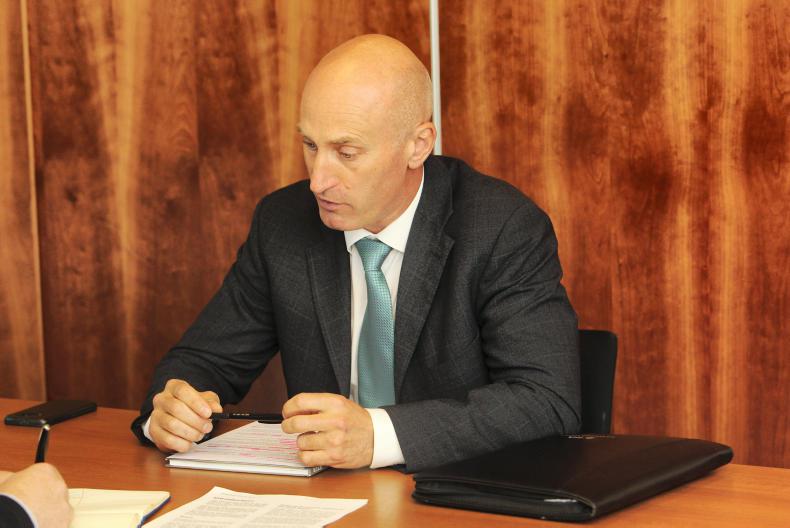
In an interview with the Irish Farmers Journal this week, IFA livestock chair Angus Woods took issue with the policy document produced by Meat Industry Ireland (MII) for missing the essential ingredient of farm profitability.
He questioned the lack of detail on how markets for additional beef would deliver a viable farmgate price, saying that “farmers being quoted a loss-making base price of €3.70/kg and being told by agents that they cannot take the stock for another week will not want to hear of plans to increase numbers”.
Comments in the MII report on achieving on-farm efficiencies also irritated the IFA livestock chair, saying that there was a Better farm programme in which key farm performance data was disclosed and he would be keen to see a similar Better factory programme with financial detail disclosed.
Market performance
The issue of the report advising about on-farm issues while avoiding specifics on processor market performance clearly rankled the IFA livestock chair, with the lack of competition and transparency in the meat processing sector highlighted.
That said, he accepted the need for ongoing improvement in farm efficiency and the IFA was lobbying for the BDGP programme to be reopened. He went further by emphasising the need for direct support for the suckler cow moving towards €200 per cow, as well as an increase in ANC payments.
It was the focus on farmer issues by MII in its document and the absence of any detail on what processors might do to improve farmgate prices that Woods was in disagreement with.
He believes that MII failed to explore how the huge price differential between Irish and British beef processors could be addressed, which he saw as a major weakness.
Woods refused to accept that it was satisfactory to benchmark Irish farmgate prices to an EU bull beef average, saying that the benchmark should be UK steer and heifer beef, which has similar production systems to Ireland.
The role of Bord Bia was also brought into the discussion, with Woods believing that it needs to come up with new promotion and marketing plans for Irish beef in the UK and across the EU that will return a better price to farmers.
He highlighted how developing the US market for prime beef would be an ideal opportunity to launch and build a premium Irish beef brand in a collaboration between Bord Bia and the companies supplying that market.
Positives
On the subject of trade deals and opening new beef markets, there was more of an endorsement of the MII document by the IFA livestock chair. He went further than MII on the ongoing trade discussions, suggesting that in light of the hard-line Brexit position adopted by the British prime minister, that the EU should put a brake on these discussions.
On the issue of market access for beef, the IFA position was at one with MII though with an important addition that would not be a priority for MII – live cattle needed to be included as well.
The MII proposal and the IFA reaction to it illustrates how sectors of the industry in Ireland are on different paths with different priorities. With the once-in-a-lifetime threat to the beef industry from Brexit, farmers and factories need to be on the same page.
The lack of transparency in the operation of large sections of the Irish beef processing industry means that farmer suppliers feel they are being ripped off.
Meat processing is typically high-volume and low-margin, but this is not understood or accepted in the absence of verifiable evidence that demonstrates it.
The ability of British sister companies to pay 50c/kg or more for a similar beef product at a time of big retail price promotions on UK Red Tractor beef adds to farmers’ grievances.
However, MII deserves credit for the initiative to put its collective thoughts in a plan and the IFA raises legitimate questions and challenges. No plan is written in stone and it is in the wider interest, particularly at this time, for farmers and processors to come together as one cannot exist without the other.





SHARING OPTIONS