



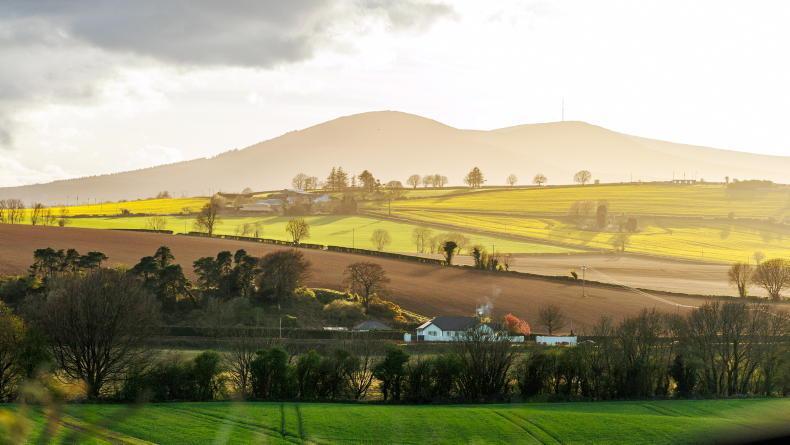
There have been questions around the delay in the publication of the second phase of the Land Use Review, which the Irish Farmers Journal understands was completed more than a year ago.
Those questions were answered this week when the report finally saw the light of day.
It contains “indicative pathways” for Ireland to reach the country’s 2050 sustainability goals, with each of those pathways seeing a huge upheaval for the country’s agriculture industry.
Both the press release accompanying the report and the report itself make it clear that the report is “not an articulation of Government policy” or a new strategy in relation to land use, nor has it been adopted by Government.
Minister for Agriculture Martin Heydon has also made clear that landowners in Ireland will be the ultimate decision makers when it comes to their land.
The report is, however, an overview of the Government of Ireland’s objectives and commitments for land use in Ireland and an evidence-based review which proposes a framework to inform and support policymakers in their decisions related to future land-use patterns in Ireland.
It highlights the multiple objectives Ireland has already set out which have a land use dimension, with commitments including an increase in agri-food exports to €21bn by 2030, while also achieving climate neutrality by 2050 and ensuring the long-term recovery of nature, protecting and improving water quality, and ensuring continuous improvement in air quality. Delivery on these commitments will, according to the report, require “extensive changes and land use management practice”.
The report says that Ireland is not on track to meet any of the socioeconomic, climate, biodiversity, water quality or air quality objectives and commitments considered in the report. Failure to meet greenhouse gas targets could lead to fines as high as €26bn. In addition, delay in implementing changes now could mean more costly and drastic action will be needed in future.
There are five “indicative pathways” presented which would culminate in different land use configurations by 2050. They are:
The analysis shows that the business-as-usual pathway would fall far short of climate neutrality and other environmental goals. The other four pathways have common elements “which would seem likely to meet Ireland’s climate objectives and commitments” while they would “affect socioeconomic outcomes for Ireland’s landholders”. Changes to land use and management practice could offer the potential for enhanced economic returns for some land holders, the report suggests.
Those socioeconomic effects, however, should not be underestimated. Under the five scenarios, the changes to output are indicated to be as per Table 1.
It is clear that any of the pathways, other than business as usual, would effectively crush Ireland’s beef sector, while the dairy industry sees potential growth under two pathways and cuts of either 16% to the 2020 baseline production under the “protein diversification” pathway and an unsustainable reduction of 58% compared to the baseline under the “cattle plus nature” pathway.
The report also contains pathways for afforestation out to 2100, which compares business-as-usual afforestation rate of circa 2,000 per year with current policy for 8,000 ha per year and a “high ambition, biodiverse” scenario for 16,000 ha per year until 2030 and 25,000 ha per year until 2080. The last of those scenarios would see 30% of Ireland’s land covered in forestry by the end of the century.
While the Government have said report is not an articulation of policy, it should be read in the wider context of CAP negotiations and what agricultural policies will be supported under the deal currently being negotiated. Earlier this year the European Scientific Advisory Board on Climate Change produced a report with recommendations for coherent EU polices on climate and agriculture.
Among those recommendations is a phasing out of CAP payments which incentivise the most greenhouse-gas intensive practices, including coupled payments for animal production. Phasing these out over the next CAP “could contribute not only to mitigation but also to adaptation by freeing up land that could be used for both mitigation and adaptation purposes” that report says.
When contacted by the Irish Farmers Journal for comment on the Land Use Review, IFA environment and rural affairs chair John Murphy said it “raises a number of significant issues for farmers and highlights the increasingly complex and competing demands being placed on Ireland’s land base and reinforces the urgent need for greater policy coherence, long-term planning and secure financing frameworks.
“IFA will take time to fully consider this substantial piece of work and review its proposals in detail. However, it is already clear that farmers will have serious questions regarding some of the scenarios outlined and the pace and scale of change envisaged.”
He concluded that, in line with the report’s findings, clear leadership, long-term funding, and voluntary locally led implementation frameworks are required if farmers are to engage with confidence and as genuine partners in this transition.
TJ Flanagan, CEO of ICOS, when contacted by the Irish Farmers Journal, succinctly said: “Ireland would need three time the land area to meet the commitments made by successive governments.” He added that any changes would need to take cognisance of the rural economy as a whole and the number of people employed in the agri-food sector.
The Land Use Review is a document born of years of disjointed government policy where climate ambitions are made, often on a statutory basis, without enough action being taken on implementation, while targets for agri-food output are also put in place which seem to run counter to climate targets.
The report is a reflection of this apparent policy dichotomy, and it does its best to square the required outputs. While we can be certain that the eventual outcome will be different from any of the proposed pathways contained in it, the direction of travel cannot be avoided if Ireland is to avoid substantial fines in future.
Negotiations over the next CAP are already underway, and while Ireland’s presidency of the European Union is unlikely to see them completed, the groundwork can certainly be put down now. If the next few years are going to see government policies and objectives coming home to roost, then it must be ensured that the transition, whatever form it takes is a just one which does not leave farmers carrying the can for promises made.


SHARING OPTIONS