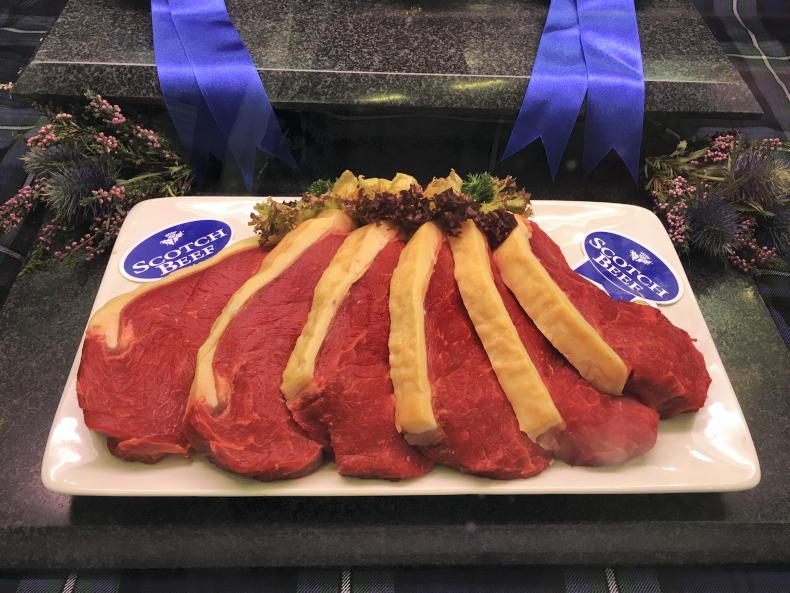
Scotland has had a PGI for beef and lamb for 20 years and, in that time, its beef has commanded a significant price premium in the UK market, but with little impact on its lamb price.
However, its beef price premium is also coming under pressure according to Scottish Farmer editor John Sleigh, who was one of the many visitors to the Irish Farmers Journal stand on Wednesday morning.
His first point on the PGI was that, since Brexit, the PGI as it was originally acquired no longer exists as Scotland is no longer part of the EU.
He pointed out that in practical terms, however, this has made no difference as the PGI legislation has basically been copied into UK law, and it is business as usual.
Live exports of lambs
As for the lack of impact on the lamb sector, he highlighted that the route to market is very different for lamb than it is for beef.
“A large number of our lambs don’t qualify for the PGI as many are sold as stores, and anywhere from one third to, at times, as many as two thirds of our lambs are processed in factories in England,” he said.
This means that they don’t meet the slaughter criteria required by the PGI rules.
Returning to the beef premium, while the latest AHDB price comparison data for the different regions of Great Britain show that Scotland is the top at present, that position isn’t as secure as it was a decade ago.
“Whereas in the past the Scotch beef premium was consistently around 20p/kg (23c/kg), there was a long period this year when our price was actually lower than England and Wales before recovering in recent weeks” Sleigh told the Irish Farmers Journal.
Iain Macdonald, market intelligence manager with Quality Meat Scotland gave more detail on the issue in a conversation with the Irish Farmers Journal.
He said: “When comparing R4L steer prices in Scotland with England and Wales, we have seen a reversal in recent weeks, with Scottish prices pushing ahead of England and Wales in mid-July having traded at a discount for most of the year to date, and the gap then widening.
"Between January and April, Scottish prices had been slightly below England and Wales, with the gap widening to around -1% through May, June and the first half of July. However, this shifted quickly in mid-July, and, by the final week of August, the Scottish price had risen 2.3% above the level in England and Wales.
"In the first half of September, the price gap has stabilised at 2.3-2.4% and 14-15p/kg (16-17c/kg), with Scottish R4L steers reaching 635.4p/kg (748c/kg) in the week ending September 12.
Beef premium
Iain Macdonald also reflected on the recent history of the Scotch beef premium.
“When looking back over time, the Scottish premium has generally been smaller in the 2020s than it had been in the 2010s, with the weekly difference averaging 1.3% since 2020, down from a 3.4% gap between 2010 and 2019. As an example, between mid-August and mid-September 2026, it has averaged about 2.3% and 14p/kg, compared to 5.3% and 19p/kg in the same period of 2016. The peak level recorded in a data series going back to mid-2009 was in summer 2013, at 8% and 31p/kg.”
He also commented on the seasonal nature of beef production in Scotland.
“In recent years, we have often seen Scottish prices looking relatively stronger in the autumn, and this appears to be the case again in 2026. The dominance of spring calving results in Scottish supplies being at their lowest of the year through the summer and this may support competition for cattle moving into autumn as the early-finishing spring calves from the previous year come on stream. By contrast, Scottish supplies tend to be relatively strong at the start of the year, when spring-born calves are reaching peak slaughter ages at around 21 months, and this often sees Scottish prices at their softest relative to England and Wales.”
There is no clear answer as to why the premium for Scotch beef is less secure now than it was in the past. The premium end of the UK beef market is very much in the retail sector, which concentrates on the promotion of British beef, supported by Irish in the case or the three largest supermarkets (Tesco, Sainsbury’s and Asda).
Since Brexit, in the catering beef market, in which Scotch beef is the recognised market leader, competition has intensified, particularly with Australian and New Zealand beef since they secured large tariff-free quotas in a trade deal with the UK.
Whatever the reason, the challenge faced by Scotland in maintaining a premium for its Scotch beef brand, underpinned by the UK equivalent of a PGI, is a reminder of the challenge we face as we try to build a premium for Irish grass-fed beef.