



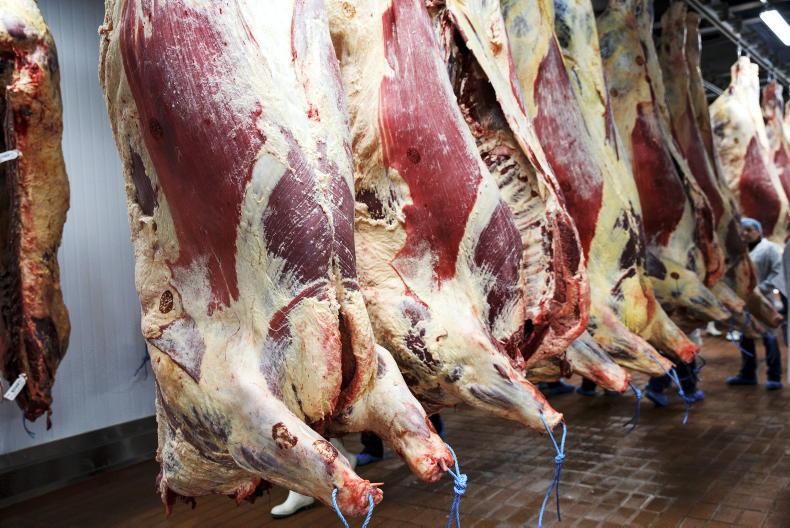
Last week’s kill continued to fall, with just over 650 fewer cattle slaughtered compared with the week before, coming in at 31,929 head - the lowest kill excluding bank holiday weeks since the middle of May.
Agents are reporting tighter numbers on the ground, with very little delays now in killing cattle.
This has sharpened the trade a little in the last few days.
There was talk last week about quotes slipping back to €4.75/kg.
Some factories are still quoting €4.75/kg base price for bullocks, but nearly all bullocks have been bought at €4.80/kg this week.
Heifers are generally being quoted at €4.85/kg, with €4.90/kg on offer in some of the smaller operators.
Larger finishers and regular customers continue to work 10c to 20c/kg ahead of quoted prices.
This is clearly evident in prices being paid for factory-fit cattle in marts this week.
Sterling has been trading around 85p:€1 since the beginning of July, which is a huge help to Irish exporters exporting beef to Britain.
Cow trade
The cow trade is steady, with P+3+ cows being quoted at €3.80/kg to €3.90/kg this week.
R grading cows are being quoted from €4.20/kg to €4.30/kg, depending on the factory, while O grading cows are working off quotes of €4.10/kg to €4.20/kg. U grading cows are being quoted at €4.30/kg to €4.40/kg this week.
Bulls
Base prices for under-16-month bulls are coming in at €4.80/kg to €4.85/kg.
Young under-24-month bull quotes are also under pressure, with U grading bulls now back at €4.90/kg to €5.00/kg.
R grading under-24-month bulls are being quoted at €4.80/kg to €4.90/kg, with O grading bulls back at €4.70/kg to €4.80/kg.
P grading under-24-month bulls are working off €4.60/kg to €4.70/kg this week.
Speaking to the Irish Farmers Journal, Irish Farmers’ Association (IFA) livestock chair Brendan Golden said: “Farmers should resist factory pressure to get quotes lower. Grass cattle are in tight supply and finishers should use this to their advantage.
“Some factories have tried to pressurise farmers into selling under-fit cattle in recent weeks, with some farmers getting big penalties killing under-fleshed stock.”
Losing a breed bonus and an in-spec bonus could be as high as 40c/kg or €120/head on a 300kg carcase, so farmers should make sure that animals have a minimum level of cover before slaughter. Looking to world beef markets, things look steady for the remainder of 2023.
Despite the economic difficulties that China is going through, the United States Department of Agriculture (USDA) maintained its beef import expectations for this year at 3.5 million tonnes, the same record levels as in 2022.
The EU is forecast to be back by 2% in terms of beef production for 2023, with EU consumption back by 1%.
UK consumption is set to grow by 1% in 2023. Australia is forecast to have the largest increase in beef production in 2023 at a 10% increase.
Brazil keeps its spot as the world’s largest exporter of beef, forecast to export just over three million tonnes in 2023, followed by the USA at 1.45 million tonnes and Australia at 1.42 million tonnes.
NI comment
Cattle quotes are down 4p to 6p/kg, with U-3 grading animals generally on 454p/kg (€5.56/kg inc VAT), although price deals continue to run well above these levels.
Most reports indicate in-spec steers and heifers are moving off farm between 472p and 478p/kg (€5.78 to €5.85/kg), with the higher end of the outlined prices easier to secure on bigger numbers.
Cows are on a base of 365p/kg (€4.47/kg) for R3 animals, but deals are generally around 390p/kg (€4.78/kg).



SHARING OPTIONS