


Of the heifers that calve down for the first time, approximately 83% will produce a second calf with an average calving interval of 403 days. The figures highlight one of the main areas of production where improvement can be made with the Irish suckler herd.
On reflection, the average age does not come as a surprise considering that the three main target ages for calving heifers are 24 months, 30 months and 36 months. The trend over recent years has seen the average age for heifers calving down for the first time moving in the wrong direction. In 2006, the average age was 30.5 months, which means that there has been a slip of two months per year over the last seven years.
Management
The age at which heifers calve down into a herd is closely linked with the level of herd management. Successfully calving heifers at 24 months and getting them back in calf requires a high standard of management.
Some producers may be able to get the heifer to calve at 24 months, but being able to have the animal produce a second calf by 36 months proves to be a stumbling block. This is where herd management comes into play by ensuring the animal is correctly managed to meet weight targets and correctly fed to meet nutritional demand.
The information provided by ICBF indicates that as the age at which the heifer calves for the first time increases, the herd management levels are less efficient as cows are not lasting past their third, or fourth calving. While this is a general trend, there will be well be plenty of cases in well run suckler herds where heifers calve at 36 months, or older, and remain in the herd for close on 10 years.
Age at first calving
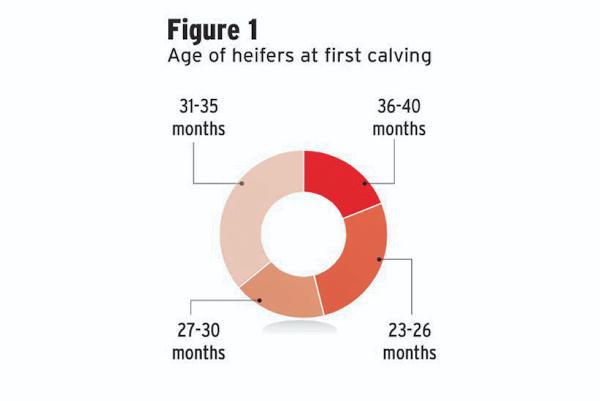
Figure 1 represents the average age of heifers at calving, separated into four age brackets. Between the ages of 23 to 26 months, there are 27% of heifers calving annually. This is reduced to 18% for heifers calving between the ages of 27 to 30 months. Between the ages of 31 to 35 months, 36% of heifers calved in this age bracket, with 19% calving between the ages of 36 to 40 months.
Breed type
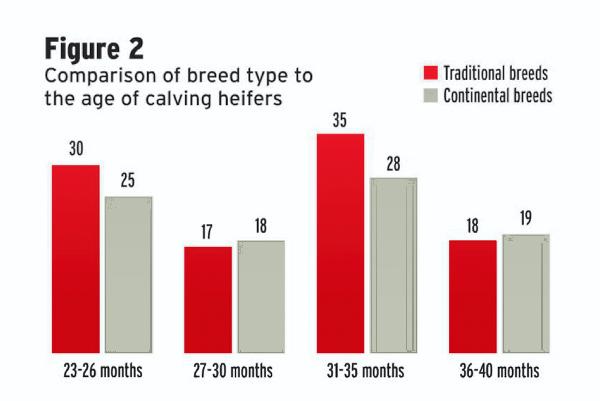
Figure 2 profiles the age breakdown of heifers into traditional beef breeds and continental breeds.
Traditional breed types such as Angus, Hereford and Shorthorn are early maturing breeds and viewed as animals that are easier to calve down at younger ages. However, from Figure 2 there are more traditional breed heifers calving at 31 to 35 months, rather than 23 to 26 months.
As dairy herds frequently use traditional breeds for cross breeding, the later calving age may be partly influenced through purchased replacements coming from the dairy herd. These animals are often purchased at an older age, hence the older age for calving.
Calving system
In Figure 2, both the traditional breeds and the later maturing continental breed types have the largest percentage of heifers calving down at the ages between 31 to 35 months, with 35% and 28% respectively. This is followed by the 23 to 26 month group with 30% of traditional beef breeds and 25% of continental bred heifers.
On analysis, the conclusion can be made that farmers are trying to calve heifers to suit either a 24 month calving system or a 36 month calving system judging by the higher percentage of heifers calving between 23 to 26 months and 31 to 35 months of age.
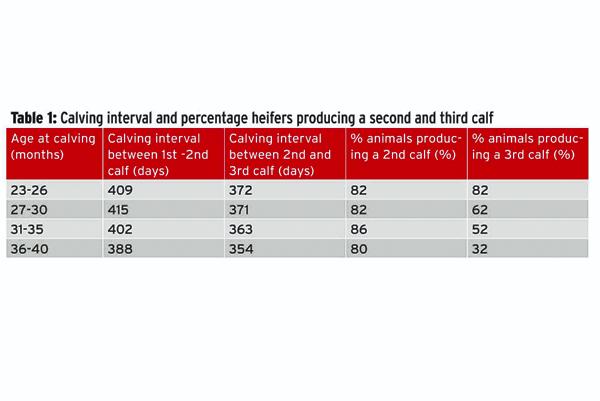
With the calving interval between first and second calving around 400 days for each of the age brackets outlined in Table 1, it reinforces the need to have heifers calving down two to three weeks earlier than cows to allow them extra time to get back in calf.
The percentage of continental type heifers calving down in the two age groups is fairly similar. As continental animals are viewed as later maturing animals, having 25% of heifers calved down at 23 to 26 months of age indicates farms with a good level of herd management in getting these animals to the correct weights for bulling.
Reappearance rate
Getting heifers that calved at a younger age back in calf again can be a difficult task and is a strong reflection of herd management. Once calved, the heifer comes under additional physical stress of producing milk to rear the calf. If the heifer has not been well managed pre calving and therefore calving down in a low body condition, milk production and fertility will suffer.
The heifer will require specific nutritional management and higher energy than the cow. The higher management level is often used as a reason for calving at the older age of 36 months, when heifers are viewed as being fully developed and therefore less problematic from a management perspective.
Herd longevity
However, even with calving at an older age, if the animal has not been correctly managed then she will be exposed to the same problems as heifers that calve at a younger age. Table 1 outlines the calving interval for the heifers between their first and second calving, and their second and third calving. It also highlights the percentage of heifers in the stated age brackets that have produced a second and third calf.
There is an alarming trend developing that is evident from Table 1. The table shows that while the percentage of heifers calving for a second time is similar across the different ages, by the time a third calf is produced, only 32% of the animals that calved down between the ages of 36 to 40 months have produced a third calf compared to 82% of heifers that calved between 23 to 26 months of age.
This poses the question as to what is actually happening with these animals as to why there is such a high percentage not making it past producing their second calf. Herd management will be an influence, but other factors have to be playing a part to have such a dramatic drop in the numbers.
A heifer calving at for the first time at 36 months will be five years old by the time it produces a third calf, considering that the calving interval is running at less than 365 days. From the calving intervals outlined in Table 1, there is a possible suggestion that only the efficiently run herds are managing to maintain these animals in the herd as mature cows. A calving interval of 388 days between first and second calving, and 354 days between second and third calving, indicates it is inefficient producers who are experiencing the higher culling rates.
Calving heifers at a younger age and getting them back in calf requires good herd management. This is evidently in place considering there is no change in the percentage of heifers that calve at 23 to 26 months of age producing their second and third calves.



SHARING OPTIONS