Liffey Meats, ICBF and Teagasc held a farm walk at Castleforbes Estate in Longford – the 2025 Suckler Farmer Finisher winner for Liffey Meats – on Thursday 14 May.
The farm is managed by Brian Jordan and runs 90 to 100 suckler cows, bringing all cattle through to finish with a number of dairy-beef cattle also purchased and brought through to finish.
The farm comprises 150ha grassland with 40ha of tillage and forestry.
There is a strong focus on continental genetics on-farm, with the majority of cows either Limousin-cross or Charolais-cross.
Despite the strong terminal genetics in the cows, they still boast a replacement figure of €113 average for the herd of 90+ cows.
The farm is 100% spring calving with one Limousin bull used alongside three Charolais bulls.
There is some AI used on the replacement heifers, mostly Limousin, and Brian said: “We’re happy with the bulls. They’re working well and I don’t see us going down the AI route in big numbers. However, we are considering it for breeding replacements and we are looking at sexed semen to try to boost replacements, especially for milk, as over time it can slip when we’re so heavily focused on continental genetics.”
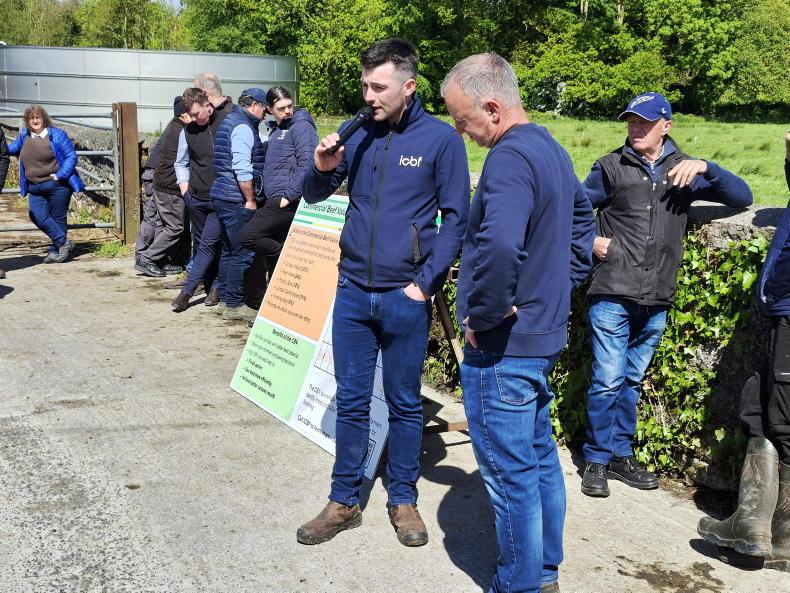
Kealan Hand from ICBF talking about the CBV index, Brian Jordan farm manager for Castleforbes Estate answering questons on the breeding system used on farm.
Their farm system has a heavy focus on maximising output; the tillage grown is all fed to the cattle, a mix of barley, wheat and maize grown. The grain is mixed with a small amount of bought-in feed.
Grazing bulls
There is a big focus on grass, with the farm laid out in fields, allowing for sub-divisions to maximise grass utilisation. Unlike some bull systems finishing under 16 months, Castleforbes grazes the bulls for a second summer and finishes bulls between 20 and 22 months.
The 2025 group of bulls are currently weighing 500kg on average. They will remain at grass until August, when they will be housed with a target weight of 580kg.
The bulls will have a 30-day adaptation period on the finishing diet and will then undergo 100 to 120 days of intensive finishing, where the diet will be built up, with bulls consuming 12kg to 14kg of concentrates, alongside high-DMD silage.
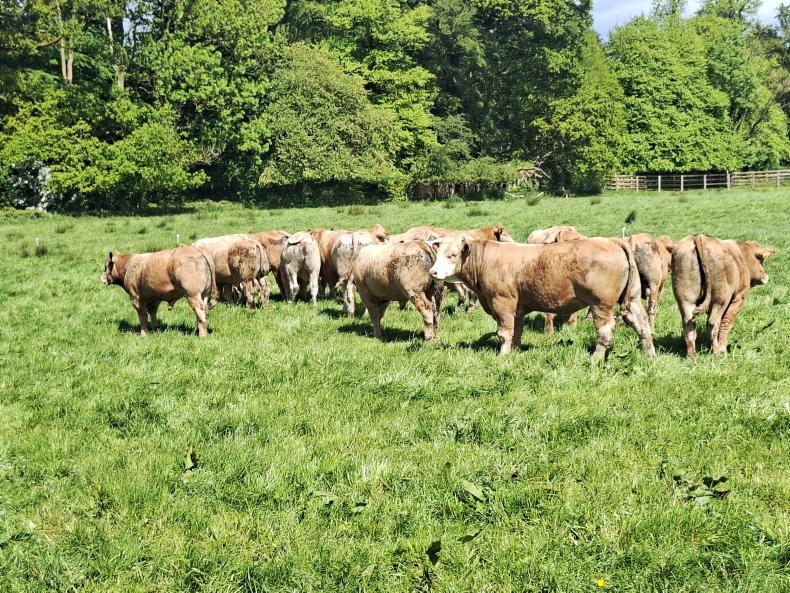
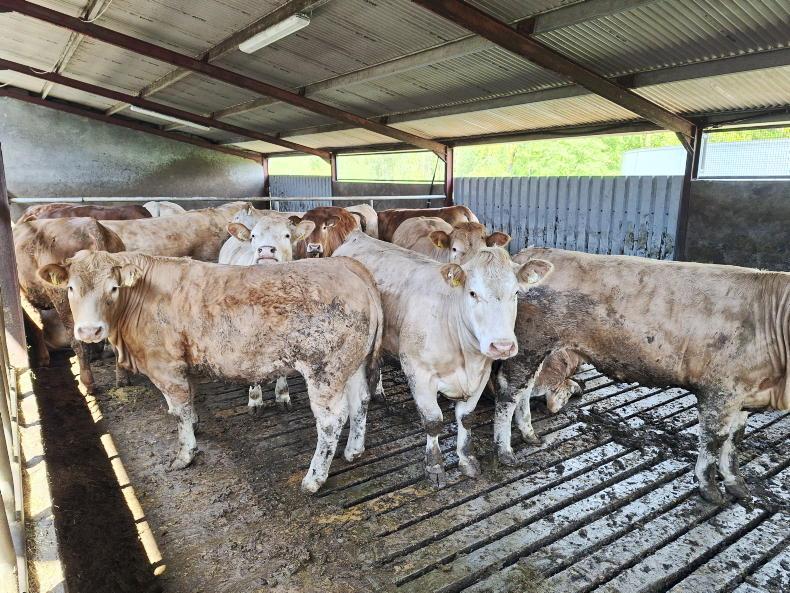
2025-born bulls grazing a grass only diet, these bulls curently average 500kg and will be grazed until August when they will be housed on a high concentrate diet to be slaughtered under 22 months.
The bulls’ diet will be a mix of 50% home-grown grain and 50% purchased grain. The 2025 killing data on the bulls born in 2024 was exceptional, with a carcase weight of 460kg.
The majority of bulls will grade either U or E, with the fat scores varying from 2+ to 3+. There are approximately 50 to 60 bulls slaughtered each year.
The heifers are grazed for longer the second summer and are then housed and finished as they approach 24 months. Heifers are slaughtered from 23 to 25 months of age. Last year’s heifers killed out at on average 375kg carcase weight grading from a R+ to U+ with fat scores of 3= to 4-.
Heifers are housed on a maintenance diet consisting of 2kg barley mixed with soya and in the month of February are switched over to a finishing diet consisting of high-DMD silage with 6kg to 7kg of concentrates fed from home-grown grains. The farm replaces around 15 cows a year to keep the herd young and fresh, while cull cows are all slaughtered with carcase weights in excess of 400kg.
On the walk were a number of stands going through how to breed cattle with a high Commercial Beef Value (CBV). The take-home message was that high terminal index bulls will have a greater chance of breeding higher-CBV cattle.
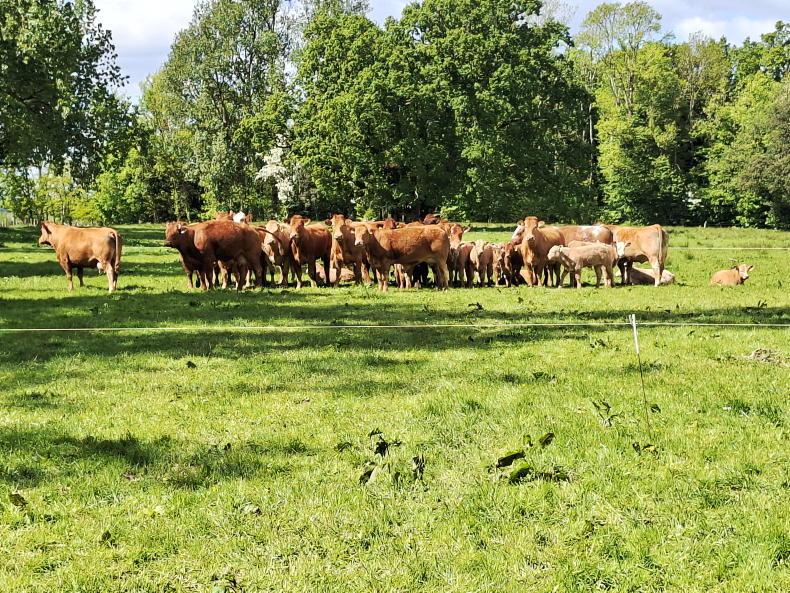
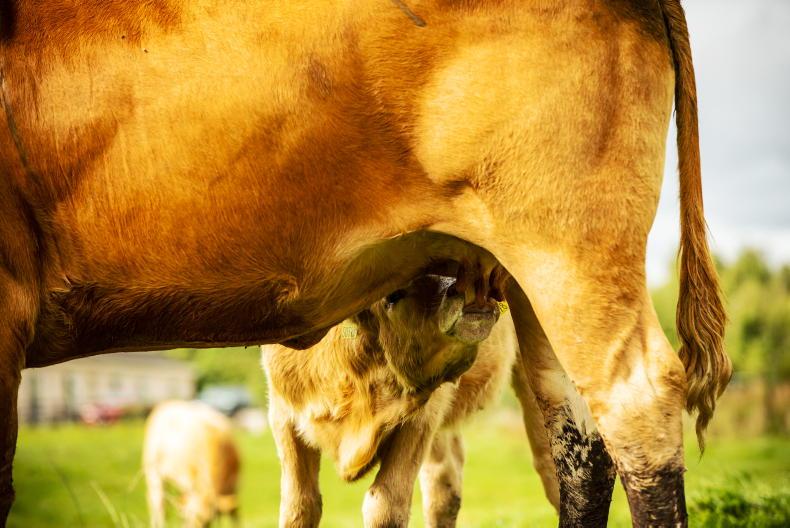
Suckler cows grazing with their 2026-born calves, the farm runs mostly Limousin-cross cows to high terminal Charolais bulls.
Kealan Hand of ICBF went through what’s involved in the CBV and how it can be utilised on farms.
CBV will identify cattle with superior beef traits such as higher carcase weight, lower feed intake, younger slaughter age and better carcase confirmation.
On the day there were two bulls from the 2025 group of bulls, born just one day apart.
Bull one had a CBV of €574 with bull two at €424. On the day of the walk, both bulls were weighed and bull one was 37kg heavier.
More information on the two bulls can be seen in the table below.
Liffey Meats, ICBF and Teagasc held a farm walk at Castleforbes Estate in Longford – the 2025 Suckler Farmer Finisher winner for Liffey Meats – on Thursday 14 May.
The farm is managed by Brian Jordan and runs 90 to 100 suckler cows, bringing all cattle through to finish with a number of dairy-beef cattle also purchased and brought through to finish.
The farm comprises 150ha grassland with 40ha of tillage and forestry.
There is a strong focus on continental genetics on-farm, with the majority of cows either Limousin-cross or Charolais-cross.
Despite the strong terminal genetics in the cows, they still boast a replacement figure of €113 average for the herd of 90+ cows.
The farm is 100% spring calving with one Limousin bull used alongside three Charolais bulls.
There is some AI used on the replacement heifers, mostly Limousin, and Brian said: “We’re happy with the bulls. They’re working well and I don’t see us going down the AI route in big numbers. However, we are considering it for breeding replacements and we are looking at sexed semen to try to boost replacements, especially for milk, as over time it can slip when we’re so heavily focused on continental genetics.”

Kealan Hand from ICBF talking about the CBV index, Brian Jordan farm manager for Castleforbes Estate answering questons on the breeding system used on farm.
Their farm system has a heavy focus on maximising output; the tillage grown is all fed to the cattle, a mix of barley, wheat and maize grown. The grain is mixed with a small amount of bought-in feed.
Grazing bulls
There is a big focus on grass, with the farm laid out in fields, allowing for sub-divisions to maximise grass utilisation. Unlike some bull systems finishing under 16 months, Castleforbes grazes the bulls for a second summer and finishes bulls between 20 and 22 months.
The 2025 group of bulls are currently weighing 500kg on average. They will remain at grass until August, when they will be housed with a target weight of 580kg.
The bulls will have a 30-day adaptation period on the finishing diet and will then undergo 100 to 120 days of intensive finishing, where the diet will be built up, with bulls consuming 12kg to 14kg of concentrates, alongside high-DMD silage.

2025-born bulls grazing a grass only diet, these bulls curently average 500kg and will be grazed until August when they will be housed on a high concentrate diet to be slaughtered under 22 months.
The bulls’ diet will be a mix of 50% home-grown grain and 50% purchased grain. The 2025 killing data on the bulls born in 2024 was exceptional, with a carcase weight of 460kg.
The majority of bulls will grade either U or E, with the fat scores varying from 2+ to 3+. There are approximately 50 to 60 bulls slaughtered each year.
The heifers are grazed for longer the second summer and are then housed and finished as they approach 24 months. Heifers are slaughtered from 23 to 25 months of age. Last year’s heifers killed out at on average 375kg carcase weight grading from a R+ to U+ with fat scores of 3= to 4-.
Heifers are housed on a maintenance diet consisting of 2kg barley mixed with soya and in the month of February are switched over to a finishing diet consisting of high-DMD silage with 6kg to 7kg of concentrates fed from home-grown grains. The farm replaces around 15 cows a year to keep the herd young and fresh, while cull cows are all slaughtered with carcase weights in excess of 400kg.
On the walk were a number of stands going through how to breed cattle with a high Commercial Beef Value (CBV). The take-home message was that high terminal index bulls will have a greater chance of breeding higher-CBV cattle.

Suckler cows grazing with their 2026-born calves, the farm runs mostly Limousin-cross cows to high terminal Charolais bulls.
Kealan Hand of ICBF went through what’s involved in the CBV and how it can be utilised on farms.
CBV will identify cattle with superior beef traits such as higher carcase weight, lower feed intake, younger slaughter age and better carcase confirmation.
On the day there were two bulls from the 2025 group of bulls, born just one day apart.
Bull one had a CBV of €574 with bull two at €424. On the day of the walk, both bulls were weighed and bull one was 37kg heavier.
More information on the two bulls can be seen in the table below.
SHARING OPTIONS