



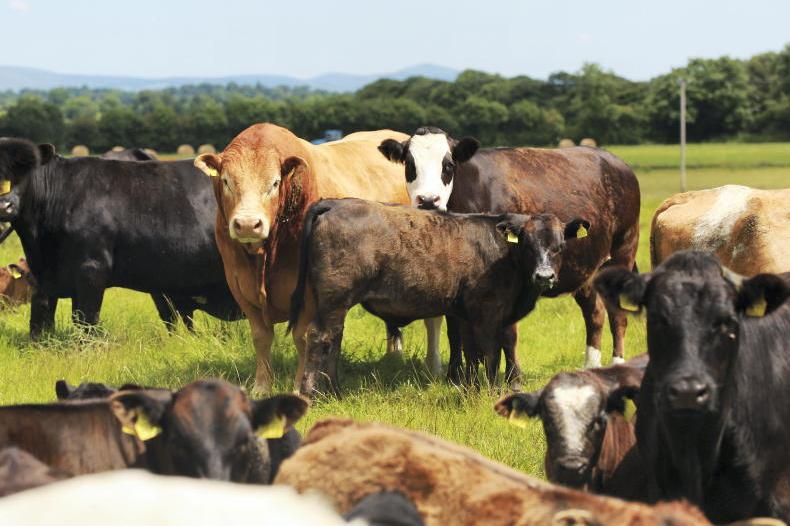
The big deadline for the 2025 SCEP scheme is fast approaching with 31 October being the date by which applicants must have 65% of the females in their herd genotyped four- or five-star on the replacement index. Beef farmers farming 100 acres, 50 suckler cows and 50 dairy beef calves participating in SCEP, the National Beef Welfare Scheme and the Dairy Beef Weighing Scheme could draw down €10,149 in scheme money in December, provided all boxes are ticked for each scheme.
Action one: eligible bull/eligible AI
In each scheme year, applicants must calve at least 50% beef breed animals of the yearly reference number. From scheme year three and four, 85% of these calves must have been sired from a four- or five-star source, ie, a genotyped four- or five-star bull on either the terminal or replacement index (on a within or across breed basis) at time of service and/or if using AI, the AI straw used on participating holdings must be from a four- or five-star eligible bull on either the terminal or replacement index (on a within or across breed basis). The target increases to 90% in year five.
Action two: female replacement strategy
Applicants are required to ensure that by 31 October 2025, at least 65% of their yearly reference number were eligible females that were genotyped four- or five-star on the replacement index (on a within breed or across breed basis) at the time of purchase (for replacements brought into the herd) or at the time of genotyping (for those replacements bred within the herd).
This target is 75% by 31 October 2027. Genotyped females must be at least 16 months old on these dates.
There are currently 1,150 herds that will miss this target based on the number of females they currently have in their herd.
Action three: genotyping
Applicants will be required to take a tissue-tag sample from animals selected for genotyping as part of the programme.
The number of animals to be genotyped each year will be at least equivalent to 70% of the beneficiary’s “yearly reference number” (rounded down to the nearest animal).
For example, an applicant with a yearly reference of 10 must have sufficient animals to genotype seven females, calves or eligible bulls, without repetition of animals genotyped under the programme to date. Samples must be returned by 30 November each year.
Action four: weighing
Participants must weigh at least 80% of eligible animals born on the holding of the yearly reference number in each scheme year and their dams and submit weights to ICBF.
Each live calf must be unweaned and weighed with its dam on the applicant’s holding on the same day.
All calves being submitted for weighing must have been born in the herd within each scheme year.
The calf must be a minimum of 50 days old before it is eligible to be weighed. Weights should be submitted within seven days of weighing and no later than 1 November annually.
Action five: calving details and surveys
In addition to meeting the statutory requirements for tagging and registration, programme applicants must complete the calving ease survey for each calf born on their farm.
Calf sire, calving ease, birth size and calf vigour must be recorded for each calf, along with calf quality, calf docility, dam docility, dam milk-ability, dam mothering ability, dam feet and legs, dam teat score and dam udder score.
All surveys for each scheme year must be submitted by 15 February the following year.
Scheme data for 2025 must be submitted by the 15 February 2026.
Payment rates
Payments will be made on a per hectare basis with the first 15ha of the maximum payable area (MPA) being paid at €225/ha and the remaining hectares being paid at €180/ha. Once applicants have satisfied the conditions of the scheme, payments will issue in mid-December this year.
There are three actions in the 2025 scheme, one mandatory and two voluntary, with a maximum payment of €3,375 for all actions at the maximum of 45 calves.
An eligible suckler calf must be born into the herd of the applicant between 1 July 2024 and 30 June 2025. Action one is meal feeding, which is mandatory.
Action two is vaccination, which is voluntary along with faecal sampling or silage sampling which is also voluntary.
You cannot vaccinate more calves than you meal-feed. Meal feeding must be done for a period of four weeks pre-weaning and two weeks post-weaning to reduce the stress on calves at weaning time.
Calves must be supplemented with compound feed stuffs containing appropriate minerals and vitamins.
Receipts, invoices and labels of all compound feed stuffs and/or straights as well as complementary mineral mixtures purchased must be kept for the purpose of inspection if you are selected for an inspection. The voluntary vaccination measure must be for clostridial diseases and/or calf pneumonia in suckler calves. Faecal sampling kits and silage sampling kits must be purchased before 13 October.
Two faecal samples must be taken four weeks apart if opting for faecal sampling and three silage tests must be completed if opting for silage testing. Payment will issue in December.
Participants in the National Dairy Beef Weighing Scheme can get a payment of €20/calf up to a maximum of 50 calves in 2025. Calves must be at least 12 weeks of age when weighed and calves must have ben moved onto the holding where the weighing is taken place for a minimum of 10 days prior to weighing.
Eligible dairy beef calves are a male calf of a dairy breed or a male or female calf of a beef breed born to a dairy breed cow. Calves can be born from 1st July 2024-30 June 2025. All weights should be submitted to ICBF within seven days of weighing but must be in no later than 5.30pm on 1 November 2025.



SHARING OPTIONS