


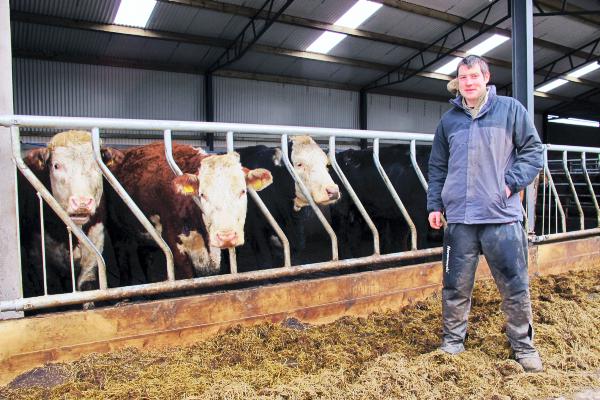
The figure represents net margin which includes all variable and fixed costs involved in suckler production on Oliver McKenna’s farm at Eskra, near Omagh, Co Tyrone.
Achieving the level of financial performance stated does not happen by chance. Oliver attributes his improved performance to four factors:
Having a farm plan and sticking to it.
Compact calving and good herd fertility.
Monitoring stock performance from regular weighing.
Getting the maximum liveweight gain possible from grass.
While all these factors are indeed crucial in running a successful suckler herd, there is one factor that Oliver has not mentioned and that is his own ability to implement all of the above successfully. It takes excellent management and willingness to change for a herd to become profitable. Simply relying on higher market prices to generate a positive margin is not a sustainable long-term strategy.
Breeding
Replacements are retained from within the herd and calve at 24 months. The target bulling weight is 400kg minimum and heifers are managed as a separate group from weaning until after calving.
At weaning, heifers are housed and fed 2kg to 3kg of concentrates (16% protein) depending on liveweight and forage quality.
After Christmas, concentrates are removed from the diet as heifers go out to grass in early February to maximise liveweight gain.
The breeding season for cows and heifers begins on 30 April and will finish on 29 June which is a nine-week period. Oliver is adamant that cows are not bred outside of this period. Empty cows are either slaughtered or sold in the local mart.
Herd fertility
Tightening the calving spread has been one of the main priorities on the farm. “If you want to achieve a high stocking rate, you will need a tight calving period. You cannot increase cow numbers if they are calving all year round,” said Oliver.
Culling unproductive cows, better grazing and herd management has reduced calving index from 408 days in 2008 to 371 days in 2010 and finally to 367 days in 2012.
Grassland
“Suckler farmers need to think of grazing grass like dairy farmers which means making use of paddocks.
“Dairy farmers do not set stock cows because it reduces milk yield, so suckler farmers should do the same as it works,” Oliver said of his grassland setup.
His viewpoint certainly challenges the grassland management of many of his farming peers, but there is plenty of logic in his reasoning.
Lack of milk is commonly regarded as a weakness in suckler cows and, despite breeding with maternal genetics, poor grazing management often means that the higher milk potential is never reached.
This is then translated into lighter weaning weights or increased use of concentrates.
Reseeding is carried out annually and young swards allow higher stocking rates. Soil analysis shows land is low in P and K so only compound fertilizer is now used. Lime status is also low and is being addressed.
Paddocks have been set-up in recent years after installation of mains electric fencing. Oliver also views the paddocks as a means for improving livestock temperament as they become used to being handled.
Stock performance
Autumn-born bulls are grazed from March to September before housing for finishing. In 2012, the average bull weighed 448kg at housing on 17 September and was finished by 16 months of age at an average carcase weight of 360kg.
Approximately 1.4 tonnes of concentrates were fed during the finishing period, with bulls consuming 10kg daily along with 10kg of silage fresh weight.
Concentrates were a mix of 37.5% maize distillers, 12.5% soya hulls and 50% barley.
Oliver sees increasing the autumn herd and finishing males as bull beef as the best way to further increase output.
Calving in August allows the cow time at grass to be served again as well as reducing silage and concentrate supplementation after calving.
Spring-born males are sold as stores in May at a target weight of 450kg.
This year, steers were turned out to grass in February but re-housed briefly in mid-March due to heavy rainfall, but this has not deterred Oliver from early grazing.
With turnout weights at 355kg, there is potential to gain 100kg of liveweight cheaply before selling in mid-May.
Financial analysis
Table 1 outlines the financial performance over the past three years for Oliver’s farm. The net profit per cow of £147 (€172) places the farm in the top 25% of suckler farms in Northern Ireland.
The cost of keeping a cow within the farm system in 2012 was £701/cow (€821/cow). Concentrate costs have reduced by 50% in two years and output increased by 34%.
Farm Details
Oliver McKenna, Eskra, Co Tyrone
25.2Ha (62 acres) of grassland all in LFA.
40 Suckler cows with 25 cows calving Feb-March and 15 calving August-September.
Hereford and Simmental stock bulls used.
Heifers retained for breeding.
Spring born males sold as stores.
Autumn born males finished as bulls.
Key points
GM/Ha has increased by £359 (€420) over two years.
Net profit has increased by £248/cow (€290/cow) over two years.
Calving index is now 367 days after tight culling and focussed breeding programme.
Paddocks system installed and emphasis on weight gain from grass.
Plans to expand herd to 50 cows over the next three years.



SHARING OPTIONS