



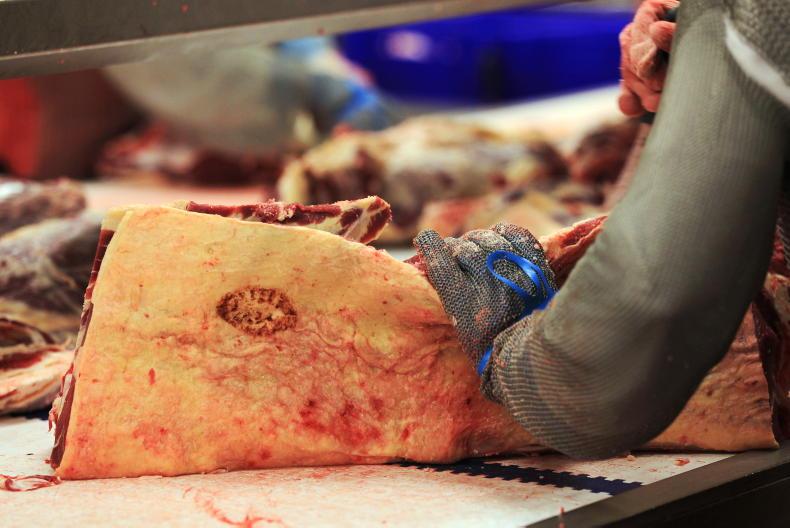
Beef throughput in recent weeks continues to run well behind the corresponding period in previous years.
Last week’s kill was recorded at just 25,509 head, equating to a reduction of 6,556 head on the previous week in 2024. An analysis of beef kill data over the last decade shows the true extent of how throughput has declined.
Throughput since the start of July is running 51,026 head behind the corresponding period in 2024, or an average of 7,289 head over the seven-week period. The tightness in supplies during this period underpinned an increase in bullock prices of 37c/kg, while heifers increased by 35c/kg and cows by 50c/kg.
Mid-year throughput in this seven-week period is running almost 45,000 head lower than the five-year average and over 49,000 head lower than the 10-year average.
One would need to go back much further for throughput to be anywhere near as low a level.
Current trade
Many factories tried to talk prices down towards the end of last week. In some cases agents tried to offer an opening base quote of €7.40/kg to €7.50/kg for bullocks, but were quickly forced to return to a base quote of €7.50/kg to €7.60/kg to negotiate deals.
There is less pressure on farmers to move stock with weather and grass supplies in a good position, while flat pricing has eased the pressure on farmers to move cattle approaching 30 months of age.
It is a similar situation with heifers, with cattle typically moving at a base price of €7.60/kg to €7.70/kg.
Farmers with big numbers are negotiating significantly higher given the pressure on factories to secure supplies, with flat-prices deals for Angus and Hereford cattle rising to over €8/kg and hitting a high of €8.10/kg to €8.20/kg.
Cow trade
Tight numbers is also very much evident in the cow trade. Some agents expect to see lower numbers of cows coming on stream this back end with cows culled in a steady manner throughout the year, underpinned by higher prices.
R grading cows are moving in the main from €7.20/kg to €7.40/kg with significant differences between plants depending on their activity in the cow trade.
Up to €7.50/kg is being paid for R grades where cows are being traded with good-quality U grades, with top prices for such cows rising to €7.60/kg.
The mart trade remains vibrant for top-quality and young cows, and is worth weighing up for farmers struggling to negotiate higher prices.
O grading cows are trading from €7.10/kg to €7.20/kg, while good-quality P+3 grading cows delivering higher carcase weights are in cases topping €7/kg.
Young bulls
Young bulls were the only category of stock where throughput last week exceeded 2024 levels.
Throughput of 1,886 head was 626 head higher, with year-to-date throughput steady with 2024 levels but running behind recent years.
U grading bulls are trading in the region of €7.70/kg to €7.80/kg, with R grades at €7.60/kg to €7.70/kg. While O grading bulls are selling from €7.30/kg to €7.50/kg depending on carcase weight and quality.
Price comparison
Bord Bia report that the Irish beef composite price is averaging €7.38/kg with the price running 70c/kg ahead of the export benchmark price. The Irish price is running €2.63/kg ahead of the corresponding period in 2024.
The latest Bord Bia cattle price dashboard shows the Irish bullock price in the week of 9 August averaging €7.58/kg and now running 30c/kg ahead of the average British bullock price.
Quotes in Northern Ireland are unchanged with farmers reporting £6.56/kg to £6.58/kg (€7.60/kg) as being available to regular sellers.
Tight supplies in ireland are said to be boosting competition with fewer numbers exported north.



SHARING OPTIONS