



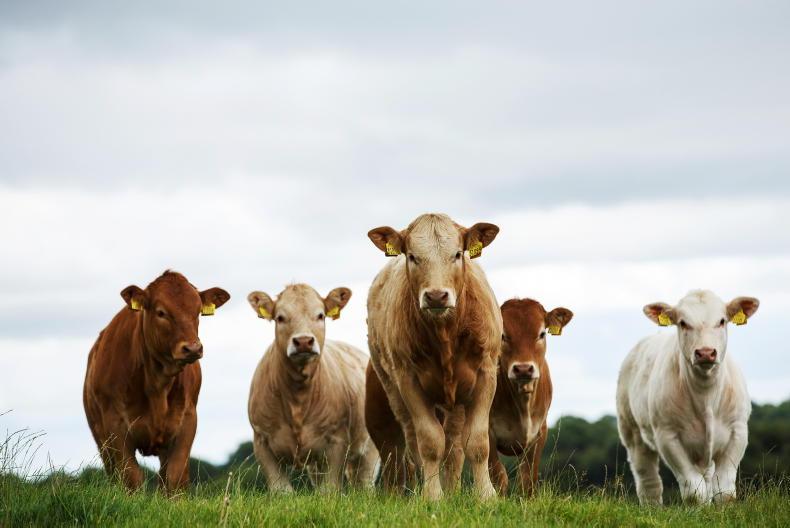
While it is still early days, interest in the 2025 National Suckler Beef Welfare Scheme (NSBWS) appears to be high with lots of discussion and questions cropping up in the week following the opening of applications. The interest is stemming from the potential for farmers to secure a higher payment of €75 per eligible calf, on up to 45 calves.
This article addresses some of the most common questions received to date. Readers can send any further questions to farmtechtalks@farmersjournal.ie and we will endeavour to answer them on www.farmersjournal.ie, our weekly Farm Tech Talk show or in the pages of upcoming editions. The Department’s contact email for scheme queries is bws@agriculture.gov.ie. The deadline for applications is 23.59pm on 24 September 2025.
Q My reference number of animals is 10 calves, but I have 13 calves in my herd that were born between January and March 2025. Three calves were purchased as part of suckler pairs – do these count for payment?
A. No, for a calf to be deemed eligible for payment they must be an eligible calf born in the herd between 1 July 2024 and 30 June 2025 and registered within 27 days of birth.
Q The number of calves eligible for payment is 28 calves, of which 11 were autumn born and have been sold. These were creep-fed and received clostridial vaccination as per the terms and conditions. I am selecting forage testing under action three, I presume I am eligible to receive payment on all calves.
A. Yes, all 28 calves are eligible for payment as action one and action two were satisfied and it makes no difference that calves are not in the herd when carrying out action three – forage testing. Ensure you retain all receipts for meal feeding and vaccination and have the three forage analysis samples sent to the lab before 13 October 2025. Ensure you complete the relevant action record sheets at the back of the terms and conditions.
Q I had five calves which were born in September 2024 and 17 in spring 2025. I can vaccinate the spring-born ones, but the autumn-born calves have been sold without being vaccinated. Am I ineligible for this action now? The calves received meal feeding when housed so meet those requirements.
A. No you are still eligible to complete the vaccination action on your 17 spring-born calves. The number of calves which you want to complete this action on can be selected at application stage and can be lower than the number of calves selected for the meal feeding action. This will not have any effect on limiting your payment for the third action. However the Department advises that given that five of your calves have been sold without completing the faecal egg testing option on them, you would be better advised to select the forage testing option in Category C which will ensure you can receive payment on all 22 calves
Q I am fairly well accustomed to the creep-feeding and vaccination elements of the suckler scheme, but what exactly is involved in the faecal testing and silage analysis?
A. The first aspect to point out is that these are optional actions. The maximum payment for this action is €25 per calf and the payment here is based on the number of calves selected at application stage for category one (meal-feeding) action.
Starting with faecal egg testing, farmers who select this option must carry out two faecal egg counts with a minimum of four weeks between each test. Samples must be submitted to a suitable laboratory/testing facility of the farmer’s choosing with all samples submitted fresh. Test kits for sampling must be purchased no later than 13 October 2025.
The parasites tested for are stomach/ gut worms or liver fluke and it is recommended to submit a pooled sample from ten animals or more.
For forage testing farmers who select this action must take three forage samples and submit them for testing to a suitable laboratory/testing facility of the participant’s choice for analysis. Test kits must be purchased no later than 13 October 2025. The analysis can be on silage, hay or straw that is being fed to animals.
Q What procedure do I need to follow when taking silage samples and where can I get the equipment to do it?
A. The terms and conditions outline advice for farmers when collecting silage samples. The first recommendation is to wait five to six weeks after ensiling to take samples. For samples being collected from pit silage the advice is to use a long core sampler to sample three-to-five well-spaced points on various areas of the surface of the silage pit. Alternatively, if sampling an open pit take nine to 10 samples in a W pattern across the pit face.
For bales the advice is to use a core sampler to sample three-to-four bales per cut located at various locations in the storage stack. Tape up sample holes to avoid spoilage. It is recommended where using a core sampler to discard the top 100mm of each core before mixing in to a composite sample.
Where taking samples from unopened forage a core sampler will be required. This is an apparatus which can be inserted in to the silage pit clamp or bales and will remove a core sample which can then be used.
A core sampler can be purchased but costs generally in excess of €100. It is worth checking with your feed merchant/co-op or local Teagasc office/consultant, as many have the apparatus which could be possibly be borrowed to collect the samples.
Q Do I need to send faecal egg samples to a laboratory approved by the Department of Agriculture as in the past?
A. There is no such requirement – the terms and conditions state that participants who select this action can send samples to a “suitable laboratory/testing facility of their choosing for analysis”. This could be a vet for example who offers such a service and is therefore regarded as a testing facility. Ensure you do this before 13 October 2025, retain your invoice/receipt of same and complete the action record sheet at the back of the Terms and Conditions.
Q I only have five calves eligible for the scheme. Do I still need to take three silage samples as it seems excessive for a small herd of six cows and one cut of silage saved at the same time and from the same field?
A. The requirement to submit three forage samples for analysis (or two faecal egg counts) is not linked to herd numbers and must be completed in full to satisfy this action.
This is an optional action so there is no pressure to select it if it doesn’t make sense for your herd.
Q Do I need to have forage analysis results received back by 13 October 2025?
A. No, this is the date by which test kits must be purchased. The earlier that samples are analysed the sooner winter feeding plans can be thought out.
Q Is there any action that must be taken on the back of forage analysis results such as submitting feeding plans?
A. There is no requirement listed in the terms and conditions. The scheme is designed to support farmers in completing the initiative and be in a position to act proactively on the results and align feeding plans to underpin optimum animal performance.
Q I usually have my forage analysed by my feed merchant to plan concentrate formulation according to the results. Do I need to change now and send samples to a laboratory?
A. The terms and conditions state that samples must be submitted to a “suitable laboratory/testing facility”. If the feed merchant in question is providing you with a service and can provide a written analysis of your forage that can be presented in the case of an inspection or request by the Department, then that is satisfactory.



SHARING OPTIONS