



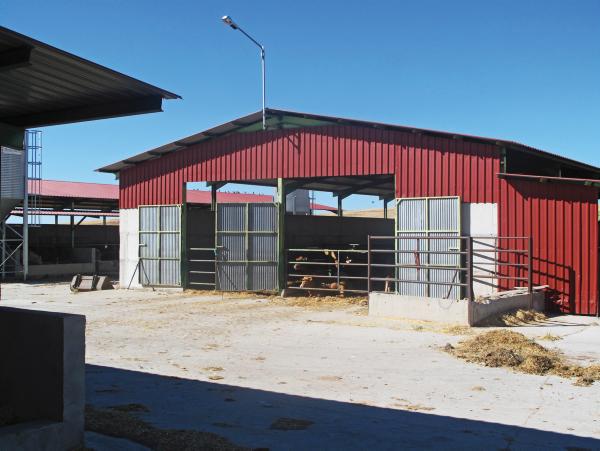
Incova Co-op has been in operation for the past 35 years. Membership is currently close to 135 farms/associates. The co-op is based primarily around intensive feedlot operations, ranging in capacity from 500 to 1,000 finishing animals.
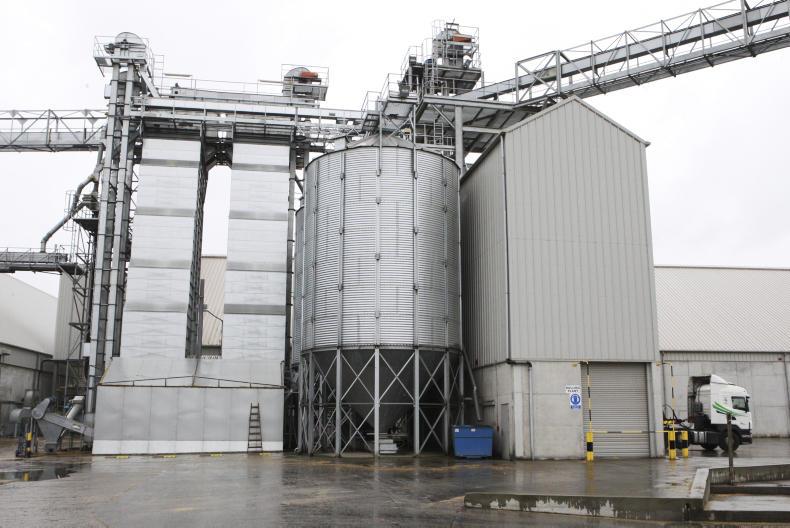
Feed mills and slaughtering facilities also form part of the overall Incova enterprise. To ensure uniformity of meat product and optimal consumer satisfaction, a fully integrated programme from ‘farm to fork’ is practised. This sees the co-op assuming full control over all aspects of the production chain from animal production right through to processing and distribution.
For instance, from an animal production viewpoint, cattle of the same genetic background and age are sourced for the associates. Cattle are offered the same dietary specification which has been manufactured in the co-op feed mills.
Cattle are fed for a defined period of time and finally slaughtered at an Incova-owned facility, where consistent processing protocols are followed.
The Canravilar feedlot, located just outside the town of Segovia, is a prime example of a successful farm operating as part of the Incova Co-op. This intensive finishing unit is quite typical in size, structure and systems of production of the average feedlot unit in Spain.
CANRAVILAR FEEDLOT
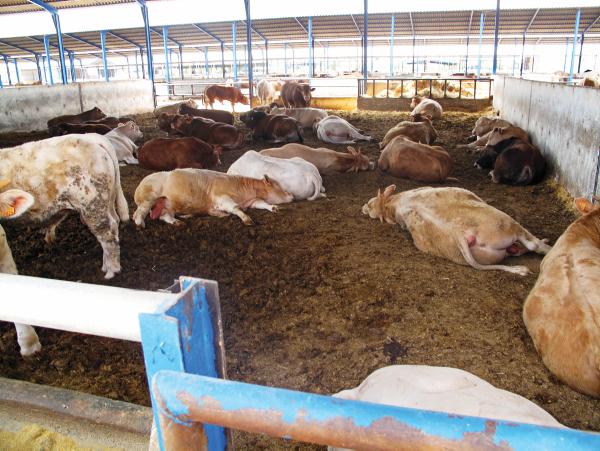
The Canravilar feedlot is run over two sites, approximately 500 metres apart. It consists of the main finishing yard, which at any one time has the capacity to house 1,000 finishing cattle and the receiving yard which has capacity for 600 cattle, kept separate for biosecurity purposes. A small land bank of 20 hectares surrounds the finishing unit.
||PIC2||
Similar to many Spanish feedlots, this farm predominately specialises in bull beef finishing and at the time of our visit there were 800 bulls at different stages of the finishing cycle.
The feedlot is managed by three people. Labour is assigned on the principle that on a well designed facility one person should manage 750 animals.
Pneumonia issues and production related diseases such as acidosis, bloat or laminitis were identified as the main health concerns on the unit.
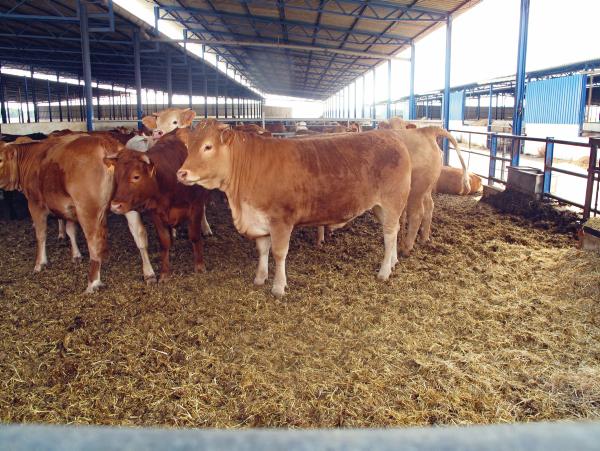
Bulls for finishing were sourced primarily from the domestic Spanish suckler herd (80%) located on the more marginal pasture land of the south and south west. The remainder (20%) come from weanling imports from France.
Close proximity means that transport costs are a fraction of those incurred in exporting animals from Ireland.
||PIC3||
Interestingly, 10 years ago Irish suckler weanlings would have dominated live imports into Spanish feedlots.
However, with the rise in price for Irish stock, particularly over the last 18 months, weanling exports to Spain have collapsed from a peak of 41,000 weanlings in 2006 to just over 2,000 head in 2012.
For the market to recover, a return to the differential that existed between the Irish beef price and the beef price paid in our main live exports markets would be needed.
PHYSICAL PERFORMANCE
Bull weanlings enter the finishing unit at a target liveweight of 220kg at six months (Spanish suckler origin weanling). Initially, bulls are held in the receiving yard for a 40-day dietary acclimatisation period, during which a full vaccination programme for respiratory and clostridia diseases is implemented. At the end of the 40 days all animals are batched, based on age and liveweight, and transferred to the main finishing yard.
During the finishing phase, bulls are housed in an open-sided, well-ventilated, straw-bedded shed.
The average group size of 30 animals per pen is targeted. Similar to most Spanish feedlots, animals are offered a dry concentrate-based diet largely made up of maize meal and barley.
All rations were bought via the Incova feed mills. The complete ration specification is 40% maize meal; 25% barley; 10% to 15% soya; 10% wheat bran; 10% soya hulls. Concentrate feed is offered by way of a hopper and feed bin, with one feed bin servicing every two pens.
Straw is allocated at 10% of the total diet to provide a source of effective fibre. Bulls are offered this diet on an ad libitum basis for an eight-month period. Target growth rate for the overall period is 1.4kg to 1.5kg/day.
Unlike other finishing systems in the EU, Spanish feedlots slaughter at younger ages. Bulls are destined for slaughter at 14 to 16 months of age or at approximately 580kg. This would equate to a carcase weight of 340kg to 360kg.
Beyond this point there is a noticeable decline in feed efficiency and, as a result, the cost per kg of carcase gain increases significantly in the later stages of the intensive finishing.
Feed cost per day for the finishing diet was quoted at €2.30 to €2.40. This has increased by 20c to 30c/ head/day on early 2011 estimates and is severely hampering the profitability of the sector.
At an average daily gain of 1.4kg liveweight per day, the cost of each kilo of carcase gain ranges from €2.50/kg to €2.70/kg.
MARGINS
The challenges of making a margin from finishing cattle are the same the world over. Finishing operations are very dependent on two critical price points: purchase price of stores and the price of feed inputs.
From a Spanish perspective, both of these variables have increased considerably over the last three years, resulting in a squeezing of margins at farm level.
For example, the Canravilar feedlot spoke about a rise in production costs in the order of 20% which was only partly offset by the 15% rise in beef price in the same period. The rise in input costs has seen most of the Spanish feedlots struggle to make a margin for the previous three years. Furthermore, current projections are no different if we take the cost figures presented on the unit.
For instance, purchased stores arrived on the unit costing €3.00/kg, so the 220kg bull weanling traded for €660/head. Feed cost over the eight-month finishing period amounted to some €600/head. Total output on the feedlot was €1,350/head (based on a 350kg carcase @€3.85/kg fixed price).
This left, on average, a meagre margin per head over feed cost of as little as €90/head – margin does not include costing for mortality, veterinary, medicine, labour or fixed costs.
At that margin, there is no room for error and, at the very best, these feedlots are just about breaking even. This shows how sensitive and exposed these systems are to fluctuations in beef, meal or store prices.
FEED EFFICIENCY
With feed costs accounting for up to 40% to 50% of the total cost, the future viability of the feedlot sector is dependent on the availability of cheap cereals and/or byproducts.
Indeed, the concerted rise in cereal prices since 2007, peaking in 2011, has limited the profit potential of the sector and has forced a third of all Spanish feedlots out of business.
To reduce the feed cost, the first step identified by the co-op was to start measuring the competitiveness of the production systems, with particular attention towards animal performance and production cost.
Feed efficiency is the key performance trait on farm. Good levels of technical recording/monitoring, particularly for feed intake and growth, is central to improve this trait.
Given the rising cost of feed in the system, identifying when feed efficiency levels are declining is fundamental to the probability of each feedlot.
Regular growth curve analysis carried out by Incova is critical for identifying this point of decline (based on weight, breed and sex). This is the optimal time point (most efficient) to put the animal forward for slaughter.
After this point, lean muscle deposition slows dramatically and more feed energy is partitioned towards fat accretion. Remember, it takes six times more feed to deposit a kg of fat versus a kg of muscle.
For the Spanish breed types, this point of decline was indentified at 580kg liveweight for the bulls and 450kg for the heifers, following an intensive six to eight-month finishing period.



SHARING OPTIONS