



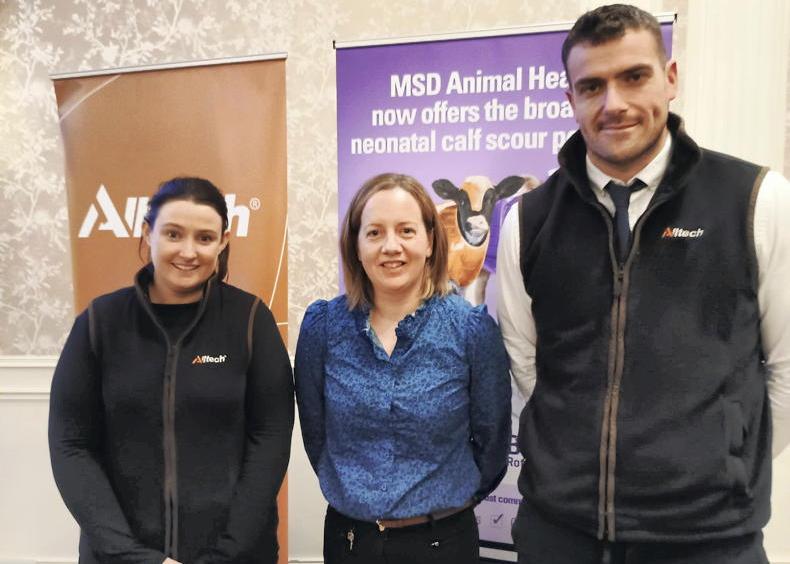
Mycotoxins in silages and other feeds can cause a host of problems on cattle farms, which will hit output and ultimately the bottom line, a meeting of farmers in Omagh last Thursday night was told.
Speaking at the event, Aislínn Campbell from Alltech said mycotoxins are produced by fungi and moulds and are invisible, tasteless and odourless, so are difficult to detect.
In NI, the greatest risk is with grass silage and the main mycotoxin is penicillium.
She said that mouldy silage from the top or sides of a silage pit should always be discarded and farmers should avoid the temptation of feeding it to dry cows or youngstock. However, not all mouldy silage has mycotoxins and equally, a silage with no visible moulds can have a high mycotoxin load.
“To be honest, we tend to see the latter more often,” said Campbell.
She said mycotoxins can cause a vast array of issues, such as higher cell counts, poor fertility, lower milk output and reduced liveweight gains.
Warning signs of a high mycotoxin challenge include reduced intakes and loose or inconsistent dung, because the digestive system is not working optimally. More visual signs can also be swollen hocks and arched backs in cows.
“It is a lethargic herd. Cows are generally off form, dull, there are longer lying times. There can be a sudden drop in milk yield,” said Campbell.
A sample of silage or of a total mixed ration can be sent to the Alltech lab in Dunboyne, Co Meath, for mycotoxin testing.
Across 2024 and to date in 2025, a total of 454 samples have been assessed, with 75% containing at least two different mycotoxins. Cost of testing is around £180 per sample.
As part of the testing each silage is assigned a Risk Equivalent Quantity (REQ). Of the samples tested, 42% were deemed ‘high risk’, 22% were ‘medium to low’, with the remaining 36% having a ‘low risk’ associated with a mycotoxin load.
However, while testing is an option, Campbell said in practice, where farmers think they have an issue and cows are under pressure, the decision should be taken not to wait on test results, but to add a mycotoxin binder to the diet such as Micosorb A+ Evo.
“You will see very quickly if things are improving – in seven to 10 days,” she said.
She also argued that there can be pockets of mycotoxins within a clamp, not necessarily picked up in a silage sample.
“I would probably feed a binder as a preventative, as it is always cheaper to prevent a problem,” she said.
During his presentation last Thursday, Declan O’Neill from Alltech outlined the various factors that can lead to higher mycotoxins in silage.
He suggested the risk is getting greater each year due to climate change, which has brought milder and wetter winters, which means fungal flora are able to survive from one season to the next.
In addition, farmers have to contend with ever-shortening weather windows to make silage, while there are fewer contractors, which ultimately means more grass is being harvested in less-than-ideal conditions, increasing the risk of soil in clamps.
His advice is to cut young, leafy swards, as grass that has gone to seed is starting to die off, which increases the risk of fungal infection.
When mowing, don’t go below 4in, tedd it out immediately and lift it within 24 hours, he said. Grass that is too dry (over 35% dry matter) is “a huge haven for yeasts”, while grass left in rows can start to compost.
LESS
Like many farmers, O’Neill is suspicious that Low Emission Slurry Spreading Equipment (LESSE) is contributing to the mycotoxin problem, especially dribble bars which leave slurry on top of grass – in dry conditions, the fibrous fraction ends up back in the pit.
“I would say the dribble bar could be a huge source of mycotoxins,” he said. A research project at the Agri-Food and Biosciences Institute (AFBI) has been commissioned by AgriSearch to further investigate the issue.
Ensiling
To minimise the build-up of mycotoxins in the pit, O’Neill said it was important to fill it in layers of 8in to 10in and roll continuously to try to minimise air.
Side sheets should be employed which overlap at least 1.5m across the floor and on top of the pit.
On many farms a double black cover is used, or a single cover along with an air-tight sheet, however, Alltech is bringing a new plastic top sheet to market in 2026 – which the company claims will significantly out-perform other options. The Egalis True OB sheet is a single cover which lets in just 5cm3 of air per m2 every 24 hours.
“Twin black plastic is allowing through forty times more air,” said O’Neill.
He added that sand bags should be put around the edge of the pit, while weighted mats on top are a much better option than old tyres.
Feed out
When feeding out, O’Neill said it was important to ensure the shear grab is sharp and to move across the face every three to four days to help ensure yeasts and moulds don’t have time to develop. Ideally, diet feeders and feed troughs should be cleaned out once per week for the same reason, he said.




SHARING OPTIONS