1. How important really is the first few hours of life?
The importance of the first few hours of life and the longer-term positive impact for the calf is regularly referred to, but I’m often asked just how important it is.
Successful passive transfer of immunity from the dam to the calf via colostrum is the cornerstone of calf rearing.
Research indicates that herds that achieve high levels of passive transfer (100%), result in significantly less mortality rates (4.95%) when compared with poor levels of passive transfer (70% to 75%), resulting in mortality rates of 9.31%.
High standards of hygiene are necessary when collecting, feeding and storing colostrum, with research indicating that colostrum contaminated with dirt/bacteria results in reduced antibody absorption
A recent study from Teagasc Moorepark on 48 commercial farms highlighted that stomach tubes and bottles with teats had the greatest quantity of bacteria present.
Pooling of colostrum on farm should also be avoided to reduce the risk of disease transfer within the herd, as well as dilution of high-quality colostrum.
2. Milk replacer - what should I be looking out for?
When looking for a milk replacer, it must contain a high level of dairy content. Milk-derived protein sources include whey and skim powder. Research indicates that up to three weeks of age, milk-derived proteins are the only proteins a calf can digest efficiently.
Plant-based ingredients or vegetable sources of protein are less digestible to the calf and therefore reduce the nutritional quality of the milk powder. Higher levels of fibre in a milk replacer typically indicate a greater percentage of plant protein.
Both Agritech’s Vitalac Red and Blue Calf Milk Replacers contain a 90% to 95% dairy content. They offer a well-balanced level of highly digestible fat and protein, using carefully selected high-quality dairy ingredients.
These quality ingredients are further enhanced using advanced techniques such as low heat spray cooling technology, meaning the ingredients do not suffer any denaturing during the manufacturing process.
3. What concentration of milk replacer should I be offering calves?
With milk replacer, we are trying to replicate the role of good-quality whole milk in the calf’s diet. Calf milk replacer is generally fed at 12.5% whole milk (3.4% protein plus 4.3% butterfat plus 4.8% lactose = 12.5% milk solids).
This equates to 125g of powder being dissolved into 875ml of water to make up one litre of milk. When six litres of milk are being offered to the calf, 750g of powder per calf per day is being used. For accelerated feeding programmes, concentrations can be increased to 15%.
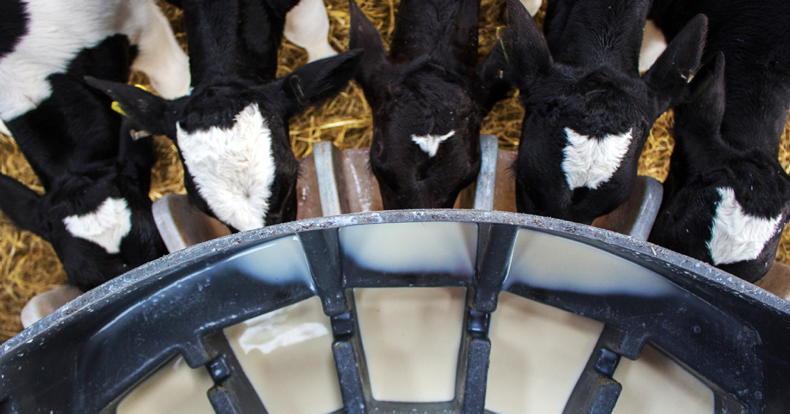
When looking for a milk replacer, it must contain a high level of dairy content.
4. Should I consider once-a-day feeding?
Once-a-day (OAD) feeding should only be considered from four weeks of age onwards. Research on farms has indicated where OAD feeding occurred before four weeks of age, average daily gains were compromised not only in the weeks before four weeks, but also up until eight weeks of age.
5. Does the environment calves are reared in affect their nutritional needs?
Having calves warm, comfortable and feeding well is what we should be aiming for. Your calves will pay you back for getting this right.
A cold environment will result in vital energy consumed by the calf being burnt to keep itself warm.
In cold sheds, try to create a warmer micro-climate for calves such as dropping a canopy area against the back wall or using large square bales to protect calves from draughty areas
When looking at the calf pen, there should be an even distribution of calves across the lying area. Where calves are often bunched against the back wall or corner, the shed may be too cold.
When it comes to nutrition, for every degree below 10C, an extra 2% milk replacer can be offered to compensate.
A calf spends approximately 80% of its time lying down, therefore it’s essential to provide a deep, warm, dry bed.
When giving the shed a bedding score, a good rule of thumb is to place your palm firmly on to the bedding. The straw around your hand should be up to your elbow.
The base of the bed also needs to be dry - kneel on the bedding and when you stand up your knees should be dry.
6. Apart from milk replacer, what other sources of nutrition should the calf have in its diet?
Milk should be seen as a feed, not a drink.
Water is an often-forgotten source of nutrition in calf rearing and is a cheap ingredient for hydration and rumen development
Fresh, clean water must be always available to calves. Where water is limited, this will restrict dry matter intakes.
Fresh clean straw is also another critical component in early rumen development and must be offered ad-lib as a source of fibre in the diet.

Starter rations should be introduced from three days of age.
7. What sort of ration/nut should be offered to calves during the rearing period?
Starter rations should be introduced from three days of age and will play a vital role in rumen development and early weaning.
They should be sweet-smelling, molassed and contain cooked ingredients – these three factors will help aid intakes and digestion.
Once intakes start to increase (normally greater than 250g), a typical 18% crude protein calf ration or nut can be offered to calves.
Once calves are turned out to grass or have grass in the diet, a 16% crude protein concentrate will suffice.
8. When should I consider weaning my calves and how long should they be on milk?
A 70-day calf rearing period is the norm on farm.
However, to have a uniform group of calves, weaning should ideally take place on a weight basis rather than an age basis
The target when weaning calves is to have doubled in liveweight from birth to weaning (40kg to 80kg in 10 weeks).
More importantly, weaning should not be considered until calves are intaking at least 1kg to 1.5kg concentrate per head per day – signalling that the calves dry matter intakes can cope with the transition to a solid feed diet.
Have further questions?
Contact your local Agritech sales adviser or click here.
1. How important really is the first few hours of life?
The importance of the first few hours of life and the longer-term positive impact for the calf is regularly referred to, but I’m often asked just how important it is.
Successful passive transfer of immunity from the dam to the calf via colostrum is the cornerstone of calf rearing.
Research indicates that herds that achieve high levels of passive transfer (100%), result in significantly less mortality rates (4.95%) when compared with poor levels of passive transfer (70% to 75%), resulting in mortality rates of 9.31%.
High standards of hygiene are necessary when collecting, feeding and storing colostrum, with research indicating that colostrum contaminated with dirt/bacteria results in reduced antibody absorption
A recent study from Teagasc Moorepark on 48 commercial farms highlighted that stomach tubes and bottles with teats had the greatest quantity of bacteria present.
Pooling of colostrum on farm should also be avoided to reduce the risk of disease transfer within the herd, as well as dilution of high-quality colostrum.
2. Milk replacer - what should I be looking out for?
When looking for a milk replacer, it must contain a high level of dairy content. Milk-derived protein sources include whey and skim powder. Research indicates that up to three weeks of age, milk-derived proteins are the only proteins a calf can digest efficiently.
Plant-based ingredients or vegetable sources of protein are less digestible to the calf and therefore reduce the nutritional quality of the milk powder. Higher levels of fibre in a milk replacer typically indicate a greater percentage of plant protein.
Both Agritech’s Vitalac Red and Blue Calf Milk Replacers contain a 90% to 95% dairy content. They offer a well-balanced level of highly digestible fat and protein, using carefully selected high-quality dairy ingredients.
These quality ingredients are further enhanced using advanced techniques such as low heat spray cooling technology, meaning the ingredients do not suffer any denaturing during the manufacturing process.
3. What concentration of milk replacer should I be offering calves?
With milk replacer, we are trying to replicate the role of good-quality whole milk in the calf’s diet. Calf milk replacer is generally fed at 12.5% whole milk (3.4% protein plus 4.3% butterfat plus 4.8% lactose = 12.5% milk solids).
This equates to 125g of powder being dissolved into 875ml of water to make up one litre of milk. When six litres of milk are being offered to the calf, 750g of powder per calf per day is being used. For accelerated feeding programmes, concentrations can be increased to 15%.
When looking for a milk replacer, it must contain a high level of dairy content.
4. Should I consider once-a-day feeding?
Once-a-day (OAD) feeding should only be considered from four weeks of age onwards. Research on farms has indicated where OAD feeding occurred before four weeks of age, average daily gains were compromised not only in the weeks before four weeks, but also up until eight weeks of age.
5. Does the environment calves are reared in affect their nutritional needs?
Having calves warm, comfortable and feeding well is what we should be aiming for. Your calves will pay you back for getting this right.
A cold environment will result in vital energy consumed by the calf being burnt to keep itself warm.
In cold sheds, try to create a warmer micro-climate for calves such as dropping a canopy area against the back wall or using large square bales to protect calves from draughty areas
When looking at the calf pen, there should be an even distribution of calves across the lying area. Where calves are often bunched against the back wall or corner, the shed may be too cold.
When it comes to nutrition, for every degree below 10C, an extra 2% milk replacer can be offered to compensate.
A calf spends approximately 80% of its time lying down, therefore it’s essential to provide a deep, warm, dry bed.
When giving the shed a bedding score, a good rule of thumb is to place your palm firmly on to the bedding. The straw around your hand should be up to your elbow.
The base of the bed also needs to be dry - kneel on the bedding and when you stand up your knees should be dry.
6. Apart from milk replacer, what other sources of nutrition should the calf have in its diet?
Milk should be seen as a feed, not a drink.
Water is an often-forgotten source of nutrition in calf rearing and is a cheap ingredient for hydration and rumen development
Fresh, clean water must be always available to calves. Where water is limited, this will restrict dry matter intakes.
Fresh clean straw is also another critical component in early rumen development and must be offered ad-lib as a source of fibre in the diet.
Starter rations should be introduced from three days of age.
7. What sort of ration/nut should be offered to calves during the rearing period?
Starter rations should be introduced from three days of age and will play a vital role in rumen development and early weaning.
They should be sweet-smelling, molassed and contain cooked ingredients – these three factors will help aid intakes and digestion.
Once intakes start to increase (normally greater than 250g), a typical 18% crude protein calf ration or nut can be offered to calves.
Once calves are turned out to grass or have grass in the diet, a 16% crude protein concentrate will suffice.
8. When should I consider weaning my calves and how long should they be on milk?
A 70-day calf rearing period is the norm on farm.
However, to have a uniform group of calves, weaning should ideally take place on a weight basis rather than an age basis
The target when weaning calves is to have doubled in liveweight from birth to weaning (40kg to 80kg in 10 weeks).
More importantly, weaning should not be considered until calves are intaking at least 1kg to 1.5kg concentrate per head per day – signalling that the calves dry matter intakes can cope with the transition to a solid feed diet.
Have further questions?
Contact your local Agritech sales adviser or click here.







SHARING OPTIONS