


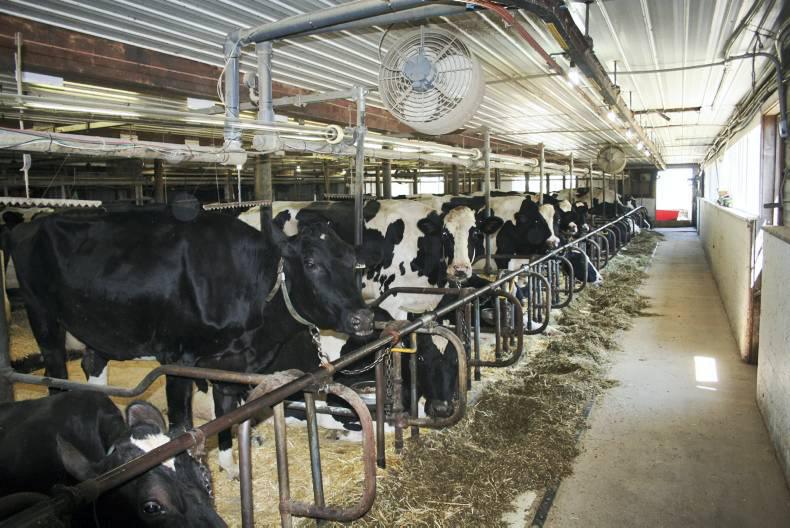
I recently met with Dr Laurie Baker, agricultural economist with McGill University in Canada, to get an overview of the dairy industry and the trends he has seen over the past 20 years. There are stark differences between the Canadian dairy industry and the one that is in operation in Ireland.
In Canada, the entire dairy industry is supply-managed so milk quotas are the order of the day. Supply management also applies to the poultry industry.
The Canadian dairy industry has been supply-managed since the 1960s. To provide an understanding of this system, we need to go back to 1985, when the federal government renewed the Canadian Dairy Commission (CDC) Act. This increased the powers of the already established CDC to govern the industry right across Canada. The agency is responsible for restricting imports of dairy products from outside Canada. It also sets the price for butter and skim milk powder, that are used to set the gross milk price that the farmer receives.
In the drafting of this 1985 act, protection of farm income was paramount: “The objects of the commission are to provide efficient producers of milk and cream, with the opportunity of obtaining a fair return for their labour and investment and to provide consumers of dairy products with a continuous and adequate supply of dairy products of high quality.”
The legislation has allowed the CDC to maintain control and strict adherence to the milk quota laws and is the main reason the dairy industry in Canada has enjoyed such consistency. More importantly, this measure has meant that for years there has been a direct transfer of wealth from the retail consumer to the producer in terms of the retail price of milk. The milk price that the farmer receives is free of any government subsidies. Today, the gross milk price paid to the farmer is approximately $0.84 (€0.60).
Focus on Quebec
Each of Canada’s 10 provinces has its own allocation of milk quota from the CDC – quota exchange between provinces is not allowed. Forty-nine per cent of the total Canadian supply of milk comes from the dairy farmers in the province of Quebec. While there are slight differences in the administration of the milk quota between provinces, Quebec leads the country in milk production. Arguably, it is here that supply management is most evident on a day-to-day basis.
One unit of milk quota is equivalent to 1kg of butter per day. So a person with only Jersey cows will need more milk quota than a farmer milking Holstein. In general terms, one quota is roughly equivalent to one cow. Quotas may only be sold within the same province. Four years ago in the province of Quebec, in response to farmers paying highly inflated prices to secure milk quota, the government introduced a price freeze to cap the price a farmer can pay for milk quota.
Price freeze
This price freeze remains in place today at $25,000 (€18,072) for each milk quota.
In other words, a farmer milking 70 cows is carrying an investment in milk quota worth over €1.25m. For the established farmer, this undoubtedly contributes to a position of financial strength, but it unfortunately makes it near impossible for new and young entrants to start up in the industry.
The Canadian average age of a dairy farmer is 54, while the average herd size is 70. Additionally, according to the Canadian government departments’ dairy information centre, in 2013 the breakdown of dairy breeds was as follows: 93% Holstein, 3% Ayrshire, 3% Jersey and 1% others.
The statistics
I spoke to Brad Sayles, marketing vice-president of Semex, Canada’s leading supplier and exporter of AI straws to 90 countries (including Ireland, through Progressive Genetics) about the trends in the demand for dairy AI straws. Sayles said that 10 years ago the top dairy cows in Canada were achieving milk levels up to 9,200kg. Presently, the market wants highly productive cows that can produce 10,000kg of milk.
The national statistics certainly follow this trend at the AI company. In 2013, the national average production among Holtein cows was 10,105kg of milk. Milk solids were at 3.84%, with 3.19% protein. According to the statistics, the average Holstein cow will have four lactations and a calving interval of 422 days.
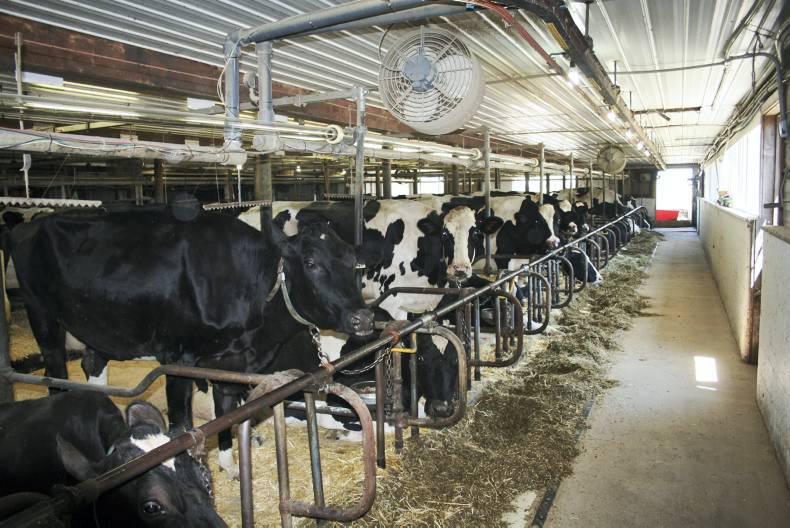
I met Paul Meldrum, manager at the McGill University farm, Montreal, Quebec. The farm has 75 Holstein cows. All the milk is sold for cheese production to a large milk producer. Meldrum said that there is no difference in the price a farmer receives for liquid milk or milk used in cheese production.
He showed me the gross milk price trends over the past 10 years. Back in 2004, the gross milk price was $0.625/kg, in 2009 it was $0.74/kg and the average he received to date this year has been $0.835/kg. His annual yield per cow averages 11,000kg, with 3.8% fat and 3.3% protein. He calves all year round to ensure the farm consistently fills the milk quota. The calving interval is 13 months and his average dry period per cow is 50 days. Paul expects a minimum of three lactations from a cow and decisions on culling are made after this time, based on the cow’s performance and health.
In addition, Paul noted that in Quebec sexed semen is in very high demand and he finds it difficult to obtain good-quality sexed semen. Recently, he has used sexed semen for his heifers selecting from bulls that are readily available.


SHARING OPTIONS