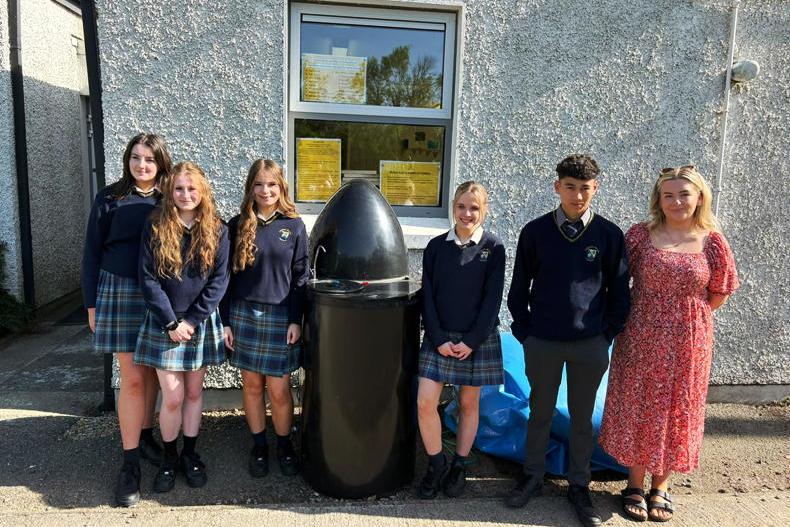
For many people, the phrase ‘anaerobic digestion’ still conjures images of industrial AD plants, towering tanks on the edge of towns and heated community meetings about odours, safety and traffic. Yet in a growing number of Irish schools, a very different story is unfolding: a small, quietly humming biodigester sitting beside raised beds or a home economics room, turning lunch leftovers into cooking gas and plant feed – and, crucially, into climate education.
Across primary, post-primary and third-level settings, around 50 small-scale biodigesters are now in use in Ireland, made by MyGug. These microscale anaerobic digesters are educational, sustainable systems for cooked and uncooked food waste. MyGug is used to teach circular economy and sustainability in schools as part of STEM education. Their impact reaches an estimated 10,000 students and nearly 900 teachers.
In secondary schools in particular, they are fast becoming a practical teaching tool that links climate action, the Agricultural Science syllabus and the wider bioeconomy. But language is one of the first barriers.
According to Fiona Kelleher, CEO of Amu Green, the term ‘AD plant’ immediately puts people into “resistance mode”. It suggests industrialisation and large-scale infrastructure – exactly the image many rural communities are wary of.
The technology in schools is different, both in scale and in purpose. The company behind the MyGug products describes them as: “A small-scale biodigester, Irish designed, Irish manufactured, an innovation that harnesses the process of anaerobic digestion – entirely safe, producing very small amounts of gas, and really user-friendly.”
In other words, they are trying to communicate that this is not a mini version of a full industrial AD plant dropped into a schoolyard.
Instead, it is closer to a sophisticated, closed-loop compost system – one that produces usable biogas for cooking and nutrient-rich liquid for gardens, while offering a live demonstration of the circular economy.
Hands-on learning
Students are not just learning about methane cycles or bioenergy on paper – they are feeding the digester themselves and observing energy and nutrient flows over time.
This hands-on element is key at a time when many young people feel overwhelmed by climate news.
“It’s just that circular economy being evidenced there; it’s the normalisation of that AD process, which is so important in terms of our climate targets. It’s educating the students of the future, arming them with the green skills they need; it’s giving them positive everyday climate action,” says Fiona. “They can actually go into school every day and feed their leftover paninis or stale bread or pasta and think, I’m actually keeping this food waste away from a bigger waste plant,” adds Fiona.
The main concern parents and staff raise is safety: what happens if there is a leak?
Traditional LPG or propane cylinders are highly pressurised; a huge amount of gas is compressed into a small steel container for ease of transport. That is where the recognised explosion risk lies.
The school biodigesters work in the opposite way.
“What we have is a bag where gas is held at atmospheric pressure and the bag is a cubic metre wide. It’s biogas at atmospheric pressure; the amount of gas that is in the bag would fill a small canister for camping.
“The only time the gas is pressurised is when you’re cooking, and in order to do that, they have to press a switch to turn on the pressure, and then they cook, and then they turn off the switch, and there’s no more pressure,” Fiona explains.
If a leak were to occur, the gas has space within the bag and no “push” to leave it. She explains there is no constant high pressure trying to force gas through a weakness. Proper training and adherence to gas regulations are still required however.
People often picture industrial-scale digestate: vast tanks of liquid that have to be moved and spread, with obvious odour and management implications.
At school scale, the volumes are deliberately kept tiny. For example, if the smallest unit is fed daily, according to Fiona, “you’re going to get a third of a watering can of liquid, which you’d be fighting over, because someone will want to put it on their raised bed.”
Funding and electricity
The smallest school unit handles about 1.5 kg of food waste per day, while larger educational models can take 5.5 kg, 11 kg or up to 20 kg in higher education or specialist settings. A 5.5 kg/day model can provide roughly 3.5 to 4 hours of cooking energy per day, depending on the mix of food waste.
For secondary schools, that typically means running gas hobs in home economics rooms, supplementing energy in science labs and providing a case study for projects in climate action, ag science, geography or CSPE.
Financially, schools have been able to access the Education for Sustainable Development (ESD) grant, which last year offered around €2,500 towards a unit costing approximately €4,000.
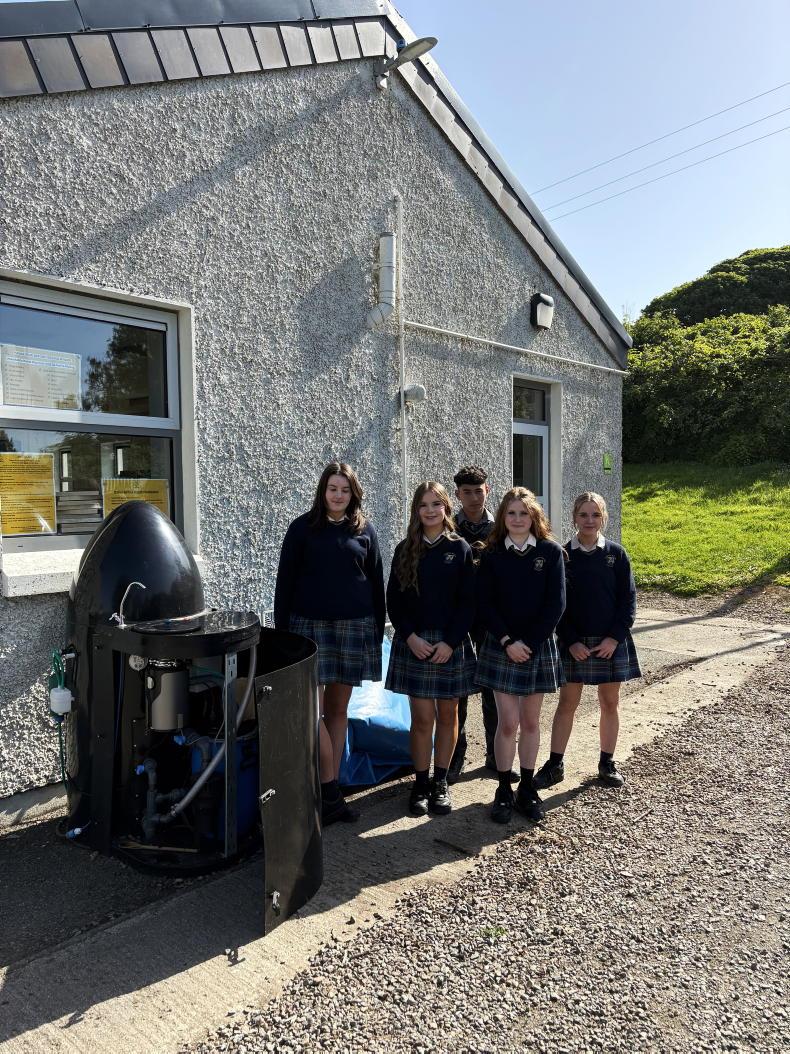
Earlier this year, Coláiste Bhríde, a secondary school in Carnew, became one of the first in Co Wicklow to install a small-scale biodigester on site, turning canteen and classroom food waste into biogas and organic fertiliser for their greenhouses.
“We installed it in February and we got the ESD grant for it, so that was €2,500, and it covers the total cost of the digester,” says Dayna Lancaster, ag science and climate action teacher.
The core aim was to reduce food waste while introducing a practical, visible form of renewable energy into the everyday life of the school.
“It converts all our food waste into biogas and fertiliser, so there’s no waste from it,” says Dayna.
How it works
How it works is the biodigester is fed once a day with food waste collected in a storage bin. A side handle is used to pump the material into the digester where bacteria break it down to produce gas and liquid fertiliser.
“Every day there’s a side handle on it, and you have to pump the food from the storage bin up into the bacteria, and it has to be fed once a day. It can take up to 1.5kg every day, which might seem like a lot, but you’d be surprised when you start feeding it,” says Dayna.
The biogas is collected in a gas bag and piped into the home economics room, where it fuels a hob with two rings.
“Any students that are trained in using it are very good; there was a little blip in the start but we got over that. It’s really easy to use. For Easter or the summer holidays we just stop feeding it gradually and it shuts down, the bacteria goes dormant and then when we come back after the break, we start feeding it again slowly, introducing food to it and it comes back alive,” says Dayna.
When it comes to health and safety, they have a cage and signage all around the MyGug where only authorised students are able to access it.
“It’s very hands on; students can see the food being converted to gas straight away. It’s not just theory; they can actually apply it. We are hoping in the next few years to get a screen where we can measure the inputs and outputs so students can use it for their Additional Assessment Components (AACs) which are project-based assignments that make up at least 40% of the marks in revised Leaving Certificate subjects,” explains Dayna.
See amugreen.com/mygug-for-education