



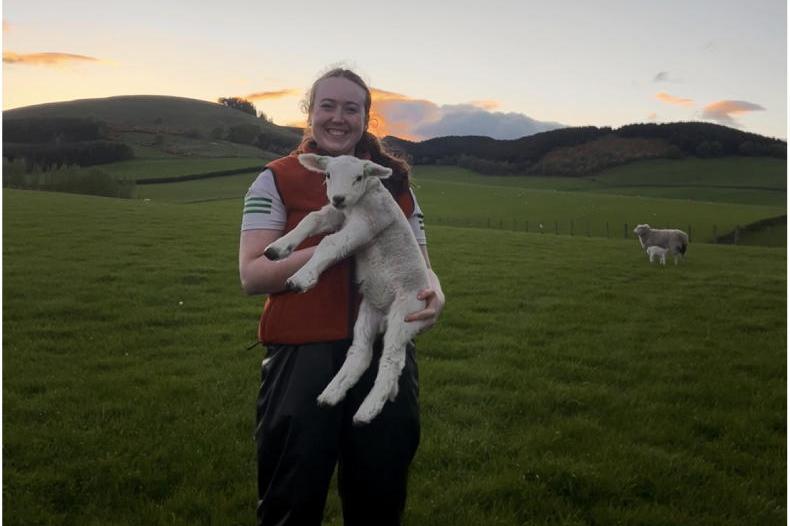
As the fifth generation of her family to farm in Rathredmond, Ballinrobe, Co Mayo, agriculture has always been a major part of life for Maria Ní Mhaicín.
Growing up on a farm with both sucklers and sheep, she developed an early interest in livestock production, which later led her to study agricultural science at University College Dublin, specialising in animal science.
Through her studies and practical experience at home, she has become increasingly interested in flock genetics, particularly maternal performance and sustainable sheep production systems, with the hope of eventually pursuing research within the sheep industry.
On the home farm, there is a strong emphasis on breeding efficient females across both beef and sheep enterprises,
“An efficient, fertile and functional dam is central to a profitable and sustainable system,” Maria says.
The farm uses performance data and technologies including EID and myostatin testing to inform breeding decisions and improve maternal traits.
This sparked Maria’s interest in how genetics and management can work together to improve flock performance, labour efficiency and profitability.
Maternal efficiency
As part of third year agricultural science at UCD, Maria completed a overseas placement through the ASA/Irish Farmers Journal Professional Work Experience Bursary.
When choosing her work experience overseas, Maria wanted to work within a progressive commercial flock that would expand her knowledge of maternal efficiency, breeding programmes and data-driven sheep systems.
That search led her to Incheoch Farm in Alyth, Blairgowrie, Scotland, where she completed her placement during the lambing season.
Incheoch Farm is a family-run upland holding totalling 1,200ac operated by the McGowan family in the Highlands, a 30-minute drive from the city of Dundee. The farm runs approximately 1,200 ewes alongside 200 suckler cows, with the business built around producing functional and efficient livestock suited to commercial grass-based systems.
The main ewe flock consists of Llyns alongside pedigree Texels, while the beef enterprise includes Luing, Simmental and Angus cows.
Across both sheep and cattle, the farm places a major emphasis on breeding maternally efficient, functional and robust females capable of performing within a low-input, grass-based system.
Incheoch Farm also runs the annual Working Genes ram and bull sale, which has developed a reputation in the UK for producing functional, forage-based genetics suited to commercial systems.
It exposed me to a sheep system operating on a much larger scale than I was familiar with at home, while also giving me experience in a highly data-driven and labour-efficient environment
The sale reflects the farm’s wider breeding philosophy, with emphasis placed on maternal ability, longevity, structural soundness and performance under commercial conditions rather than intensive feeding systems.
Through performance recording, EID technology and Estimated Breeding Values, customers can assess both physical performance and maternal traits when selecting stock.
“It was interesting to see the emphasis placed on growth and performance figures, but also on traits such as lambing ease, mothering ability and overall efficiency,” Maria says.
A major part of the placement involved working with the Llyn ewe flock during lambing.
Information recorded included lambing ease, mothering ability, lamb vigour and birth weights, using both EID technology and paper records.
Learning through lambing
Ease of lambing, lamb vigour, mothering ability and the capacity of ewes to rear lambs efficiently all have a direct impact on labour, welfare and profitability.
This year, tail length was also recorded in response to increasing demand from commercial farmers for shorter-tailed sheep, particularly in light of tightening welfare legislation in the UK.
It is hoped that, through breeding records and genetic profiling, tail length can be managed more effectively within commercial flocks.
For Maria, this showed how breeding objectives are constantly adapting in response to welfare considerations, legislation and commercial demand.
“It exposed me to a sheep system operating on a much larger scale than I was familiar with at home, while also giving me experience in a highly data-driven and labour-efficient environment,” Maria says.
As she enters final year, the knowledge gained at Incheoch Farm will be directly relevant to her studies and future ambitions.
Her time in Scotland has strengthened her appreciation for evidence-based breeding decisions and the role maternal traits can play in reducing labour requirements and improving the flock.
“The placement has further strengthened my ambition to continue working within the sheep industry and pursue future opportunities in sheep genetics and sustainable livestock production systems,” she adds.
Over the last 12 years, the Agricultural Science Association (ASA) has teamed up with the Irish Farmers Journal to support agricultural science students looking to expand their knowledge abroad. The €1,000 scholarship aims to provide students with financial support, allowing them to travel to different countries to complete this placement and gain a more global understanding of agri food production.




SHARING OPTIONS