We often feature Irish agriculture students who go on to do a PhD after completing an undergraduate programme. However, many international students also travel to Ireland to avail of the research and education opportunities.
In 2024, international students represented a significant portion of the overall student population in Irish higher education, with a record-breaking number of 40,400 students. This represents a 15% increase on the previous year.
One of these students is Jimena Barrientos from Mexico, who has just finished her first year as a research student in the agri-environmental research group within the Centre for Freshwater and Environmental Studies (CFES) in Dundalk Institute of Technology (DkIT).
Jimena was always interested in molecular and microbiology and studied it for her undergraduate degree at the National Autonomous University of Mexico (UNAM).
“I also did a masters at UNAM, the project was using algae (Sargassum) that are currently plaguing the southeast coasts of Mexico to produce energy through the process of anaerobic digestion. We used it to produce methane and, with that, produce energy. That’s the type of project I am interested in, using biomass or waste to get something out of it,” she explains.
Although Jimena is from the city centre, growing up, she was always drawn towards nature and loved to go camping in Mexico.
“I think that’s where my interest grew, there are a lot of polluted areas in Mexico. You can go to a lake and just see a lot of pollution, garbage and eutrophication [a process where water becomes overly enriched with nutrients, leading to excessive growth of algae]. I always wondered what is causing this,” she says.
She found the masters interesting as she saw the application for the project and the benefit it could have to a wider audience. Wanting to scale it up, she brought it to the industry but didn’t get the financial support to continue on the research.
“In some places, it’s harder to get funding and interest in research projects, which is why I started looking for a PhD across the world that had some sort of application. That is when I found this PhD programme in DkIT. It has lab work and a link to the industry, and I wanted to apply what I was learning and discovering,” she explains.
Jimena looked into studying in Ireland and felt it would be a good experience to meet new people and go outside her comfort zone.
“When it came to finding accommodation, the PhD students already in the centre gave me contacts and I found somewhere to stay,” she says.
The PhD project that she is working on in DkIT is using biochar, which is a carbon material with similar aspects to charcoal, for its bioremediation potential [bioremediation is a process that uses living organisms, like microorganisms, to remove or neutralize pollutants from contaminated environments, such as soil and water].
In some places, it’s harder to get funding and interest in research projects, which is why I started looking for a PhD across the world that had some sort of application
“This material is extremely porous, so it has the potential to trap and remove pollutants from contaminated soils and water. Biochar can also sequester carbon and improve the soil properties to increase crop yields and stop nutrients from leaching and being washed away into waterbodies. The first stage of the project focuses on using biochar to remove microplastics from water and soils,” explains Jimena.
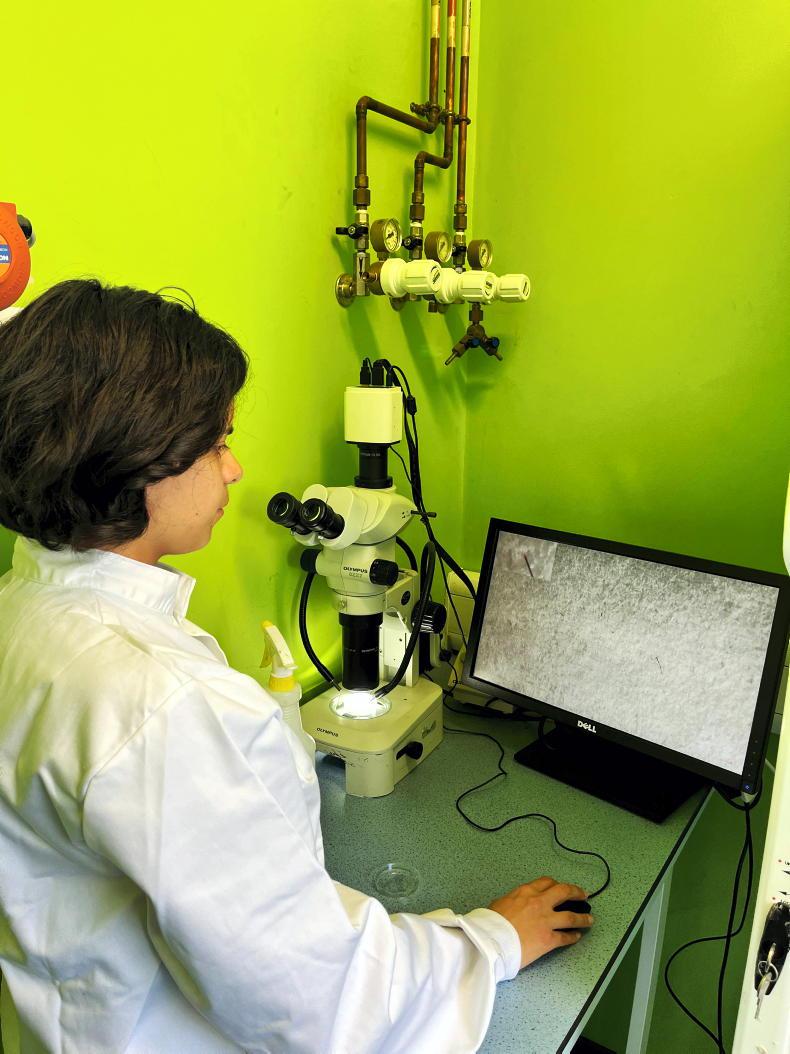
Jimena working on her research in the lab at DkIT.
She started the four-year PhD project in October 2024 with the title, ‘Charring it up; properties, potential and applications of biochar within the circular economy.’
The project will investigate using organic waste from agriculture (from wood waste, manures, mushroom compost, poultry litter, anaerobic digestate, equine waste, etc.) to produce biochar (a charcoal-like material) for use as a filtration medium for wastewater and as a soil conditioner.
“Right now, what we are trying to focus on is using biochar to remove microplastics. At first, the samples will be in a controlled condition, not in the environment, and then we will use them in grey waters. Ultimately, this project will facilitate the development of innovative climate mitigation strategies for the agri-environmental sector in Ireland and provide a means of improving the circularity of the agri-environmental economy,” says Jimena.
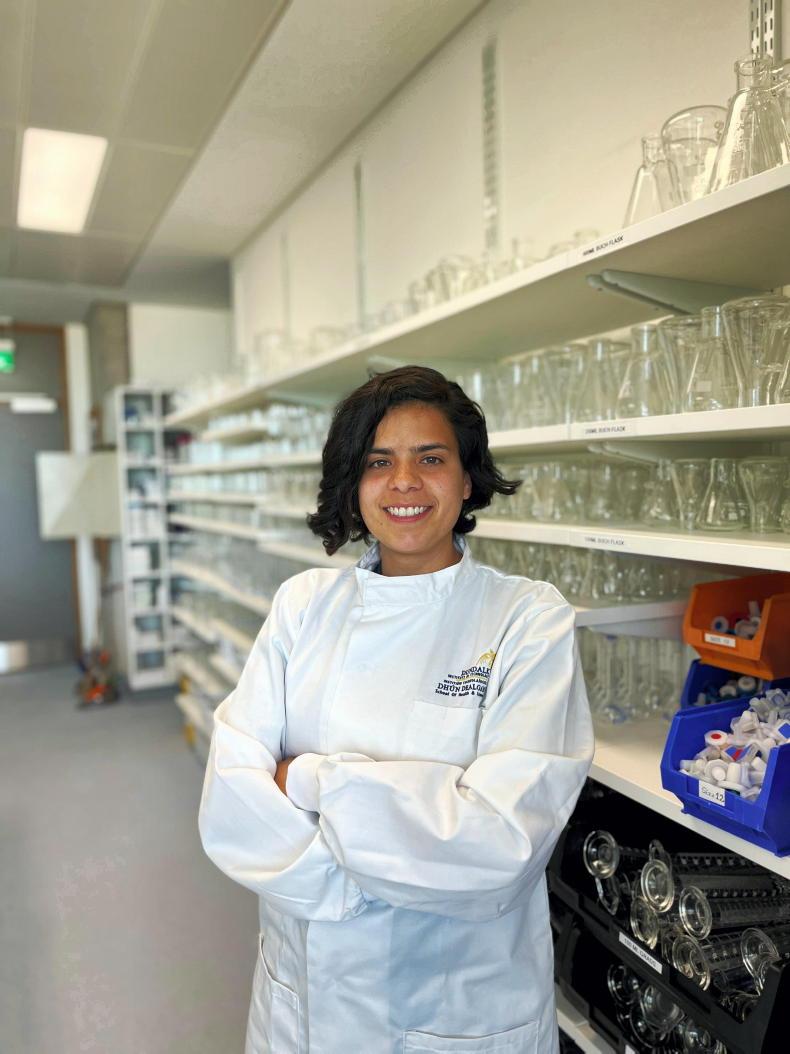
Jimena Barrientos, PhD student from Mexico studying at DkIT.
A career in research
Jimena chose to do a PhD because she felt that it would give her more control to decide what research she wanted to do.
“When you’re doing a job, you get told what to do, how to do it, and that’s it. That’s mainly why I decided to do a PhD. I was working before, and I didn’t feel the fulfilment. Now I am enjoying the research and the flexibility of deciding what I want to do. I try to split up my time between researching and experimenting.
“At the start, it’s a lot of research to get your plan outlined, but it has been very useful. Now I feel confident going into the lab as I have the knowledge that supports what I am doing.”
We often feature Irish agriculture students who go on to do a PhD after completing an undergraduate programme. However, many international students also travel to Ireland to avail of the research and education opportunities.
In 2024, international students represented a significant portion of the overall student population in Irish higher education, with a record-breaking number of 40,400 students. This represents a 15% increase on the previous year.
One of these students is Jimena Barrientos from Mexico, who has just finished her first year as a research student in the agri-environmental research group within the Centre for Freshwater and Environmental Studies (CFES) in Dundalk Institute of Technology (DkIT).
Jimena was always interested in molecular and microbiology and studied it for her undergraduate degree at the National Autonomous University of Mexico (UNAM).
“I also did a masters at UNAM, the project was using algae (Sargassum) that are currently plaguing the southeast coasts of Mexico to produce energy through the process of anaerobic digestion. We used it to produce methane and, with that, produce energy. That’s the type of project I am interested in, using biomass or waste to get something out of it,” she explains.
Although Jimena is from the city centre, growing up, she was always drawn towards nature and loved to go camping in Mexico.
“I think that’s where my interest grew, there are a lot of polluted areas in Mexico. You can go to a lake and just see a lot of pollution, garbage and eutrophication [a process where water becomes overly enriched with nutrients, leading to excessive growth of algae]. I always wondered what is causing this,” she says.
She found the masters interesting as she saw the application for the project and the benefit it could have to a wider audience. Wanting to scale it up, she brought it to the industry but didn’t get the financial support to continue on the research.
“In some places, it’s harder to get funding and interest in research projects, which is why I started looking for a PhD across the world that had some sort of application. That is when I found this PhD programme in DkIT. It has lab work and a link to the industry, and I wanted to apply what I was learning and discovering,” she explains.
Jimena looked into studying in Ireland and felt it would be a good experience to meet new people and go outside her comfort zone.
“When it came to finding accommodation, the PhD students already in the centre gave me contacts and I found somewhere to stay,” she says.
The PhD project that she is working on in DkIT is using biochar, which is a carbon material with similar aspects to charcoal, for its bioremediation potential [bioremediation is a process that uses living organisms, like microorganisms, to remove or neutralize pollutants from contaminated environments, such as soil and water].
In some places, it’s harder to get funding and interest in research projects, which is why I started looking for a PhD across the world that had some sort of application
“This material is extremely porous, so it has the potential to trap and remove pollutants from contaminated soils and water. Biochar can also sequester carbon and improve the soil properties to increase crop yields and stop nutrients from leaching and being washed away into waterbodies. The first stage of the project focuses on using biochar to remove microplastics from water and soils,” explains Jimena.

Jimena working on her research in the lab at DkIT.
She started the four-year PhD project in October 2024 with the title, ‘Charring it up; properties, potential and applications of biochar within the circular economy.’
The project will investigate using organic waste from agriculture (from wood waste, manures, mushroom compost, poultry litter, anaerobic digestate, equine waste, etc.) to produce biochar (a charcoal-like material) for use as a filtration medium for wastewater and as a soil conditioner.
“Right now, what we are trying to focus on is using biochar to remove microplastics. At first, the samples will be in a controlled condition, not in the environment, and then we will use them in grey waters. Ultimately, this project will facilitate the development of innovative climate mitigation strategies for the agri-environmental sector in Ireland and provide a means of improving the circularity of the agri-environmental economy,” says Jimena.

Jimena Barrientos, PhD student from Mexico studying at DkIT.
A career in research
Jimena chose to do a PhD because she felt that it would give her more control to decide what research she wanted to do.
“When you’re doing a job, you get told what to do, how to do it, and that’s it. That’s mainly why I decided to do a PhD. I was working before, and I didn’t feel the fulfilment. Now I am enjoying the research and the flexibility of deciding what I want to do. I try to split up my time between researching and experimenting.
“At the start, it’s a lot of research to get your plan outlined, but it has been very useful. Now I feel confident going into the lab as I have the knowledge that supports what I am doing.”
SHARING OPTIONS