



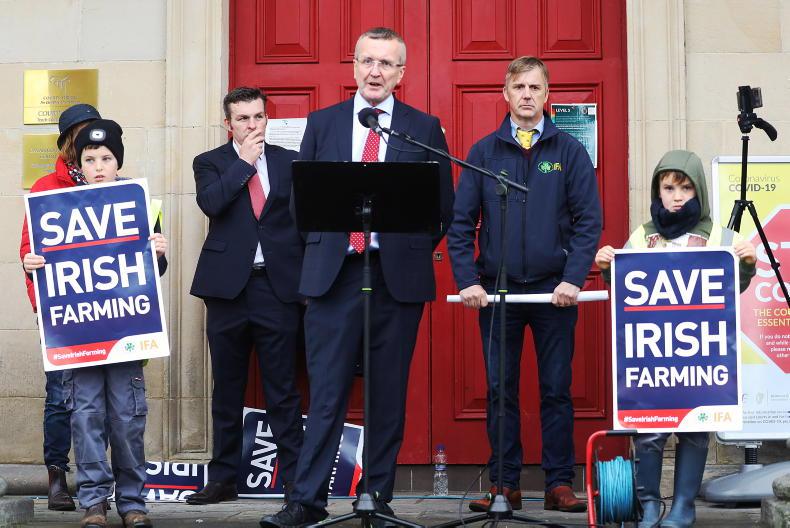
Farm leaders have rejected suggestions that the 21% to 30% cut in carbon emissions being sought from farmers represented a win for the industry.
Both Pat McCormack of the ICMSA and Tim Cullinan of IFA said the targets were a major challenge for farmers in general, and the dairy sector in particular.
Speaking exclusively to the Irish Farmers Journal, they called for increased Government investment in research to help mitigate the impact of the national and sectoral targets, which are expected to be announced officially over the next fortnight.
In addition, the pair said targeted supports will be essential in assisting farmers to invest in low-emission slurry spreading (LESS) machinery and increasing slurry storage.
Pat McCormack said there was “huge frustration” among dairy farmers – and new entrants in particular – that the growth potential of dairying was being “paused” just five years after the abolition of milk quotas.
While the ICMSA leader conceded that the farm sector’s “environmental aspirations” has been muted to date, he expressed confidence that milk suppliers will embrace new technologies such as improved genetics, LESS, protected urea and increased clover usage.
“It’s going to be a challenge, and we can’t underestimate the challenge. But I think if people embrace the technologies that are out there, we can go a long way,” McCormack said.
The ICMSA president pointed out that Ireland’s farmers were still among the most efficient and environmentally sustainable food producers on the planet.
“If we want to feed the world’s growing population then we need to maximise dairy and beef production in this country,” McCormack insisted.
This point was echoed by IFA leader Tim Cullinan.
The Paris Agreement had noted that food security could not be compromised in the drive to tackle climate change; this had to be “acknowledged and recognised”, Cullinan said.
Asked about a possible cut in livestock numbers to meet agriculture’s climate change targets, the IFA leader pointed out that the farm sector was operating at the same number of animals as 1999.
Managed growth
“It is important to maintain the [number of] animals we have now, but looking to the future we want to see that we can have managed growth,” Cullinan said.
The IFA leader stressed that the “massive importance” of the farm sector to the rural economy, and nationally, had to be recognised in the debate around climate change.
Cullinan also urged the Government to address the delays in forestry planting applications as a matter of urgency.
“We need a proper plan and programme around forestry,” he said.





SHARING OPTIONS