


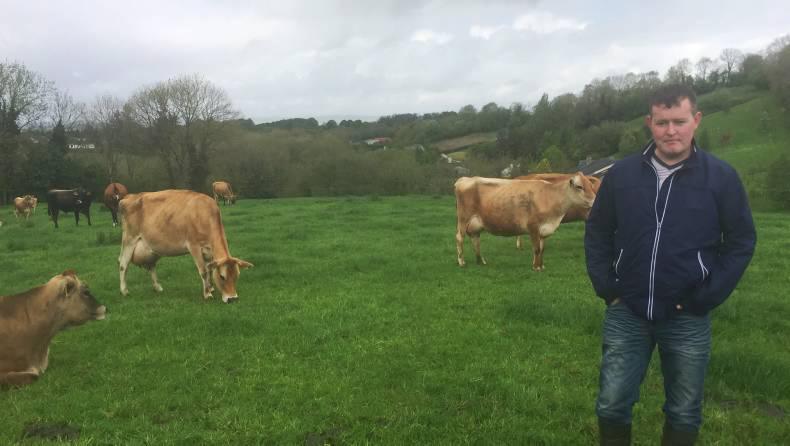
In 2012, James Croarkin was milking 32 Holstein Friesian cows on his 23ha farm outside Smithborough near the Monaghan and Fermanagh border. Despite having a relatively dry and free-draining farm, grazing the large Holstein cows was always a struggle.
“We would be doing well to get the cows out grazing by 17 March. On average, we were feeding about 1.8t of meal per cow and average protein was one of the lowest in the then Town of Monaghan Co-op at 3.12%,” James says.
Because proteins were low, James rarely ever achieved the base milk price – only in October and November did protein percent go above 3.3%. After feed costs increased during the wet summer of 2012, James decided that something had to change.
He sold half of his cows at the end of 2012 and purchased in 18 spring-calving purebred Jersey cows from Ben Tyrell in Co Meath.
“It was a big decision at the time, but I visited Ben a few times and did my own research and budgets. Cost wise, what I got for my own cows more than covered the cost of buying in the Jerseys.”
Why not crossbreed with Jersey? “I wanted to maximise the effect of Jerseys and I think going for purebred was the best way to do that. While I would get hybrid vigour if I crossed, the protein percent of my cows was so low I would have to be crossing for a long time to get the solids up to where it needs to be, plus the cow would be an in-between size, whereas now I really capitalise on the small cow,” James says.
So in 2013, roughly half of the cows were purebred Jersey and the other half were Holstein Friesian. James saw an immediate lift in milk solids. The volume of milk being sold didn’t drop much and fertility in the Jerseys was as good if not better than with the Holstein Friesians, so he knew it was going to work.
Encouraged by these results, at the end of 2013 James decided that he was going to sell the remaining Holstein Friesians and go all purebred Jersey. He went back to Ben Tyrell looking for more cows but none were available so Ben suggested importing in-calf heifers from Denmark.
The Jersey Cattle Society put James in touch with a Danish exporter. At this stage, James was more familiar with the Jersey bloodlines and knew which sire lines were best suited to grass-based spring-calving systems, like the one he was running in Smithborough.
In December 2013, a lorry-load of 32 in-calf Jersey heifers arrived in from Denmark. The heifers cost €1,500 on average, and the remaining black and white cows were sold privately in the previous October. Milking 50 cows was a fairly big jump from 32 cows in 2012. This equates to an increase in stocking rate (including youngstock) from 1.74 cows/ha to 2.5 cows/ha.
James thinks that being able to increase stocking rate is one of the main benefits of the Jerseys. The amount of land he is farming has not changed, nor is more meal being fed or more fertiliser being spread, but the amount of cows being milked has increased from 32 to 50.
In terms of milk solids sold off the farm, in 2011, which was the last full year of milking Holsteins, 14,501kg of milk solids was produced, which is 453kg per cow. Fast forward to 2015 and the total amount of milk solids sold off the farm increased to 20,565kg – a staggering increase with similar levels of input. Because there were no replacements last year, cow numbers dropped to 45, so total milk solids sold per cow was 457kg.
So how is it being done? James starts calving in early January and this year he turned out the cows to grass on 20 January. Depending on the weather, this might only be for a few hours of grazing and then they go back into the shed for the night. James has 13ha around the milking parlour and 10ha 2.5km away up a quiet country road that he grazes twice in spring and once in autumn and then takes two cuts of silage off it.
Cows go out full-time by 20 March. When I visited in mid-May, the cows were on an 18-day round length, getting 2kg of meal per cow and were milking 22 litres at 5.31% fat and 4.03% (1.89kg milk solids per cow).
On meal feeding, James will continue to feed 2kg per cow for most of the summer. When he had the Holsteins he would have been feeding 4kg per day. Last year, just short of 1.2t of meal was fed per cow. James doesn’t routinely measure grass so the total amount of grass grown is not known but cows were out for about 300 days in 2015.
The total amount of meal being purchased is the same as before, with the 6t bin lasting about one month, but the big difference now is that the meal is being spread out over more cows and way more milk solids are being produced.
James puts this down to the Jerseys being smaller and more efficient than Holstein Friesians. He thinks that for every two Holstein cows you could have three purebred Jerseys. But while James isn’t measuring grass, it is highly likely that the amount of grass being grown on the farm has increased too.
We know that early grazing and regular grazing increases the grass growth potential of a farm. The Jersey cows, with a mature liveweight of about 450kg, allow James to get out to grass early without causing excessive damage. There is no doubt in James’s mind that he couldn’t practice early grazing like he does now with Jerseys if he had Holstein Friesians.
Health
James said there were no health issues with the imported stock. The fact that they came from high-input indoor systems did mean it took a bit of time for them to get used to grazing but he said that they readjusted quickly.
However, if he was doing it again he would probably purchase yearlings and have them on the farm for a year before calving to get them settled and adjusted to grazing.
He did say that he found it harder to pick up the imported cows in heat in the first year, but says there is no difference now and he can only tell the imported from the native cows by their ear tags.
Milk fever is often more prevalent in Jerseys but James says this hasn’t been an issue for him.
He feeds dry cow nuts for 60 days before calving and at the first milking he only takes enough milk from the cow to feed the calf. He milks out the cow to about 75% at the second milking and then milks the cow out fully from the third milking on.
Vaccinations
Prior to getting into Jerseys, James was vaccinating for IBR, BVD and Leptospirosis but now he is just vaccinating for IBR. While his total vet bill hasn’t changed, it hasn’t increased, despite having more cows.
With the high solids, milk price has increased and James has gone from having one of the poorest milk prices in the co-op to being the highest. His Co-Op Performance Report from ICBF shows five stars for most of the milk and quality parameters.
His milk price for January and February, including the LacPatrick bonus, was 38c/l and 37c/l respectively. There was no bonus paid in March and his milk price was 35c/l. Last month, the milk price received was 34.08c/l. Just short of 27,000 litres of milk was produced in the month. He is milking 56 cows this year but not all cows were calved in April.
James has only kept eight heifer calves as he doesn’t intend to increase stocking rate any further. Surplus heifer calves were sold privately. The male calves were sold off the farm for small money at two weeks of age.
When it comes to milking, he hasn’t had to make any changes to the parlour but sometimes an extra cow comes into the row, particularly in springtime.
Comment
This year’s World Jersey Congress is being held next week in Ireland and the UK. Delegates from all over the world are visiting Moorepark and five Irish farms with purebred Jerseys. It’s an opportunity to reflect on what the breed has to offer.
Results from the experiments at Moorepark showed that the crossbred cow was more profitable than either parent breed, across a number of stocking rates.
But as James Croarkin is proving, we shouldn’t dismiss the purebred Jersey. In Ireland, there is a trend towards larger cows the further north you go. Stocking heavier land with larger cows producing white water just doesn’t make sense. As an exporting country, it’s kilos of milk solids produced at low cost that counts.
But the breed is only part of the story – James uses his breed of cow to graze grass. Grazed grass is the driver of profit on this farm and the Jersey cow is the converter to milk solids.



SHARING OPTIONS