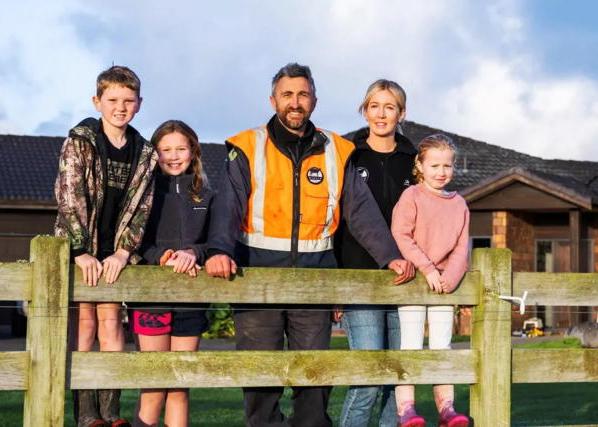
When the Irish Farmers Journal put it to Simon Lynskey that Taranaki must be the best place to farm in all of New Zealand, his answer: “nah, mate, the best place in the world” was only half a joke.
The region in the mid-west North Island is often nicknamed Taradise, after its epic beauty and rich cultural heritage.
Named after the dormant volcanic mountain Mount Taranaki which dominates the landscape, Taranaki is famous for surfing, rugby and dairy farming and is home to the largest milk processing plant in the world – Fonterra’s Whareroa milk plant.
Topography wise, the region closely resembles parts of Ireland or Britain with rolling green hills – very unlike the flat plains in Canterbury. It might be for this reason that many Irish emigrants decided to settle in Taranaki, as it may have reminded them of home.
It’s no surprise then that many of the farmers in the locality bear Irish names, such as the Lynskeys whose ancestors hail from the west of Ireland.
Just because his ancestors may have chosen the best place in the world to farm, doesn’t automatically make Simon Lynskey a good farmer, but he is nonetheless.
According to Dairybase data, which is similar in nature to the profit monitor, Simon and Lisa Lynskey’s dairy farm business, Maolla Farms, is one of the most profitable in Taranaki. The fact that the Lynskeys milk most of their herd only once a day, makes this even more remarkable.
The pair are now farming together in their own right for the last six-and-a-bit years, having taken over the farm from Simon’s parents, John and Carole.
Simon had been working in the family business for 10 years prior to buying his parents out while Lisa’s career involved roles in personal and private banking before working for Fonterra for two years prior to starting a family.
The business is in growth mode, with plans to expand over the coming year.
At present, the pair are milking 1,520 cows across two farms, just 10 minutes apart from each other.
The big farm carries 1,230 cows and this herd is in its seventh year of once a day (OAD) milking. Simon explains why they went once a day.
“We lease a lot of land in so I didn’t want to be over-capitalised by building a second rotary with so much leased land.
"I’m a fan of simple systems and we want to attract and retain people so once a day was attractive from that point of view. Professor Colin Holmes was a big inspiration to me and he gave us the confidence to go ahead with it,” he says.
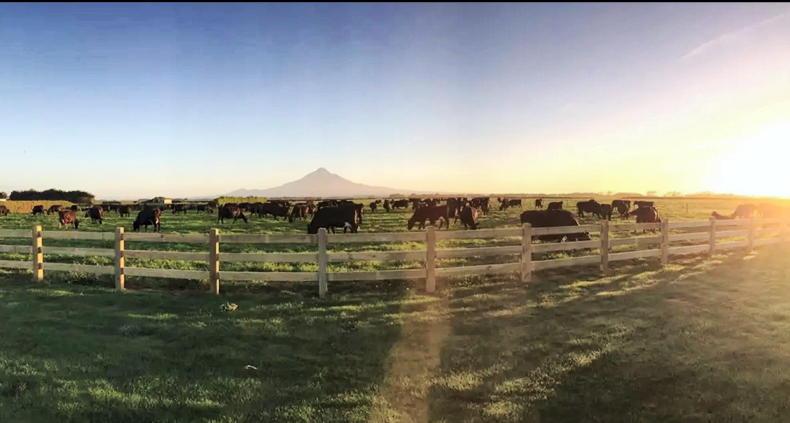
The Lynskey's dairy herd with Mount Taranaki in the background.
There is one 60 bail rotary on the big farm and Simon says that the optimum number or rows in a herringbone or spins on a rotary is 10, but with over 1,200 cows being milked on the farm the Lynskey’s rotary was turning over 20 times per milking. So rather than building a second rotary, Simon and Lisa decided to just milk the same number of cows once a day. Milking the four herds takes four hours per day.
I asked him is he is now a once-a-day advocate?
“I am an advocate in the right situations. I think it was the right decision for us, but we are still milking twice a day in the smaller herd and I often refer to this as the safety net. Some cows are just not suited to once-a-day. They are still very good cows but they just put fat on their back rather than milk in their udder.”
For the first three years any cow that was showing signs of being unsuitable for OAD was brought to the twice-a-day farm, but he says they haven’t had to do that in a long time.
No replacements are bred from the twice-a-day herd, they are all put in calf by beef bulls meaning all the replacements come from the once-a-day herd.
Infrastructure on the twice-a-day farm is good, with a 36-unit herringbone for the 290 cows so the requirement for once-a-day isn’t the same as on the bigger farm. This farm is being operated by a contract milker, who gets paid a fixed amount per kilo of milk solids sold and in return supplies all of the labour and management.
Philosophy
Simon and Lisa’s philosophy is very much around keeping costs as low as possible in order to maximise profit. Pasture eaten per hectare is the main key performance indicator on the Lynskey farm, with the farm typically utilising around 15t DM/ha, which means it grows over 17t DM/ha.
There is no irrigation in this part of New Zealand and Simon only applies around 120kg N/ha, so I can see why he was only half joking when he said it’s the best place to farm in the world.
While that may be so, the Lynskeys are outperforming their fellow Taranaki farmers by a significant amount when it comes to profitability, so it’s definitely not just about location.
In the 2023/2024 season, the Lynskeys made an operating profit of $4.53/kg MS while the benchmark for the region was 40% lower at $2.72/kg MS.
Simon says he is “hard-wired” on keeping costs low
What’s interesting is that in terms of milk solids per cow, the Lynskey herd delivered 355kg MS/cow while the benchmark productivity rate was 412kg MS/cow, or 16% higher.
This shows the irrelevance of production per cow as a metric for profit. The benchmark is derived from the average of other owner-operated farms in the region.
So despite lower milk solids yield per cow, the Lynskey’s still managed to be significantly more profitable than the benchmark by focusing on keeping costs low and harvesting as much grass as possible.
In terms of costs, total operating expenses for the last season were $4.71/kg MS, whereas the benchmark costs were $6.55/kg MS. Looking at the costs, there is no single item that stands out as being exceptionally low as all costs are low, relative to the benchmark.
Simon says he is “hard-wired” on keeping costs low.
“I can proudly say that I never intend to fully feed a cow and instead we optimally feed cows. With once-a-day milking, the big risk for us is that cows get too fat so it’s easy to manage condition score. We never want to deviate away from grazing residuals of 1,500kg DM/ha which is zero in the Irish system,” he says.
Breeding performance is good with the OAD cows achieving 9.5% empty after nine weeks of breeding using 100% AI and cow collars, while the twice-a-day herd with only stock bulls achieved a 5% empty rate.
Cows are outwintered on the farm with grass built up in the autumn. Simon says the herd will be on a 100 day round during the winter getting 6kg DM of grass and 2kg DM of purchased straw. Silage that is made in spring is usually fed back during the summer dry spells.
Total purchased supplement including the straw is 600kg DM/cow/year.
Simon and Lisa will be speaking on various topics throughout the day at Dairy Day, sharing their experiences of farming at scale, running a low cost dairy farm and managing the people and finances within their high performing business.
As well as being top of their class farmers, the Lynskeys prioritise time away from the farm with family and making the most of what life has to offer.
These will be must-see sessions and we are delighted to have them at Dairy Day 2025.
When the Irish Farmers Journal put it to Simon Lynskey that Taranaki must be the best place to farm in all of New Zealand, his answer: “nah, mate, the best place in the world” was only half a joke.
The region in the mid-west North Island is often nicknamed Taradise, after its epic beauty and rich cultural heritage.
Named after the dormant volcanic mountain Mount Taranaki which dominates the landscape, Taranaki is famous for surfing, rugby and dairy farming and is home to the largest milk processing plant in the world – Fonterra’s Whareroa milk plant.
Topography wise, the region closely resembles parts of Ireland or Britain with rolling green hills – very unlike the flat plains in Canterbury. It might be for this reason that many Irish emigrants decided to settle in Taranaki, as it may have reminded them of home.
It’s no surprise then that many of the farmers in the locality bear Irish names, such as the Lynskeys whose ancestors hail from the west of Ireland.
Just because his ancestors may have chosen the best place in the world to farm, doesn’t automatically make Simon Lynskey a good farmer, but he is nonetheless.
According to Dairybase data, which is similar in nature to the profit monitor, Simon and Lisa Lynskey’s dairy farm business, Maolla Farms, is one of the most profitable in Taranaki. The fact that the Lynskeys milk most of their herd only once a day, makes this even more remarkable.
The pair are now farming together in their own right for the last six-and-a-bit years, having taken over the farm from Simon’s parents, John and Carole.
Simon had been working in the family business for 10 years prior to buying his parents out while Lisa’s career involved roles in personal and private banking before working for Fonterra for two years prior to starting a family.
The business is in growth mode, with plans to expand over the coming year.
At present, the pair are milking 1,520 cows across two farms, just 10 minutes apart from each other.
The big farm carries 1,230 cows and this herd is in its seventh year of once a day (OAD) milking. Simon explains why they went once a day.
“We lease a lot of land in so I didn’t want to be over-capitalised by building a second rotary with so much leased land.
"I’m a fan of simple systems and we want to attract and retain people so once a day was attractive from that point of view. Professor Colin Holmes was a big inspiration to me and he gave us the confidence to go ahead with it,” he says.

The Lynskey's dairy herd with Mount Taranaki in the background.
There is one 60 bail rotary on the big farm and Simon says that the optimum number or rows in a herringbone or spins on a rotary is 10, but with over 1,200 cows being milked on the farm the Lynskey’s rotary was turning over 20 times per milking. So rather than building a second rotary, Simon and Lisa decided to just milk the same number of cows once a day. Milking the four herds takes four hours per day.
I asked him is he is now a once-a-day advocate?
“I am an advocate in the right situations. I think it was the right decision for us, but we are still milking twice a day in the smaller herd and I often refer to this as the safety net. Some cows are just not suited to once-a-day. They are still very good cows but they just put fat on their back rather than milk in their udder.”
For the first three years any cow that was showing signs of being unsuitable for OAD was brought to the twice-a-day farm, but he says they haven’t had to do that in a long time.
No replacements are bred from the twice-a-day herd, they are all put in calf by beef bulls meaning all the replacements come from the once-a-day herd.
Infrastructure on the twice-a-day farm is good, with a 36-unit herringbone for the 290 cows so the requirement for once-a-day isn’t the same as on the bigger farm. This farm is being operated by a contract milker, who gets paid a fixed amount per kilo of milk solids sold and in return supplies all of the labour and management.
Philosophy
Simon and Lisa’s philosophy is very much around keeping costs as low as possible in order to maximise profit. Pasture eaten per hectare is the main key performance indicator on the Lynskey farm, with the farm typically utilising around 15t DM/ha, which means it grows over 17t DM/ha.
There is no irrigation in this part of New Zealand and Simon only applies around 120kg N/ha, so I can see why he was only half joking when he said it’s the best place to farm in the world.
While that may be so, the Lynskeys are outperforming their fellow Taranaki farmers by a significant amount when it comes to profitability, so it’s definitely not just about location.
In the 2023/2024 season, the Lynskeys made an operating profit of $4.53/kg MS while the benchmark for the region was 40% lower at $2.72/kg MS.
Simon says he is “hard-wired” on keeping costs low
What’s interesting is that in terms of milk solids per cow, the Lynskey herd delivered 355kg MS/cow while the benchmark productivity rate was 412kg MS/cow, or 16% higher.
This shows the irrelevance of production per cow as a metric for profit. The benchmark is derived from the average of other owner-operated farms in the region.
So despite lower milk solids yield per cow, the Lynskey’s still managed to be significantly more profitable than the benchmark by focusing on keeping costs low and harvesting as much grass as possible.
In terms of costs, total operating expenses for the last season were $4.71/kg MS, whereas the benchmark costs were $6.55/kg MS. Looking at the costs, there is no single item that stands out as being exceptionally low as all costs are low, relative to the benchmark.
Simon says he is “hard-wired” on keeping costs low.
“I can proudly say that I never intend to fully feed a cow and instead we optimally feed cows. With once-a-day milking, the big risk for us is that cows get too fat so it’s easy to manage condition score. We never want to deviate away from grazing residuals of 1,500kg DM/ha which is zero in the Irish system,” he says.
Breeding performance is good with the OAD cows achieving 9.5% empty after nine weeks of breeding using 100% AI and cow collars, while the twice-a-day herd with only stock bulls achieved a 5% empty rate.
Cows are outwintered on the farm with grass built up in the autumn. Simon says the herd will be on a 100 day round during the winter getting 6kg DM of grass and 2kg DM of purchased straw. Silage that is made in spring is usually fed back during the summer dry spells.
Total purchased supplement including the straw is 600kg DM/cow/year.
Simon and Lisa will be speaking on various topics throughout the day at Dairy Day, sharing their experiences of farming at scale, running a low cost dairy farm and managing the people and finances within their high performing business.
As well as being top of their class farmers, the Lynskeys prioritise time away from the farm with family and making the most of what life has to offer.
These will be must-see sessions and we are delighted to have them at Dairy Day 2025.
SHARING OPTIONS