



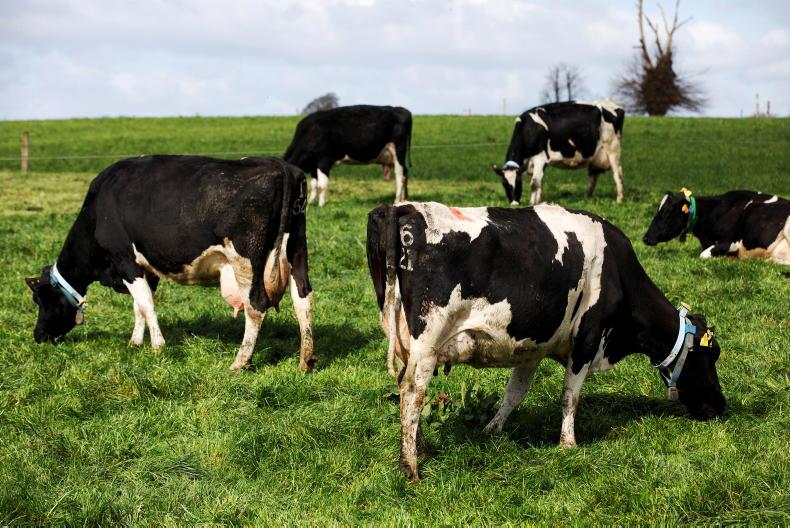
Grass has been flying over the last couple of weeks and the majority of farms have now hit their targets for farm covers at the end of September.
The challenge coming down the track is getting all of this grass grazed. With above-average rainfall forecast for the week ahead, heavier farms will start to become challenging in terms of grazing management.
As farm covers are between 1,000kg to 1,200kg DM/ha for most farms, that means pre-grazing yields will range anywhere from 2,000kg up to 2,400kg DM/ha.
If not already doing so, a 12-hour strip wire will be necessary to maximise the utilisation of grass.
As it maybe the last grazing for the year on some paddocks, it’s important to get good cleanouts with residuals close to 4cm, in order to have good-quality grass coming back over the winter months.
When measuring grass over the next week account for lower dry matter percentages. Dry matter is somewhere between 11% and 14% on most farms, according to Pasturebase data.
Growth is back slightly across the country for this week as temperatures start to fall and daylight hours get shorter.
Predicted growths are still good however, at 52kg DM/ha on average. This is a great opportunity to keep cows on a mainly grass diet and keep meal feeding levels low.
In terms of slurry most farms will be finishing up the last of the spreading this week with the deadline for spreading now extended to 7 October for all farms. Prioritise silage ground or paddocks that had surplus bales taken in recent weeks for the slurry that’s left.
Clover
Clover contents in swards are very high as conditions have been optimal for growth. Attention on high clover paddocks is needed to prevent cases of bloat.
Most farms are using a strip wire to stop cows selectively grazing the clover. Allowing cover to build up on a paddock will also mean more fibre in the grass which should also help.
If bloat is an issue on the farm, bloat oil in the water trough 24 hours before cows go into a paddock should prevent cases.
Swardwatch
Liam Burke, Innishannon, Co Cork
Grass growth is still well up and although we were promised heavy rain at the weekend, we actually didn’t get that much. There’s more expected this week, but so far grazing conditions are good and there’s no damage being done.
When we’re out measuring, the heaviest covers look close to nearly 3,000kg DM/ha, but doing the back calculation after cows finish up there’s probably only a cover of 2,200kg DM/ha. This is just down to low DM and we’re accounting for that on Pasturebase now. All paddocks are being grazed on a 12-hour strip wire. We have a lot of lime spread already this year, but will probably go with another small bit next week.
Stocking rate (LU/ha):3.07
Growth (kg/cow):59
Average farm cover (kg/ha):1,138
Yield (l/cow):17.5
Fat (%):5.05
Protein (%) :4.05
Milk solids (kg/cow):1.6
Concentrates (kg/cow):2
Kevin Fagan, Glasson, Co Westmeath
The grass situation is good here. Growth has dropped back from around 60kg/ha over the last couple of weeks and we’re noticeably starting to get a bit colder.
We’re happy where we are with farm cover, however, going into covers of 1,600kg to 1,700kg DM/ha. The cows are cleaning them out well and we’ve stretched to a 40-day rotation. The last of the silage was made two weeks ago with some third-cut bales. That ground will come back into the grazing platform over the next week.
Slurry is going out on that ground as well this week. The cows are still milking okay, solids are excellent, but they’ve definitely dropped back in litres.
Stocking rate (LU/ha):2.6
Growth (kg/cow):50
Average farm cover (kg/ha):840
Yield (l/cow):18
Fat (%):5.5
Protein (%) :4.1
Milk solids (kg/cow):1.78
Concentrates (kg/cow):3.5
Liam Rochford, Cleariestown, Co Wexford
After a tough August, growth has exploded in September. We’re still growing over 60kg and it’s well above demand. We’re on a heavy enough clay soil type, so we don’t usually build farm cover this high.
We would normally be housed by early November, but so far grazing conditions are excellent. We’ll be hoping to keep grazing well into November this year. After the drought, we did a fodder budget and at that time had 120 days of silage. We would normally need five months, so last week we made another 75 bales. We also have red clover on an outblock yet to cut and will be offloading some cull cows in the next few weeks.
Stocking rate (LU/ha):2.6
Growth (kg/cow):63
Average farm cover (kg/ha):999
Yield (l/cow):18.5
Fat (%) :4.9
Protein (%): 4.0
Milk solids (kg/cow):1.7
Concentrates (kg/cow):2





SHARING OPTIONS