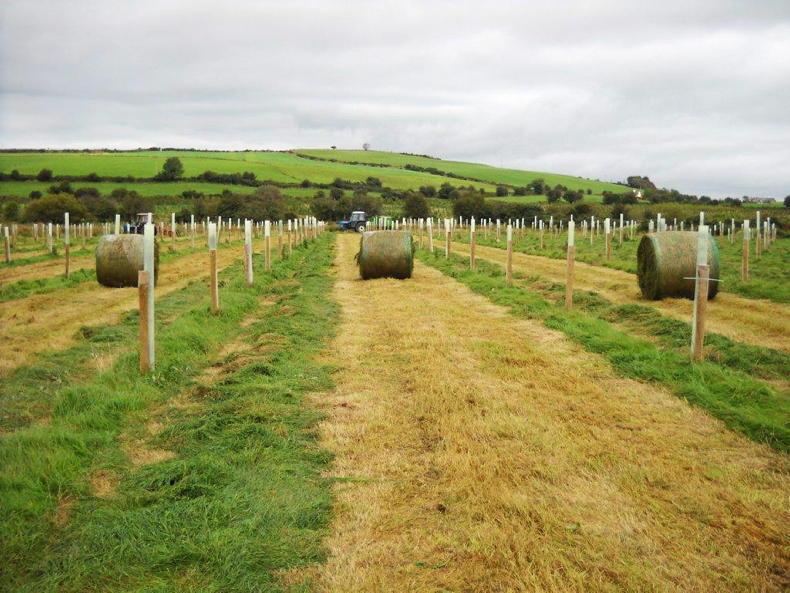
The permanent land use change tied to planting trees on farmland is the “number one obstacle” to the wider uptake of agroforestry in Ireland, according to Nuffield Scholar and forester Marina Conway.
“It's that psychological barrier around not giving people flexibility about how they manage their land into the future,” Conway told Nuffield Ireland’s annual conference on Friday.
Conway set the need to improve tree-planting’s uptake among farmers against looming fines into the billions of euros approaching if the State fails to meet its climate targets.
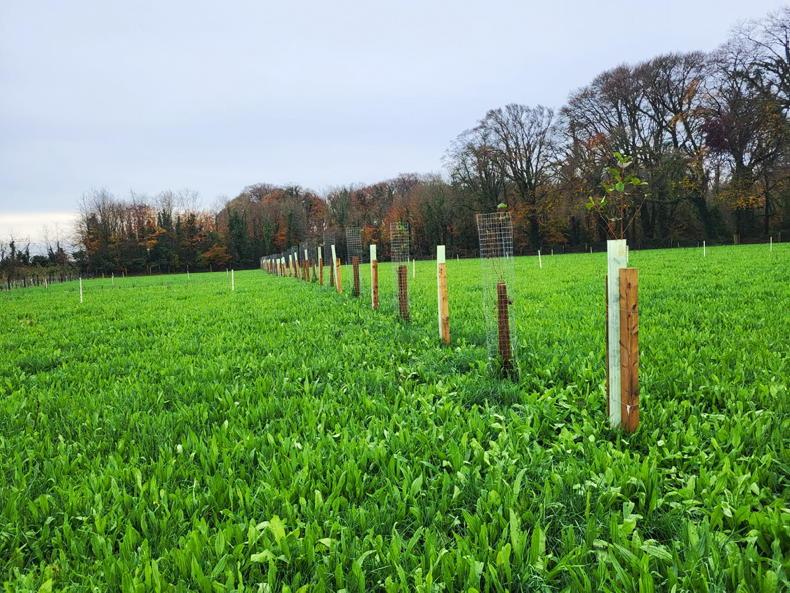
The scholar explained that integrating trees into grassland or tillage ground can see a farmer paid for increased environmental services without having to cease agricultural activity on their lands.
Two-thirds of farmers that did not have agroforestry surveyed as part of Conway’s study reported that they would consider it in the future.
Three-quarters of surveyed farmers with agroforestry stated that “it hadn’t restricted their farming enterprise whatsoever”.
Current payments
Ireland has provided different iterations of an agroforestry scheme since 2014, but the researcher chalked the reason for poor farmer interest in the option down to weak incentives up to a 2023 update of the scheme.
“The payment terms were doubled to 10 years, and it now has got the highest forestry payment in Ireland at €1,170/ha income tax-free for 10 years.
“Also, it is the only land use in Ireland on the same land.”
Eligible agroforestry lands can receive its dedicated forestry payment, an Organic Farming Scheme payment, as well as Basic Income Support for Sustainability (BISS).
“With all this generosity, there has been a bit of uptake in the scheme, but nowhere near where we thought it would be. So, why,” Conway said to the conference.
“There's been some rigid rules around it, some barriers, but I suppose the main barrier is the forest land designation.”
Conway said that the psychological barrier of slapping a permanent land use designation change leaves some farmers “concerned about handing that barrier on to the next generation”.
Tree density barrier
Conway also flagged the granting of flexibility around tree densities in the agro-forestry scheme as a means of increasing its attractiveness to farmers.
Ireland’s agroforestry scheme requires the planting of a minimum of 400 trees/ha, which Conway warned that many farmers “feel is too high”.
The scheme operating in England and Scotland allows for flexible tree densities within a range of 30 to 400 trees, with payment terms and amounts built around the chosen density.
Conway reckoned that Czechia’s CAP agroforestry scheme provides the best international example of incentivising the land use option.
“It remains agricultural land, 100 trees/ha and in two years they achieved 1,750ha,” she explained.
“What I learned from this is that Ireland's minimum of 400 trees/ha is the maximum that you have in other countries like England and Scotland.
“But on the reverse of that, Ireland pays the highest amount for the longest term, and you can stack three payments, which other countries couldn't do.”